SMED for multi-SPF sunscreen tube lines with AI — in the summer campaign, every minute down is a SKU that doesn't ship.
A sunscreen tube line concentrates everything that is hard about SMED in cosmetics: multi-SPF (15, 30, 50, 50+) with mandatory intermediate cleaning, multi-format (50, 100, 150, 200 ml) with mandrel changes, and a summer campaign that won't wait. iLEAN Agents orchestrates the sequence step by step through the operator's earpiece, separates internal from external, and learns from the veteran. The person validates every step.
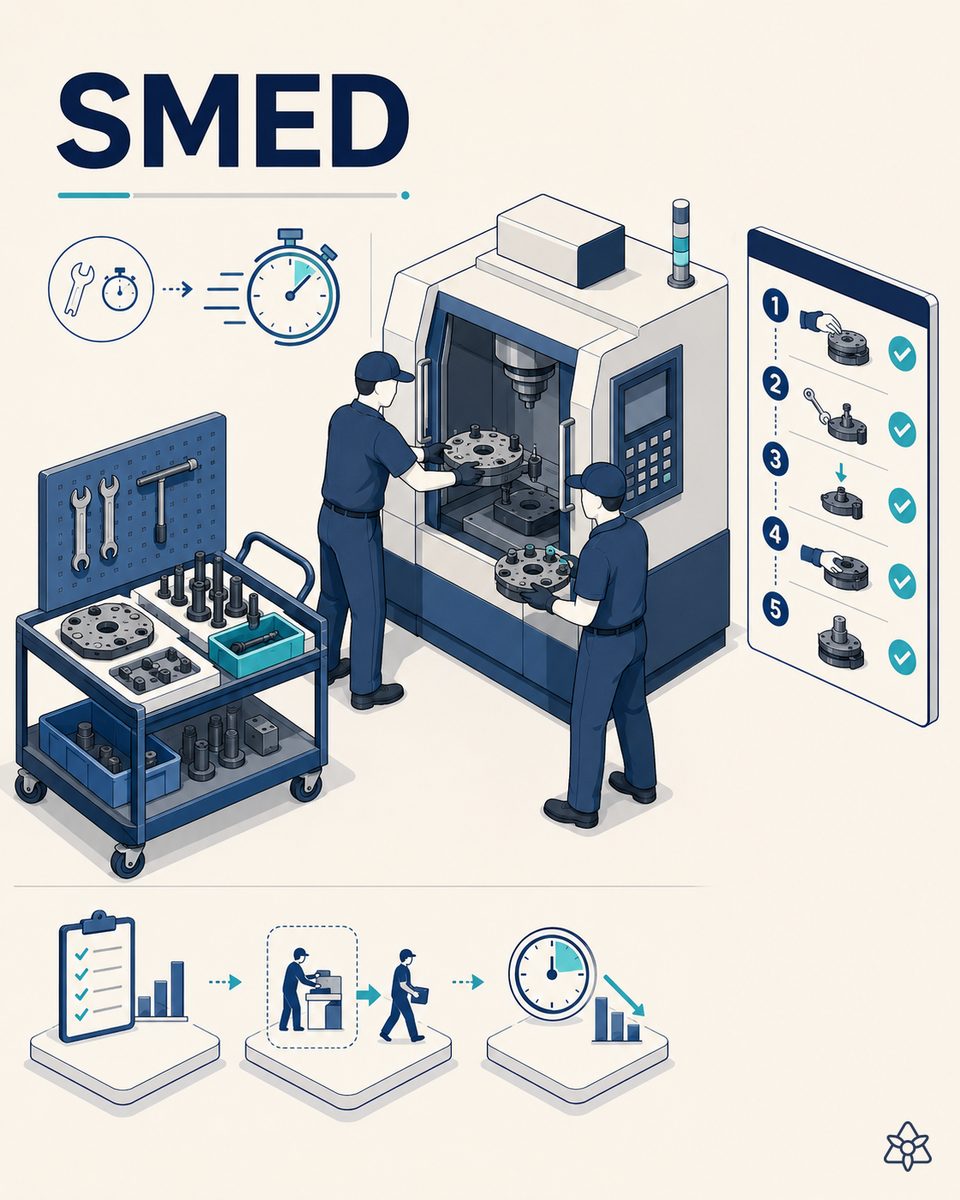
The format change doesn't break down over mechanics — it breaks down over coordination.
Classic SMED — separate internal from external, convert internal into external, simplify — works on a stable line. A sunscreen tube line is not stable: demand is seasonal, SKUs multiply (SPF15 50 ml, SPF50 100 ml, SPF50+ 150 ml, repeat for the kids' family, repeat for after-sun…) and every change between SPFs drags along a mandatory intermediate cleaning — an SPF50+ cannot carry traces of SPF15, because the protection factor is what sells the product.
The three realities that fall out of sync during the change:
- Operations — the operator has a checklist of steps, part mental, part on screen, part on a changeover sheet.
- The warehouse — the mandrels, the dies, the label rolls for the next SKU: are they at the line, or does someone have to go find them? The operator finds out when they need them.
- Planning and quality — the optimal sequence (which SPF after which, to minimize cleaning) is known to planning, but it's decided by the shift lead with whatever information is in their head that morning.
The classic system (SMED + checklist + veteran shift lead) delivers decent changeovers — above all when the veteran is there. The problem grows the day they're absent, the day a seasonal temp arrives, the day the shift lead retires. And in sun-care cosmetics, that day can land in July.
iLEAN doesn't replace the shift lead — it multiplies their knowledge across every shift.
The format-change problem is not a lack of procedure: it is information living in islands and veteran knowledge living in one person's head. iLEAN acts as the putty that fills the gaps between operations, warehouse, planning and quality during the critical minutes of the change, without asking anyone to change their system.
The agent proposes the sequence. The operator runs it step by step through the earpiece. The person validates every step; the agent learns from the veteran for the changes to come.
The iLEAN pieces applied to sunscreen tube SMED:
- Connect — captures the real state of the line (multi-SPF filler parameters, the mandrel loaded in the cartoner, the label loaded in the labeler), the stock of mandrels and dies in the warehouse (via ERP, or via a photo of the shelf if there is no system), and the planning for the next reference. It also captures the shift lead's knowledge — their real sequences — by voice or gesture, without asking them to fill in a form.
- Agents — the format-change agent cross-references everything and proposes a sequence: external tasks (the ones that can be brought forward while the line is still producing the previous SPF) flagged as such, internal tasks cut to the minimum, and the optimal order to minimize intermediate cleaning (SPF15 → SPF30 → SPF50 in a single direction shortens the cleaning cycle). The operator receives the steps one by one through their earpiece. The agent logs the actual time of each step to refine the next run.
- Edge — visually verifies that the mandrel/label change is the right one before startup (no mandrel from the previous format slipped through, no label from the previous SPF still loaded). It prevents the classic first-shift disaster of a mislabeled run after a rushed change.
- The veteran's knowledge becomes a permanent capability — the agent learns by watching how the experienced shift lead does the change in 25 minutes when the procedure says 45. Once captured, that sequence is available to every shift.
Classic SMED + checklist vs. SMED orchestrated with iLEAN Agents
| Aspect | SMED + checklist + shift lead | With iLEAN Agents + Connect + Edge |
|---|---|---|
| Optimal sequence between SPFs | The shift lead knows it | The agent proposes it with the day's planning |
| External pre-change tasks | Brought forward if there's spare time | Identified and assigned while the line is still producing |
| Availability of mandrels / dies | Discovered when they're needed | Confirmed before the change starts |
| Mandatory intermediate cleaning | Procedure on paper | Traced at the line + automatic record for audits |
| Veteran's knowledge | Walks out the day they retire | Captured as a sequence available to everyone |
| Changeover time in the summer campaign | Varies by shift | Stable and improvable every cycle |
Impact estimate for your plant — to be validated with your numbers.
The block below is an estimate to be validated with the specific data of your plant. We put it forward so the committee has an order of magnitude; we refine it during the diagnostic.
- Sunscreen tube packing line, 6-10 active SKUs in season, multi-SPF (15, 30, 50, 50+) and multi-format (50/100/150/200 ml), current average changeover time between 30 and 60 minutes depending on the cycle.
- Connect + Agents pilot on one line during the campaign (plus a light Edge to verify the mandrel/label change before startup). First value expected within a few weeks: the first change orchestrated by the agent with a step-by-step sequence.
- Indicative payback between 4 and 9 months, calculated on the cost of the minutes down during the campaign (every minute is a SKU that doesn't ship) and the cost of scrapping mislabeled units after the change.
- Hard levers: stabilized changeover time + a drop in first-shift post-change scrap + capture of the shift lead's knowledge before their retirement.
- Expected reduction of format-change time ≥ 30% once the agent has two full campaigns behind it and the sequences stabilize.
And the veteran shift lead's reasonable doubt
“What if the agent proposes a bad sequence that wrecks the change?” — hallucination is a problem of free generation, not of anchored tasks. In tasks where the AI merely recontextualizes known data (line state + planning + procedure + historical times) and proposes a sequence, the best models brought error below 1.5% [1]. And even so, what is critical is never decided alone: you validate every step. The agent proposes; you sign. The three safety rings are there precisely for this.
[1] OpenAI paper “Why Language Models Hallucinate”, 2025 — on the reliability of AI in anchored tasks.
What people ask about SMED on multi-SPF sunscreen tube lines
What makes SMED on a sunscreen tube line harder than on other products?
Three things. (1) Multi-SPF: SPF15, 30, 50 and 50+ share a line but demand different dosing, different mix control and different intermediate cleaning (an SPF50+ cannot carry residue of SPF15). (2) Multi-format: 50, 100, 150 and 200 ml tubes share the same machine, with changes of mandrels, sealer and labeler. (3) Aggressive seasonality: the summer campaign concentrates demand into a few weeks, and a slow format change leaves you without product on the shelf at the worst possible moment. Classic SMED tackles the mechanics; the missing piece is coordination between operations, quality, warehouse and planning during the change.
How does iLEAN Agents orchestrate a SMED format change?
The format-change agent doesn't decide alone — it proposes a sequence. It cross-references the next planned reference (which SPF, which tube, which label), the current state of the line, the availability of mandrels and dies in the warehouse, the operator available for the change and the mandatory intermediate cleaning procedure between SPFs. It gives the shift lead and the operator a step-by-step sequence through their earpiece/tablet — external tasks (the ones that can be done while the line is still running the previous SPF) classified as such, internal tasks cut to the minimum. The person validates every step; the agent logs the actual time to improve the next one.
Does it help if my line mixes modern and old machines?
Yes — and that's exactly where it adds the most. iLEAN Connect has three capture levels: manual (a photo of the old filler's analog panel), intermediate (reading the labeler's local computer even if it's isolated), integrated (the modern API of the recent cartoner). The agent doesn't need the whole line to speak the same language to orchestrate the change — it needs each machine's information to reach the central system. Graduated capture is what makes real SMED possible on a heterogeneous line.
What about the veteran shift lead who knows how to do the change in half the time?
That is exactly the knowledge iLEAN captures as a permanent capability. The biggest island in any plant is what lives in the head of the veteran who knows in what order to do things so the change comes out fast. The day they retire, it walks out with them. The agent learns by watching the real sequences: when the veteran runs a task as external that the procedure marks as internal, which safe shortcuts they use, which steps the least experienced person can execute. What was tacit knowledge becomes an explicit sequence — without replacing the veteran: amplifying them across every shift.
How much does it cost to digitize the SMED format change on a sunscreen tube line?
The order of magnitude is that of a Connect + Agents pilot on a cosmetics line: an initial investment covering the capture of each machine (at the level suited to each one), the operators' earpieces/tablets and the integration with your ERP/MES, plus an annual license. A reasonable payback is several months — the hard lever is the hidden cost of the minutes down during the summer campaign, where every minute is a SKU that isn't shipped on time. We ask for your plant's data and send you the estimated ROI in 48h, with your numbers, not ours.
More cases in cosmetics
- Industrial AI in personal care contract manufacturingReal AI cases in plants making personal care for third-party brands: capture what is lost today, line…
- Multi-batch cosmetic PIF: the dossier ready when the authority calls, not weeks later.How iLEAN Agents compiles the cosmetic Product Information File batch by batch from your ERP, MES and…
- Shampoo viscosity out of range: correct it in line, not as scrap at the end of the shift.How iLEAN Edge reads an in-line shampoo and hair-mask viscometer, cross-references recipe and…
- Pressure and valve crimping in cosmetic aerosols with AI — the shelf leak is born on the line, not in the truck.How iLEAN Edge controls internal pressure and valve crimping on cosmetic aerosol lines (hairspray,…
- Fill level in opaque perfume bottles with AI — reading what the classic optical sensor cannot.How iLEAN Vision reads the fill level in black or opaque glass perfume bottles where the classic optical…
- Child dermo pH 5.5 and hypoallergenic — an excipient that slips into a bath or diaper product is not an incident, it is a damaged brand.How iLEAN Edge controls pH 5.5 and verifies the hypoallergenic formulation on child dermo lines for…
Tell us your case and in 48h we'll send you the estimated ROI of this AI project for your sunscreen line.
We work on your plant's real data, not ours. Diagnostic with no commitment.
Request estimated ROI in 48h See cosmetics