Multibrand cosmetic contract manufacturing — two competing brands on the same line, one traceability trail per customer.
In a cosmetic contract manufacturer you pack brand A and competing brand B on consecutive shifts. The risk is not only a physical mix-up — it is a contractual and confidentiality mix-up. iLEAN Tracer segregates batch, formula, cleaning and dossier by customer as a cross-cutting dimension, and blocks the start of the next batch if the cleaning was not closed out. The person signs.
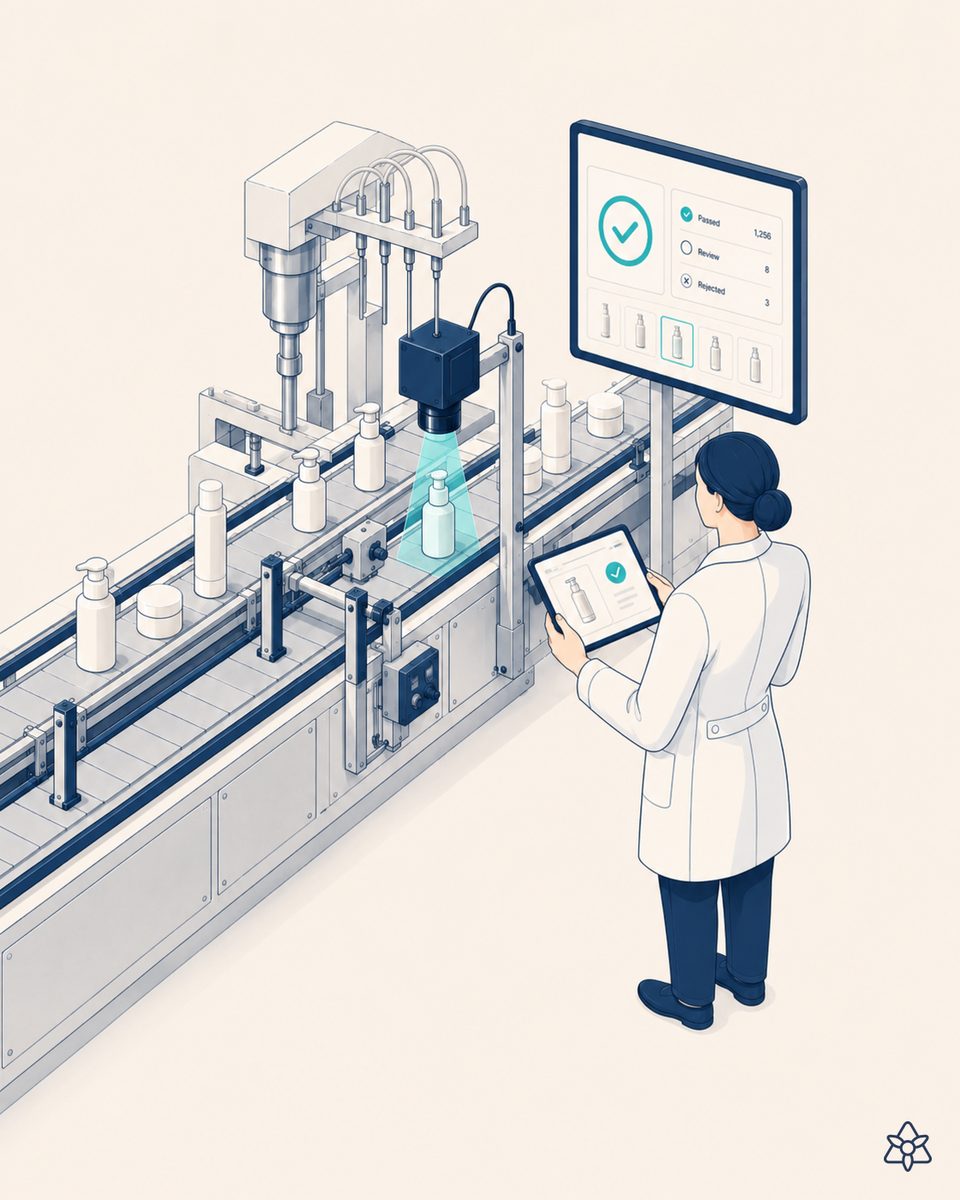
Running competing brands on the same line is not just a technical risk — it is a contract risk.
A mature cosmetic contract manufacturer has 5, 10 or 20 active brands in its portfolio. On a single filling line it packs brand A's anti-wrinkle cream in the morning and competing brand B's in the afternoon, with the cleaning in between and the SKU changeover. The classic setup — one ERP per order, one MES per line, a pile of spreadsheets per customer — works until something crosses over:
- A confidential formula belonging to brand A ends up appearing in brand B's audit dossier because someone copied the wrong template.
- A batch of raw material belonging to brand A is assigned by mistake to a brand B order because per-customer traceability lived in a column nobody was looking at.
- An intermediate cleaning was not recorded as complete, and the system allowed the next batch to start without anyone signing anything.
None of those incidents is likely — but any one of them cancels the contract with the affected brand and stains your reputation with the other 19. The classic setup works 99% of the time. That 1% is the one that ends in a lawsuit, not in an incident report. And every customer audit means rebuilding the file by hand: the quality team spends more time putting evidence packs together than out on the floor.
iLEAN Tracer does not add one more system — it seals the cracks between the systems you already have, with the customer as a cross-cutting dimension.
The multibrand contract manufacturer's problem is not a lack of information: it is that the customer identity lives in a badly maintained column inside every system, instead of being the first dimension of the data. iLEAN acts as the putty that fills that crack between your systems, without asking you to change ERP, MES or the line.
Connect captures everything with the customer tag. Edge inspects at the line and signs with the customer. The agent assembles a dossier per customer. Each brand sees its own, never anybody else's.
The iLEAN pieces applied to cross-customer traceability in a cosmetic contract manufacturing plant:
- Connect — captures the customer order whether it arrives from the customer portal, from EDI or from an email with a PDF. It digitizes formulas, raw-material lots and reporting requirements and integrates them with the internal ERP/MES, tagging every capture with the customer it belongs to.
- Edge — a terminal with vision and process capture at the line. Every reading (printed label, dosing, fill weight, visual check) is recorded with the active customer and the current batch. It works without a network: if the plant loses WiFi, Edge keeps capturing and the data syncs when the line comes back, without losing a single record.
- Tracer agent — assembles the dossier by batch and by customer, with formula, lots, checks, cleanings and signatures. It blocks the start of the next batch if the intermediate cleaning between competing brands was not closed out with a photo, parameters and a signature. It exports the dossier to each customer brand's portal — each one sees only its own.
Traceability by order vs. traceability by customer with iLEAN Tracer
| Aspect | ERP + MES + spreadsheets per customer | With iLEAN Tracer (customer as a dimension) |
|---|---|---|
| Customer identity in the data | Manual column, prone to error | Structural tag on every capture |
| Confidentiality between brands | Depends on the operator's good faith | By design, each customer sees only its own |
| Cleaning between competing brands | Paper checklist, shift lead's signature | Photo + parameters + signature, blocks the next batch |
| Dossier for a customer audit | Rebuilt by hand, weeks | Exportable per batch, automatic |
| Customer switches its portal | Rework in spreadsheets and reports | Connect adapts to the new channel, not the plant |
| Operation without network | n/a | Edge keeps capturing on panel power |
Impact estimate for your plant — to be validated with your numbers.
The block below is an estimate to be validated with the specific data of your plant and your customer portfolio. We put it forward so the committee has an order of magnitude; we refine it during the diagnostic.
- Cosmetic contract manufacturing plant with 5-15 active brands, 2-3 of them with a competitor present on the same line, and a customer audit at least once a quarter.
- Tracer pilot on one line and two competing customers (Connect against portals and ERP + Edge for capture at the line + per-customer dossier agent). First value expected within a few weeks: the first per-customer audit pack exportable in one click.
- Indicative payback between 4 and 9 months, dominated by the radical reduction in quality time spent preparing packs per customer and the elimination of contractual incident risk.
- The hard lever is not losing a single contract to a confidentiality or mix-up incident. One cancelled contract pays for the entire pilot — with enough left over to roll it out to the other lines.
And the general manager's reasonable doubt
“What if the AI crosses a piece of customer A's data with customer B?” — hallucination is a problem of free generation, not of anchored tasks. In tasks where the AI merely labels and reorganizes structured data (order, batch, customer, lot), the best models brought the error below 1.5% [1]. And even so, what is critical is never decided alone: the dossier is exported when a person signs, and the three safety rings guarantee that the critical operation is executed only by that person.
[1] OpenAI paper “Why Language Models Hallucinate”, 2025 — on the reliability of AI in anchored tasks.
What people ask about multibrand cosmetic contract manufacturing
What is the real risk of running competing brands on the same line?
In a cosmetic contract manufacturer it is normal to pack brand A's anti-wrinkle cream and competing brand B's on the same line, on consecutive shifts. The risk is not only technical (cross-contact, residue in the mixer): it is contractual and reputational. A brand that discovers its formula, its batch or its traceability has leaked to another customer cancels the contract and sues. Every customer demands confidentiality by contract and an on-site audit — and demands that the plant system guarantee it by design, not by the shift lead's good faith.
How do you segregate traceability by customer without duplicating systems?
iLEAN Tracer works with a customer identity as a cross-cutting dimension of the batch: every work order, every Edge reading, every Connect capture, every agent decision carries the tag of the customer it belongs to. When brand A's manager asks for their batch file, they see only their own — formula, raw-material lots, in-line checks, quality dossier. When brand B audits, it sees only its own. The plant is still a single plant, but each customer operates in its own logical lane, without the operator having to keep two parallel systems alive.
What happens with cleaning between batches of competing brands?
Cleaning validation between competing brands is where the immature contract manufacturer falls down. iLEAN Tracer forces the cleaning record to be closed out with a photo, parameters and a human signature before enabling the next order from the competing brand. If the cleaning was not recorded as complete, the system does not start the next batch. What is critical is never decided alone — the three safety rings exist precisely for this: the critical operation is executed only by a person, by design.
Can each customer brand receive its own dossier without seeing anybody else's?
Yes. Tracer assembles the dossier by batch and by customer: each brand receives — via portal, via export or via API — its complete file with its formula, its lots, its checks and its signatures. It never sees anything that is not its own. The contract manufacturer's quality team keeps a single global view to govern the plant, while each customer brand sees only its own. This is exactly the pattern of the evidence agents we were deploying before generative AI exploded: the auditor-ready dossier comes out on its own, with nobody rebuilding anything by hand.
How much does it cost to implement cross-customer traceability in a contract manufacturing plant?
The order of magnitude of a Tracer pilot in a cosmetic contract manufacturing plant covers the connectors to the ERP/MES, the integration with your customer portfolio (each one with its own formula and reporting quirks), and the Connect layer that captures cleanings and in-line validations, plus an annual license. A reasonable payback to put in front of the committee is a matter of several months — the hard lever is not losing a single contract to a confidentiality or mix-up incident, plus the radical reduction in the time spent preparing audit packs per customer. We ask for your plant's data and send you the estimated ROI in 48h, with your numbers.
More cases in cosmetics
- Child dermo pH 5.5 and hypoallergenic — an excipient that slips into a bath or diaper product is not an incident, it is a damaged brand.How iLEAN Edge controls pH 5.5 and verifies the hypoallergenic formulation on child dermo lines for…
- ISO 8 cleanroom for cosmetic powder: see particles and PPE at second zero, not at the audit.How iLEAN Vision reads particles and PPE in real time in an ISO 8 compact-powder cleanroom — the quality…
- Foundation color matching with AI — today's N3 the same as tomorrow's N3, batch after batch.How iLEAN Vision verifies color batch by batch in foundation and multicultural makeup bases — no drift,…
- Multichannel cosmetovigilance: the adverse event reaches the safety officer — it doesn't die in an inbox.How iLEAN Connect captures cosmetic adverse events from email, WhatsApp and web forms, classifies…
- Eyeshadow and blush compaction with AI — the crack is born in the press and paid for by the customer on the shelf.How iLEAN Edge controls compaction press force on eyeshadows and blushes to prevent cracks, waste and…
- AI against premium perfume counterfeiting — the bottle that leaves the plant twice should never leave at all.How iLEAN Tracer serializes with GS1 DataMatrix and uses vision to verify the unique code on every…
Tell us about your case and within 48h we'll send you the estimated ROI of this AI project for your contract manufacturing plant.
We work on your plant's real data, not on ours. Diagnostic with no commitment.
Request estimated ROI in 48h See cosmetics