Paperless Work Permit and demolition report
(3-5 lines of prose): On a demolition site, every work zone starts with a signed Work Permit and a paper site report noting which machine is working where and how far it has progressed. Today that paper lives in the site office or the foreman's pocket until someone transcribes it — or it never gets transcribed at all. With iLEAN Connect, the foreman photographs the permit and the report right when the zone starts, and the information exists in the central system at zero latency, with no change to their routine.
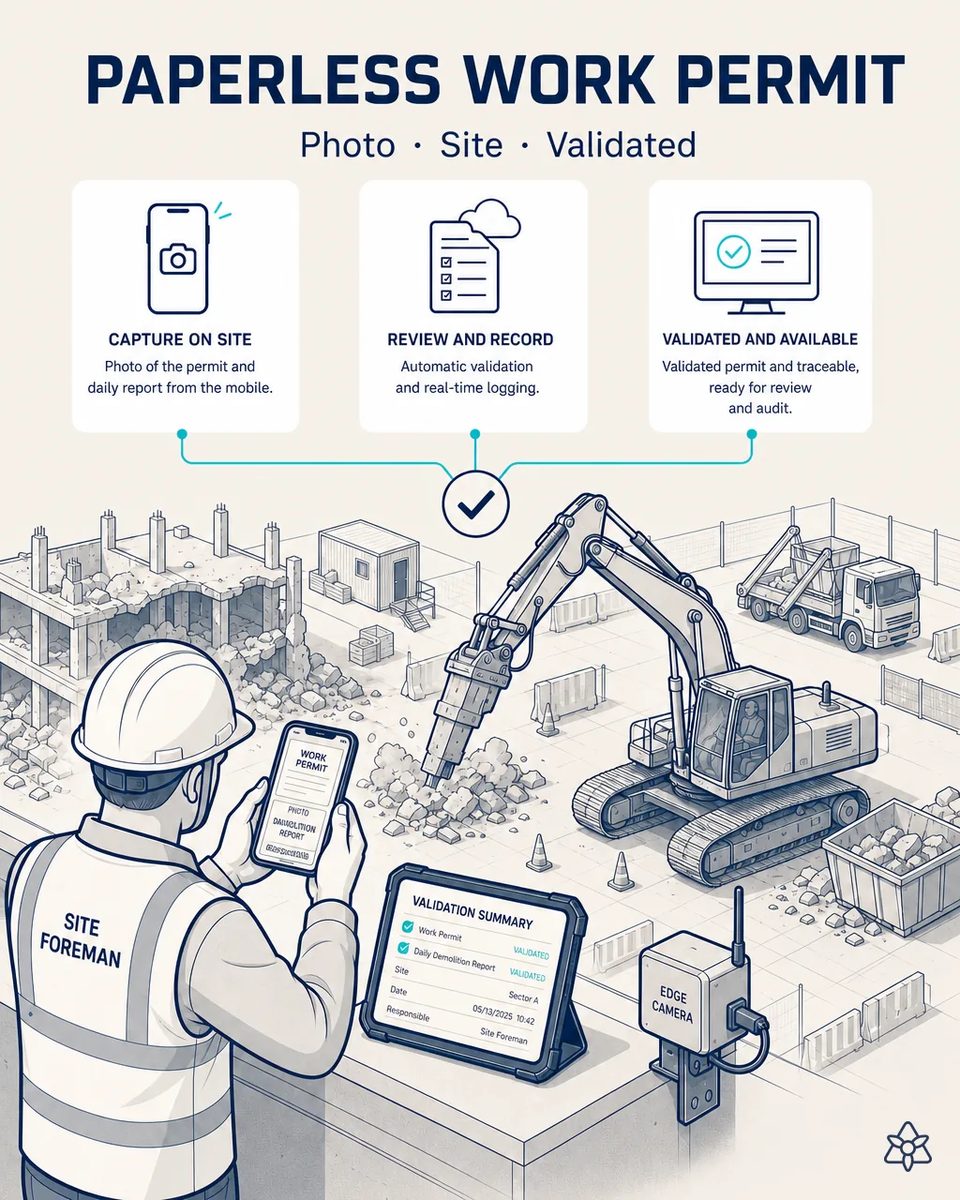
The site is a cost center that moves, and its only record is on paper.
Every demolition site is a mobile cost center with no fixed office. The Work Permit and the daily report are the only source of truth for "which machine did what, where and when," and today they depend on someone physically collecting them from the site office at day's or week's end. When the paper gets lost or is transcribed late, the technical office reconstructs what happened on each work zone from memory, with all the errors and gaps that implies.
- Every work zone opens with a signed Work Permit and closes the day with a handwritten report: machine assigned, attachment fitted, operator, incidents, progress against the demolition plan.
- That paper is the only source of truth for which machine did what, where and when — and it lives in the site office or in the foreman's pocket until somebody physically goes out to collect it at day's or week's end.
- The site has no fixed office and the crew rotates: the person who could explain a line in that report may already be on another site, with another subcontractor, by the time the technical office gets around to reading it.
- When a sheet is lost or typed up a week late, progress per zone is reconstructed from memory, and the certification that comes out of it inherits every one of those gaps — in front of a developer who is paying against exactly that figure.
Connect in photo mode — the foreman keeps filling in the same paperwork.
Connect's photo mode: the foreman photographs the permit and the report with their phone, no habit change required. A grounded LLM recognizes the document's structure and extracts the key fields — work zone, assigned machine, attachment, operator, issues, progress — and stores them in the site's central memory.
It is the least intrusive of the twelve and the one the crew accepts fastest, because nothing is taken away from them: the same permit, the same pen, the same signature, plus one photo. Nobody has to learn an app halfway through a shift and nothing depends on a tablet surviving the dust. That is usually why it is the case that gets approved first, and why it is still running six months later.
Today's site paperwork versus captured site paperwork
| Aspect | Today, on paper | With iLEAN Connect |
|---|---|---|
| Where the permit lives | The site office or a pocket | In the system from minute one |
| Capture latency | Until someone drives out to collect it | Zero |
| Which machine worked which zone | Rebuilt from memory | Recorded zone by zone |
| Progress against the plan | Weekly and approximate | Daily, with its evidence |
| A report that gets lost | Nothing survives it | The photo is the record |
| The foreman's routine | — | Unchanged: one photo |
Before: paper sitting in the site office until the week closes, memory-based reconstruction. After: information is available in the central system at zero latency, site by site.
Impact estimate — to be validated with your numbers.
The block below is an estimate to be validated against your plant's actual data. We put it forward so the committee has an order of magnitude; we refine it during the assessment.
- Estimated payback 4-9 months, depending on how many sites you run concurrently.
- Technical-office transcription time recovered, which today piles up at week's end and gets done against the clock, which is when the mistakes go in.
- From paper sitting in the site office to information available at zero latency, site by site.
- And the demolition report stops being a sheet of paper that has to survive a dusty site, a van and a week in a folder before it counts for anything.
Estimated payback of 4-9 months depending on how many sites run concurrently, counting recovered technical-office transcription time. Estimate to validate.
And the fair question from the production manager
"What if it misreads the zone or the machine on the permit?" — reading fields from a document with a known structure, printed by your own technical office, is an anchored task, where the best models drop below 1.5% error [1]. And there is a second net: the extracted summary reaches the site-office tablet and the manager confirms or corrects it before anything crosses into the central system.
[1] OpenAI paper "Why Language Models Hallucinate", 2025 — on the reliability of AI in anchored tasks.
What people ask about digitizing the work permit
Do we have to change our permit form?
No, and it is better not to. The permit is agreed with the site supervisor and written into the safety plan, so changing it means reopening both. Vision reads the sheet you use today, handwritten annotations included.
Does it work with no coverage on site?
Yes. The photo is queued on the phone and uploads when there is signal, which on an itinerant site is the normal condition rather than the exception. The foreman sees it queued and carries on.
What about the handwriting of a foreman in a hurry?
It is the field with most value, because that is where what actually happened is written rather than what was planned. A low-confidence value is flagged so a person confirms it instead of being guessed at.
Does it work when the crew rotates between sites?
That is exactly where it pays. The record stays tied to the work zone and the machine, not to whoever happened to be the foreman that week, so a handover between subcontractors stops erasing the history.
Do we need ERP integration to start?
No. It works from the first zone against iLEAN's central memory, and the push into your system is connected afterwards, once there is demonstrated value and the technical office has stopped transcribing.
More cases from this series
- Asbestos enclosure verified before work startsEdge cameras verify enclosure sealing and PPE before an asbestos removal starts; JIDOKA AI blocks the…
- The aggregate crushing plant, digitized without touching itAn external camera reads the aggregate crushing plant's proprietary panel and structures output,…
- Auditable evidence for every demolition, ready without rebuilding itiLEAN Edge + Agents automatically builds a dossier with pre/post photos, decision logs and sign-offs for…
- Zero exclusion-zone intrusion incidentsConnect, Edge and Agents coordinated: the work permit, the voice alert, the Edge camera and the evidence…
- Hands-free on site: the foreman dictates, iLEAN logs itThe demolition foreman dictates issues via earpiece while walking between work zones; iLEAN structures…
- The aggregate quality spreadsheet, connected to the ERPiLEAN watches the recycled-aggregate quality spreadsheet and, after validation, pushes it automatically…
Tell us how long a demolition report takes to exist in your system today.
We work on your plant's real data, not ours. Assessment with no commitment.
Request estimated ROI within 48h ‹ See all cases of industrial demolition See construction