Asbestos enclosure verified before work starts
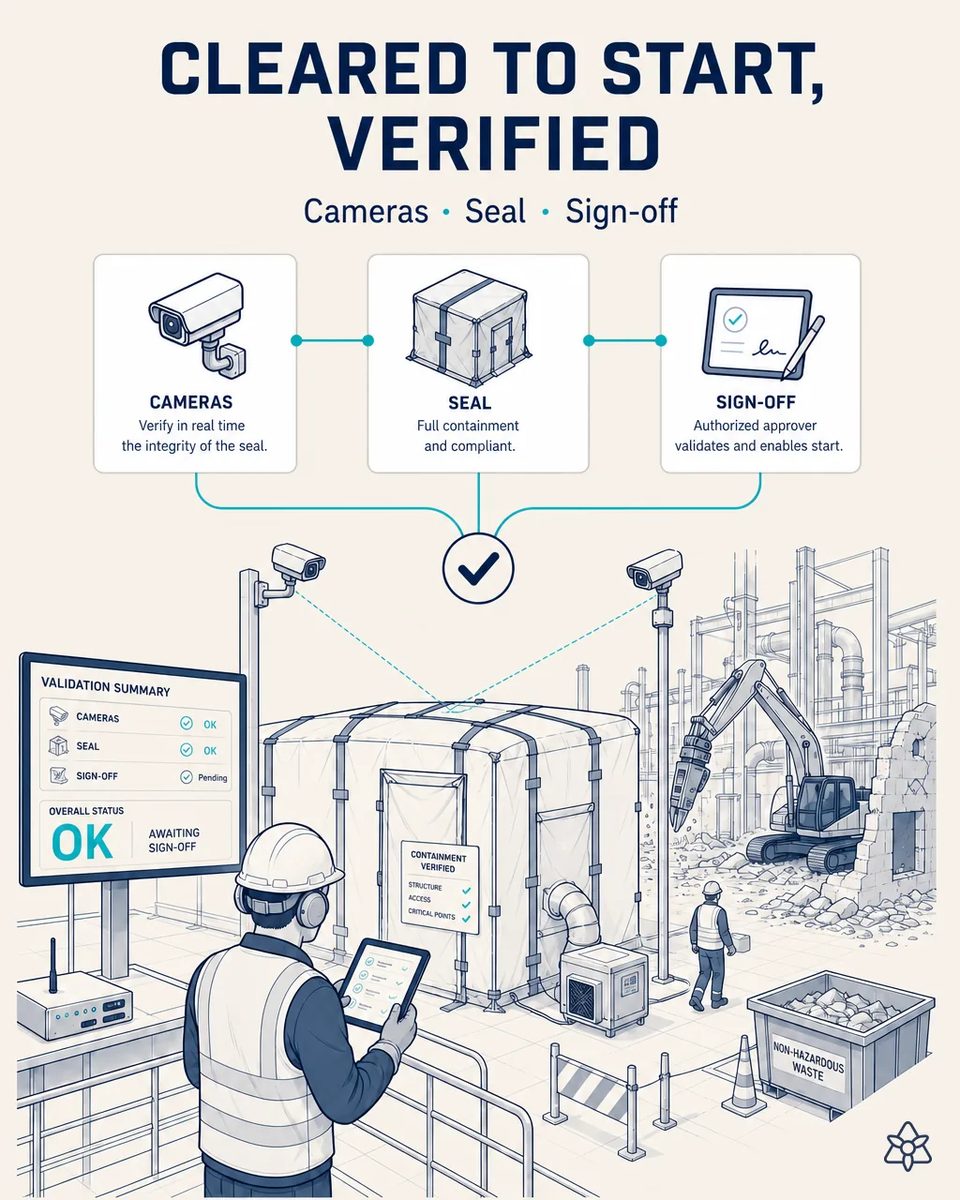
(3-5 lines of prose): Before removing asbestos-containing material, protocol requires a sealed, signposted enclosure with specific PPE, validated today by a supervisor who signs off "ready" without objective visual evidence. With iLEAN Edge, fixed cameras at critical points compare the current state to the reference state and won't allow work to start until everything checks out and the supervisor signs off on that evidence.
An eyeballed sign-off is the weakest point of the whole asbestos work plan.
A sealing flaw missed in time is a possible exposure for personnel and puts the company's asbestos-work authorization at risk. Today, the "ready to start" validation depends on an eyeballed sign-off, with no objective visual evidence at each critical point.
- Before touching asbestos-containing material, the work plan requires a sealed enclosure, signage, an airlock, negative pressure and the specific PPE for the crew going in.
- All of that is checked today by a supervisor who walks around it and says "ready". There is no objective visual evidence of any single critical point, only a signature on a form.
- A sealing flaw missed at that moment is a possible exposure for the crew going inside, and it is exactly the kind of finding that puts the company's asbestos-work authorization at risk if an inspector sees it first.
- And the crew changes between sites: the person signing the enclosure off this morning is often not the one who built it yesterday afternoon, and has nothing but the enclosure itself to go on.
Edge with JIDOKA AI — removal does not start until every point confirms its state.
Edge + JIDOKA AI: fixed cameras with CNNs trained to recognize "sealed enclosure vs. visible flaw" at each critical point. The system blocks the start of removal work until every camera confirms the correct state and the safety officer signs off based on that evidence.
The camera does not decide alone and it does not replace the safety officer. It checks each critical point against its reference state and puts that evidence in front of the person who signs, so the signature rests on something other than a walk-around and a good memory of how the enclosure looked yesterday. What changes is not who decides, but what they get to decide on.
Today's sign-off versus the verified enclosure
| Aspect | Today | With iLEAN Edge |
|---|---|---|
| What "ready" rests on | A walk-around and a signature | Evidence at every critical point |
| Sealing of the enclosure | Checked by eye | Compared to the reference state |
| Airlock and signage | Assumed in place | Confirmed before start |
| PPE of the crew going in | Checked if there is time | Checked every entry |
| Start of removal | Whenever the supervisor says | Blocked until the state checks out |
| Record of the check | The signed form | The form plus its images |
Before: eyeballed sign-off with risk of a flawed enclosure. After: sign-off grounded in objective visual evidence at every critical point.
Impact estimate — this one is defended as protected authorization, not as payback.
The block below is an estimate to be validated against your plant's actual data. We put it forward so the committee has an order of magnitude; we refine it during the assessment.
- The brief gives this case no payback range, and it is not invented here: what it protects does not reduce to a monthly figure.
- It protects the asbestos-work authorization, which is the permit the whole business line depends on.
- It reduces the exposure risk of the crew who go inside the enclosure, which is the part no estimate should ever be put on.
- It is a case to size with your safety officer, against the last enclosure that was signed off by eye.
Protects the asbestos-work authorization and reduces personnel exposure risk. Estimate to validate with the safety officer.
And the fair question from the production manager
"What if the camera blocks a removal for no reason?" — the block is what makes the case worth having, so the threshold matters. Conformity is checked against the reference state of that specific enclosure, and recognizing a sealed panel versus a visible flaw is an anchored task, where the best models drop below 1.5% error [1]. In case of doubt it does not block silently: it escalates to the safety officer, who decides on the evidence.
[1] OpenAI paper "Why Language Models Hallucinate", 2025 — on the reliability of AI in anchored tasks.
What people ask about validating the asbestos enclosure
What exactly is checked?
Sealing of the panels and joints, the airlock, the signage, the negative pressure indication and the PPE of whoever enters. The points are defined with your safety officer when the enclosure is set up, and they follow the work plan rather than a generic list.
Does it replace the supervisor's sign-off?
No, and it should not be presented that way. The sign-off stays with the person who answers for it; what changes is that it rests on visual evidence instead of on a walk-around.
Does it work on an enclosure built for one removal?
Yes. The reference state is captured when the enclosure is set up, which takes minutes, and the checks run against that same site's setup.
Can it be overridden when the schedule is tight?
An exception needs the safety officer's signature and is recorded as such. What cannot happen is a removal starting with no trace of who decided to skip the check.
Does the evidence stay for an inspection?
Yes, and that is half the value: the images of each critical point stay attached to that removal and to the work plan it belongs to, so the file exists before anybody asks for it rather than being assembled afterwards.
More cases from this series
- The aggregate crushing plant, digitized without touching itAn external camera reads the aggregate crushing plant's proprietary panel and structures output,…
- Auditable evidence for every demolition, ready without rebuilding itiLEAN Edge + Agents automatically builds a dossier with pre/post photos, decision logs and sign-offs for…
- Zero exclusion-zone intrusion incidentsConnect, Edge and Agents coordinated: the work permit, the voice alert, the Edge camera and the evidence…
- Hands-free on site: the foreman dictates, iLEAN logs itThe demolition foreman dictates issues via earpiece while walking between work zones; iLEAN structures…
- The aggregate quality spreadsheet, connected to the ERPiLEAN watches the recycled-aggregate quality spreadsheet and, after validation, pushes it automatically…
- Clean recycled aggregate, guaranteed by computer visionAn Edge camera on the output belt detects wood, plastic or scrap metal in recycled aggregate and diverts…
Tell us how your last asbestos enclosure was declared ready to start.
We work on your plant's real data, not ours. Assessment with no commitment.
Request estimated ROI within 48h ‹ See all cases of industrial demolition See construction