Zero exclusion-zone intrusion incidents
(3-5 lines of prose): The capital pain of any demolition company is the same: zero serious incidents from intrusion into the exclusion zone of a large-tonnage machine or demolition robot. The iLEAN flagship system coordinates Connect, Edge and Agents in several cross-checking verification rings, from the work permit to the machine's automatic lockout.
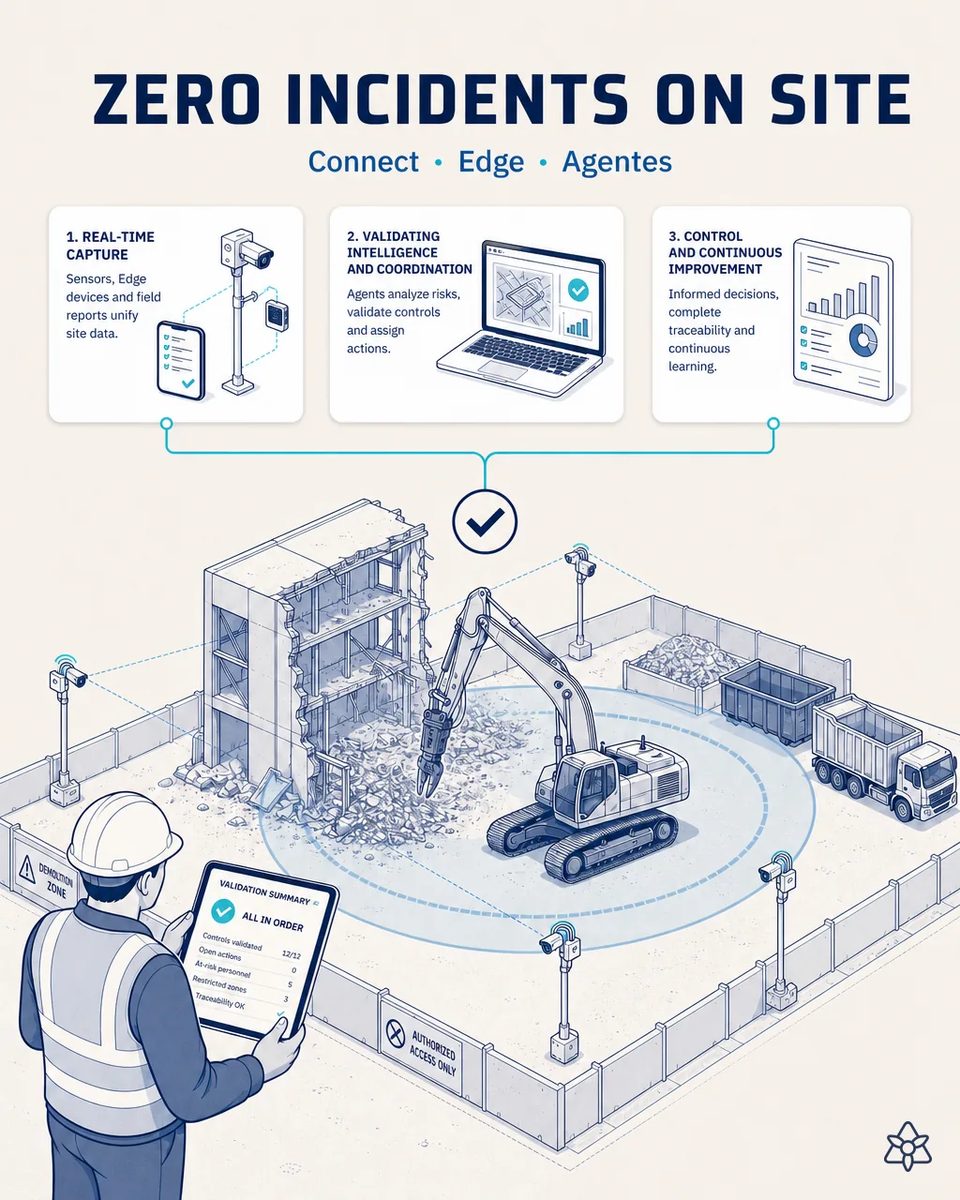
One person in the swing radius is the exposure the whole company is measured on.
Heavy-tonnage machinery risk is the sector's biggest reputational, human and financial exposure. Every serious incident costs, beyond the human toll, penalties, work stoppage and possible loss of future contracts — especially on public or high-profile projects.
- The exclusion zone around a heavy-tonnage machine or a demolition robot is defined on paper, marked out with cones and tape, and reconfigured by hand every time the work zone advances — which on a live demolition is daily.
- The crew rotates, subcontractors come and go for a morning, and the person who walks into the radius is very often the one who was not on site when that zone was briefed.
- Beyond the human toll, a serious incident means penalties, a stopped site and the loss of future contracts, which on public and high-profile projects is the part the company does not recover from.
- And a near-miss leaves no trace at all: it is told in the site office at the end of the day and never becomes a record anybody can act on before the next one.
Agents orchestrating four rings — permit, voice, camera and evidence.
Ring 1 (Connect): the Work Permit defines which machine operates in which zone and with what exclusion radius. Ring 2 (Connect): the foreman alerts in seconds via earpiece if they see someone approaching. Ring 3 (Edge): cameras on every large-tonnage machine detect intrusion into the swing radius and trigger JIDOKA AI — automatic lockout. Ring 4 (Agents): every intrusion and every safety sign-off is documented in the evidence pack. SMED AI speeds up reconfiguring the exclusion zone as the work zone progresses.
No single ring solves it. Each of them already exists today in some form — a permit, a shout on the radio, a spotter watching the swing — and people still end up inside the radius. The strength is in the cross-check, and above all in the fact that the third ring does not ask a human being to see the intrusion and react in time.
The four rings, and what each one closes
| Ring | Which cases it draws on | What it closes |
|---|---|---|
| 1 · Permit | Work permit (1) + tablet validation (5) | Which machine works which zone, and with what radius |
| 2 · Voice | Foreman earpiece (4) + supervisor alert (3) | The warning given in seconds, hands free |
| 3 · Machine | Edge on every heavy machine | Intrusion into the swing radius, and automatic lockout |
| 4 · Evidence | Evidence pack (11) | Every intrusion and every sign-off, documented |
| Reconfiguration | SMED AI | The exclusion zone follows the work zone |
| Who decides | The site manager | iLEAN proposes, the machine stops |
Before: incidents or near-misses with no objective evidence. After: automatic detection and lockout in the moment, fully documented.
Impact estimate — to be validated with your numbers.
The block below is an estimate to be validated against your plant's actual data. We put it forward so the committee has an order of magnitude; we refine it during the assessment.
- Estimated payback 6-12 months, measured against the cost of a single serious incident avoided.
- Detection and automatic lockout in the moment, instead of a warning that depends on somebody seeing the intrusion and reacting in time.
- Near-misses stop being site-office stories told at the end of the day and become documented events with their own evidence.
- It is a case to size with your safety officer and general management, because the exposure it covers — human, financial and reputational — is theirs.
Estimated payback of 6-12 months against the cost of a single serious incident avoided. Estimate to validate with the safety officer and general management.
And the fair question from the production manager
"Do we have to deploy all twelve cases to get this?" — no, and framing it that way would be the way never to start. The rings are built in layers and each case pays on its own. On ring 3, detecting a person entering the swing radius is an anchored task, where the best models drop below 1.5% error [1], and JIDOKA AI locks out on a verified detection, not on model uncertainty.
[1] OpenAI paper "Why Language Models Hallucinate", 2025 — on the reliability of AI in anchored tasks.
What people ask about the complete safety system
Where do you start?
With the work permit, because it is what defines which machine works which zone and with what exclusion radius. Without it ring 3 has nothing to check a detection against, and each earlier layer pays for itself on its own.
Does the machine really stop on its own?
Lockout is triggered on a verified detection inside the swing radius. How it is wired depends on the machine and the attachment, and it is agreed with your fleet team before anything is fitted to a single unit.
What about the operator who has to be near the machine?
Authorized presence is part of the permit: a banksman working with that machine is expected there. What triggers the ring is presence that the permit does not account for.
Does it work with subcontractor crews?
That is precisely the case it is built for. The ring checks the zone, not the badge, so somebody who arrived this morning and was never briefed is covered exactly like your own crew.
Can the return be estimated before committing?
Yes: with your near-miss history, the machines in the fleet and the type of project, the return of each layer is estimated before deciding the order.
More cases from this series
- Asbestos enclosure verified before work startsEdge cameras verify enclosure sealing and PPE before an asbestos removal starts; JIDOKA AI blocks the…
- The aggregate crushing plant, digitized without touching itAn external camera reads the aggregate crushing plant's proprietary panel and structures output,…
- Auditable evidence for every demolition, ready without rebuilding itiLEAN Edge + Agents automatically builds a dossier with pre/post photos, decision logs and sign-offs for…
- Hands-free on site: the foreman dictates, iLEAN logs itThe demolition foreman dictates issues via earpiece while walking between work zones; iLEAN structures…
- The aggregate quality spreadsheet, connected to the ERPiLEAN watches the recycled-aggregate quality spreadsheet and, after validation, pushes it automatically…
- Clean recycled aggregate, guaranteed by computer visionAn Edge camera on the output belt detects wood, plastic or scrap metal in recycled aggregate and diverts…
Tell us how your exclusion zones are defined today, and who reconfigures them when the work zone moves.
We work on your plant's real data, not ours. Assessment with no commitment.
Request estimated ROI within 48h ‹ See all cases of industrial demolition See construction