The aggregate crushing plant, digitized without touching it
(3-5 lines of prose): The fixed plant producing recycled aggregate is often a decade or more old, with a proprietary panel and no accessible network port. Replacing it costs hundreds of thousands of euros and weeks of downtime. With iLEAN Connect, an external camera aimed at the panel is enough: the plant stays the same, but aggregate output is now digitized batch by batch, without touching the original electrical cabinet.
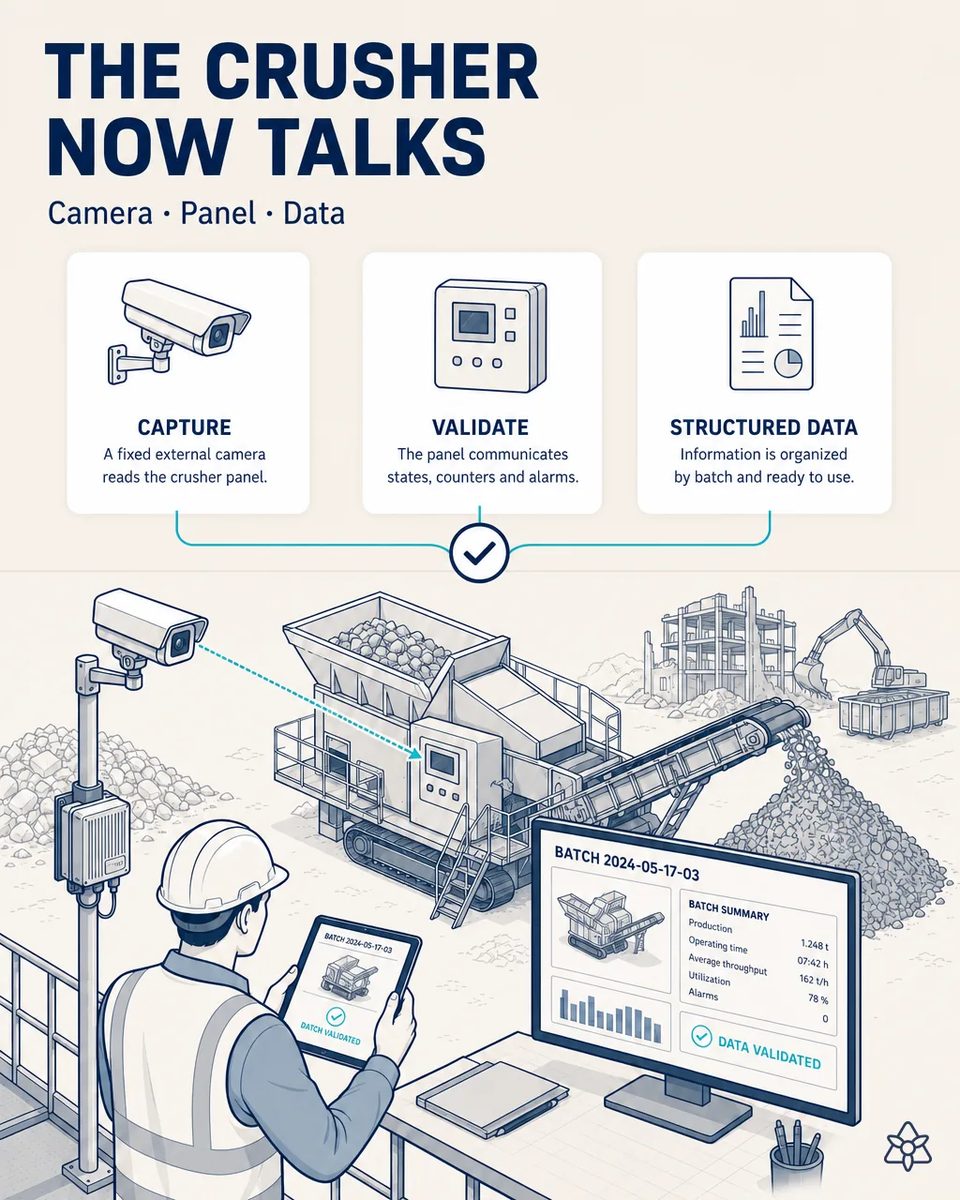
The plant that makes your product is the one that records nothing.
The crushing plant's panel constantly shows metric tons produced, moisture and consumption — vital data that dies on screen every time the batch changes, because no one transcribes it systematically. Without that correlation, figuring out why a batch of aggregate came out with more fines than expected means reconstructing what happened at the plant that day from memory.
- The plant producing recycled aggregate is often a decade or more old, with a proprietary panel, a closed protocol and no accessible network port. Replacing it is hundreds of thousands of euros and weeks with no aggregate coming out.
- Its display shows, continuously, metric tons produced, moisture and consumption — and every one of those readings dies on screen when the batch changes, because nobody transcribes them systematically.
- So when a batch comes out with more fines than expected, nobody can tell whether it was the feed material from that particular demolition, the closed side setting left from the previous job or a screen deck about to blind.
- The CE marking of the recycled aggregate asks for traceability of what the plant produced, and today that traceability is a stack of notes somebody wrote down on the days they had a spare minute.
Connect in photo-on-panel mode — solved from outside the cabinet.
Connect's photo-on-panel mode: a fixed industrial camera aims at the display and an OCR pipeline with a grounded LLM interprets each reading, structuring it by batch and shift in central memory, without touching the original electrical cabinet.
Nothing is installed inside the plant, no port is opened and its manufacturer's warranty is untouched. On a machine the whole site's aggregate output depends on, that is the difference between a case that gets approved in a week and a project that waits forever for a shutdown window nobody wants to give it. The plant carries on crushing exactly as it is; the only thing that changes is that what it produces now leaves a trace.
Today's plant versus the plant being read
| Aspect | Today | With iLEAN Connect |
|---|---|---|
| Output per batch | On screen, then gone | Digitized batch by batch |
| Moisture and consumption | Never correlated | Tied to the batch and the shift |
| A batch with excess fines | Explained from memory | Explained from the readings |
| CE-marking traceability | Loose notes | History per batch |
| The electrical cabinet | — | Untouched, warranty intact |
| Plant replacement capex | In the plan | Indefinitely postponable |
Before: zero output-quality correlation, data dying on screen. After: per-batch analysis in minutes, and plant replacement becomes indefinitely postponable.
Impact estimate — to be validated with your numbers.
The block below is an estimate to be validated against your plant's actual data. We put it forward so the committee has an order of magnitude; we refine it during the assessment.
- Estimated payback 5-10 months, counting the avoided plant-replacement capex first, which is the largest single line in the case.
- Per-batch analysis in minutes instead of a reconstruction, weeks later, of what somebody thinks happened at the plant that day.
- Aggregate traceability improved exactly where it is demanded: the CE marking of the material you sell or reuse on another site.
- And the replacement decision stops being forced by the fact that the plant reports nothing: the machine crushes perfectly well, it simply never told you what it was doing.
Estimated payback of 5-10 months, avoiding plant-replacement CAPEX and improving aggregate traceability for CE marking. Estimate to validate.
And the fair question from the production manager
"Can a camera pointed at a screen be trusted for a traceability record?" — here the task is anchored: a fixed display, fields in known positions and physically bounded ranges, where the best models drop below 1.5% error [1]. Any frame whose value falls outside the plant's possible range is discarded instead of accepted, which is exactly what would invalidate the series in front of a certification body.
[1] OpenAI paper "Why Language Models Hallucinate", 2025 — on the reliability of AI in anchored tasks.
What people ask about reading the crusher panel
Do we have to touch the plant's electrical cabinet?
No, and that is the whole point. The camera is external, nothing is wired into the panel and neither the plant's warranty nor its certification is affected. No electrician and no shutdown are needed to install it.
Does it work on a mobile plant that changes site?
Yes. The camera and its mast travel with the plant; what has to be repeated at each setup is aiming it at the display, which takes minutes and is done by whoever commissions the plant.
What about dust and the vibration of the crusher?
The enclosure is industrial and the mount is decoupled from the machine frame. Dust is handled by cadence: readings are frequent enough that a dirty or blurred frame is discarded rather than averaged into the batch.
Does it read alarms as well as counters?
Yes, and they are often what explains the batch: a blocked chute, a feeder tripping or a screen deck blinding shows up as a run of alarms nobody logged and nobody remembered a week later.
Does it serve a plant we hire in for a few weeks?
It does, and that is common on demolition sites. The setup is portable, so a hired plant can be read for the duration of that job and the readings stay attached to the project it belonged to.
More cases from this series
- Asbestos enclosure verified before work startsEdge cameras verify enclosure sealing and PPE before an asbestos removal starts; JIDOKA AI blocks the…
- Auditable evidence for every demolition, ready without rebuilding itiLEAN Edge + Agents automatically builds a dossier with pre/post photos, decision logs and sign-offs for…
- Zero exclusion-zone intrusion incidentsConnect, Edge and Agents coordinated: the work permit, the voice alert, the Edge camera and the evidence…
- Hands-free on site: the foreman dictates, iLEAN logs itThe demolition foreman dictates issues via earpiece while walking between work zones; iLEAN structures…
- The aggregate quality spreadsheet, connected to the ERPiLEAN watches the recycled-aggregate quality spreadsheet and, after validation, pushes it automatically…
- Clean recycled aggregate, guaranteed by computer visionAn Edge camera on the output belt detects wood, plastic or scrap metal in recycled aggregate and diverts…
Tell us what your crushing plant produced last week, and where that figure lives.
We work on your plant's real data, not ours. Assessment with no commitment.
Request estimated ROI within 48h ‹ See all cases of industrial demolition See construction