The aggregate quality spreadsheet, connected to the ERP
(3-5 lines of prose): The quality technician fills in a spreadsheet each batch with granulometry, fines and contaminants for the recycled aggregate, in a folder the ERP never sees. iLEAN Connect watches the folder, absorbs every cell as soon as it's saved and, once the technician validates it, pushes it automatically into the ERP.
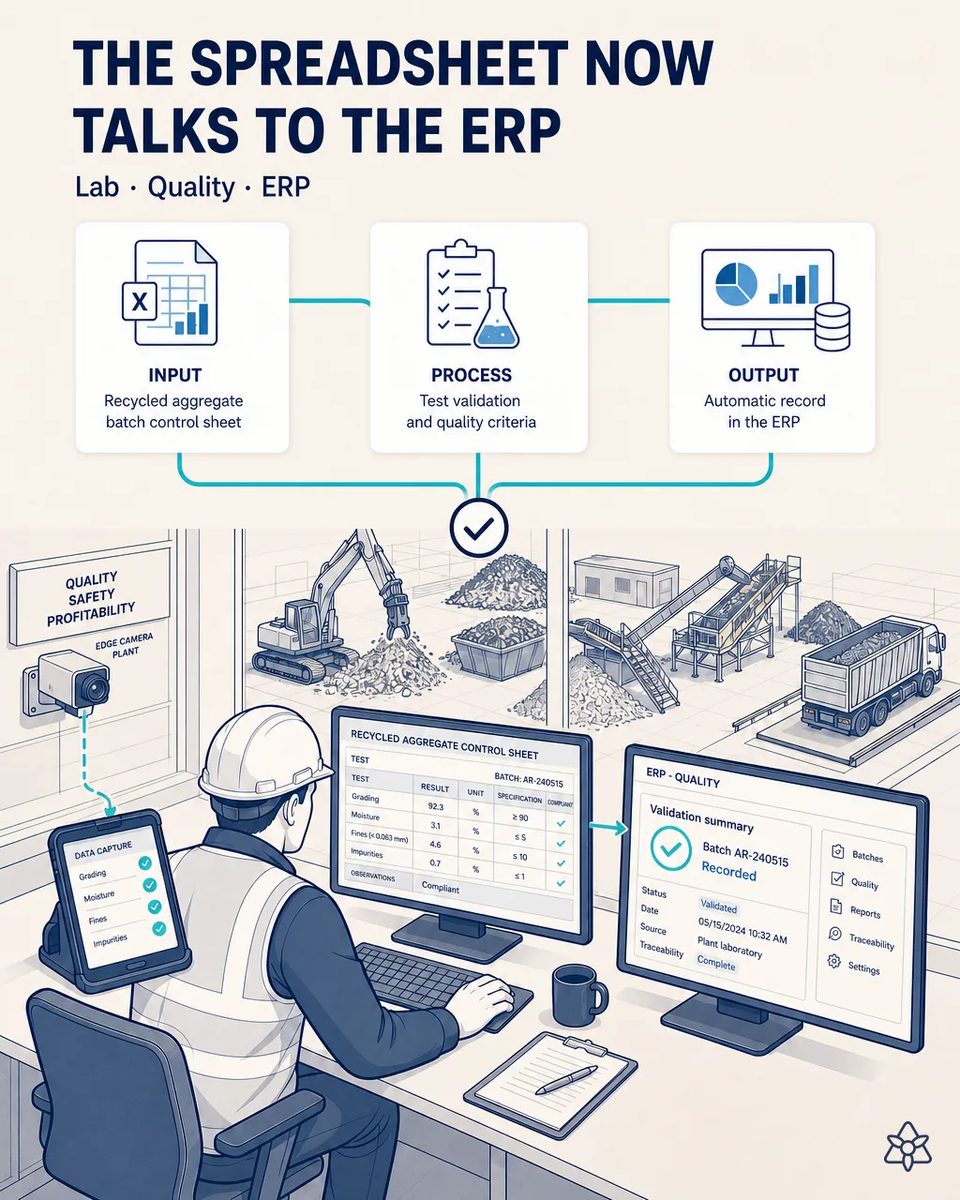
Two parallel worlds, and one person copying cells between them every month.
Two parallel worlds coexist: the real spreadsheet, where the live aggregate data lives, and the official ERP, updated weeks later by someone spending hours a month copying and pasting. That lag makes it hard to cross-reference each recycled-aggregate batch with its CE-marking traceability.
- The live data is in the spreadsheet: grading, fines below the sieve, moisture and the count of wood, plastic and gypsum the technician runs on each batch of recycled aggregate produced by the plant.
- The official ERP has a transcribed version of it, incomplete and weeks out of date, kept alive by somebody spending hours a month on copy and paste between two screens.
- That lag is what breaks the cross-check between a batch and its CE-marking traceability, which is precisely what a customer reusing the aggregate — or the site engineer accepting it — asks to see.
- And the transcription errors surface at the worst possible moment: when a delivery is questioned and the sheet has to prove what that batch actually was, not what somebody typed it as.
Connect in listen-inward mode — it watches the shared folder, never the person.
Connect's "listen inward" mode: it watches the shared folder (not the person) and reads the delta when the file is saved. A grounded LLM parses it, shows the data for the technician's validation and, once confirmed, pushes it to the ERP via API.
Nobody is asked to change the sheet, and that is deliberate: asking the quality technician to standardize a file they have refined over years is the fastest route to a system nobody uses and a second spreadsheet appearing in a private folder. iLEAN reads the one that exists, in the shape it is in today, including the columns somebody added for the last job and never removed.
Today's quality control versus the sheet connected to the ERP
| Aspect | Today | With iLEAN Connect |
|---|---|---|
| Gap between sheet and ERP | Weeks | Zero |
| Manual transcription | Hours a month | None |
| Batch to CE-marking cross-check | Rebuilt by hand, weeks later | Automatic, batch by batch |
| Copying errors | Surface when questioned | Eliminated |
| The spreadsheet format | Must be respected | Read as it is, changes included |
| Quality module licenses | Several | One, the technician who validates |
Before: weeks of lag and hours a month spent transcribing. After: zero latency and automatic per-batch traceability cross-referencing.
Impact estimate — to be validated against your actual invoice.
The block below is an estimate to be validated against your plant's actual data. We put it forward so the committee has an order of magnitude; we refine it during the assessment.
- 💰 CFO angle: the ERP bills per named user. If several lab and quality people log in purely to enter results, that is a 50-80 % reduction in quality-module licenses, recurring every year.
- Estimated payback 4-9 months, before counting anything the lag itself costs you.
- Hours a month of an expensive quality technician recovered from copying cells between two screens that should have been talking to each other.
- And per-batch traceability that stops being assembled in a hurry the afternoon a customer asks for it, because it is already there.
CFO angle: a typical 50-80% reduction in ERP licenses for the quality/lab module (from several licenses down to one). Estimated payback 4-9 months. Estimate to validate.
And the fair question from the production manager
"That sheet has been passed between three technicians over the years — will it hold?" — that is the anticipated case, not the exception. Parsing does not depend on fixed cell positions: it interprets columns, units, merged cells and margin notes without asking anybody to standardize anything or to stop adding a column when a job needs one. It is an anchored task, where the best models drop below 1.5% error [1], and the technician sees and validates the parsed batch before anything is pushed into the ERP.
[1] OpenAI paper "Why Language Models Hallucinate", 2025 — on the reliability of AI in anchored tasks.
What people ask about connecting the recycled-aggregate quality sheet
Do we have to standardize the spreadsheet?
No, and it is better not to. The sheet works because the technician built it around how this plant actually runs; iLEAN reads the file in the format it has today, merged cells and margin notes included.
Does it push results on its own?
No. It reads the delta when the file is saved, shows it for validation, and pushes to the ERP only once the technician confirms it. Nothing reaches the quality record unsigned.
Can licenses really be cut?
It depends on your contract, which is why it is framed as an estimate to check against last year's invoice. The logic is simple: whoever logs into the ERP only to type results stops needing a seat of their own.
Does it cover contaminant counts as well as grading?
Yes, and on recycled aggregate those are the numbers that matter most: wood, plastic and gypsum content are what a customer reusing the material questions first, well before the grading curve.
Does it watch the folder or the person?
The folder. The file is read when it is saved, and nothing else is looked at: there is no record of who opened what, from where, or how long they spent in it.
More cases from this series
- Asbestos enclosure verified before work startsEdge cameras verify enclosure sealing and PPE before an asbestos removal starts; JIDOKA AI blocks the…
- The aggregate crushing plant, digitized without touching itAn external camera reads the aggregate crushing plant's proprietary panel and structures output,…
- Auditable evidence for every demolition, ready without rebuilding itiLEAN Edge + Agents automatically builds a dossier with pre/post photos, decision logs and sign-offs for…
- Zero exclusion-zone intrusion incidentsConnect, Edge and Agents coordinated: the work permit, the voice alert, the Edge camera and the evidence…
- Hands-free on site: the foreman dictates, iLEAN logs itThe demolition foreman dictates issues via earpiece while walking between work zones; iLEAN structures…
- Clean recycled aggregate, guaranteed by computer visionAn Edge camera on the output belt detects wood, plastic or scrap metal in recycled aggregate and diverts…
Tell us how many people log into your ERP purely to type recycled-aggregate results, and how far behind it runs.
We work on your plant's real data, not ours. Assessment with no commitment.
Request estimated ROI within 48h ‹ See all cases of industrial demolition See construction