Clean recycled aggregate, guaranteed by computer vision
(3-5 lines of prose): On the crushing plant's output belt, the human eye doesn't systematically catch contaminants slipping into the recycled aggregate. iLEAN Edge places a camera above the belt with a CNN trained on the specific material, diverting contaminated material before it's classified as valid aggregate.
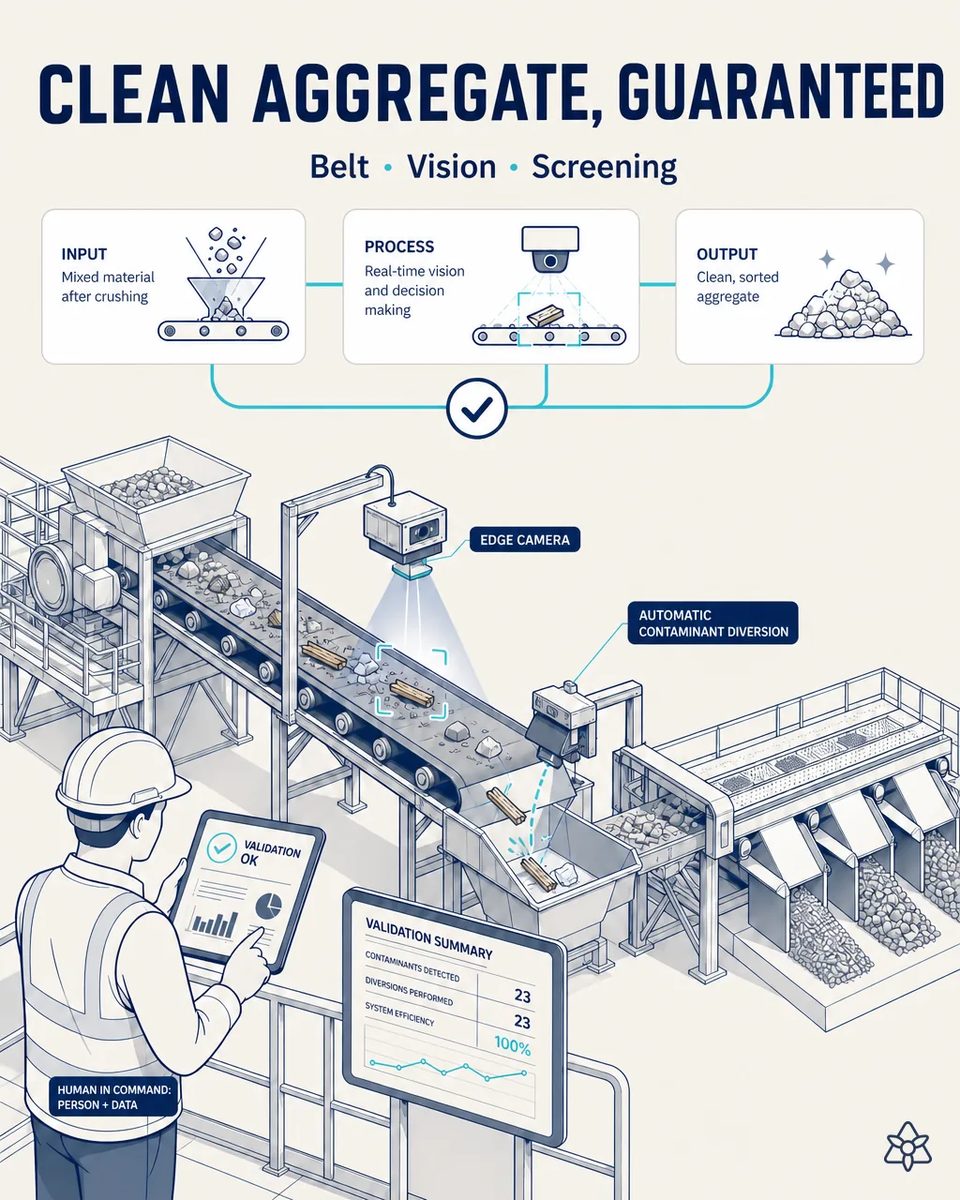
At belt speed, the human eye is sampling, not inspecting.
At belt speed, the human eye can't systematically catch wood, plastic or scrap-metal fragments in the recycled aggregate. If that contaminated material reaches a customer or the site reusing it, it compromises product quality and its CE marking.
- Demolition feedstock arrives mixed by definition: concrete and masonry, but also timber, plastic sheeting, gypsum board and scrap metal that makes it through the crusher intact.
- On the output belt, somebody glances at the flow now and then between other jobs. That is sampling with gaps, and the fragment that slips through is precisely the one nobody was looking at.
- When contaminated aggregate reaches a customer or a site reusing it, the complaint is never about one bucket: it questions the whole batch, its grading report and the CE marking behind it.
- And the cost is rarely the material itself. It is the relationship with the customer who chose to take your recycled aggregate instead of buying virgin, and who now has a reason not to.
Edge — local CNN vision over the output belt, with no cloud round-trip.
Edge — local CNN vision, no cloud round-trip, trained on clean and contaminated examples of the specific material the plant processes. In milliseconds per belt section, it triggers diversion of non-conforming material.
The model is trained on clean and contaminated examples of the material this plant actually processes, not on a generic dataset bought off a shelf. Demolition feedstock changes with every building taken down — an office block is not a warehouse and neither is an old industrial plant — and that variation is exactly what the training has to cover.
Today's visual check versus Edge vision on the output belt
| Aspect | Visual inspection | With iLEAN Edge |
|---|---|---|
| Coverage | Occasional glances | The whole belt, continuously |
| Timber and plastic sheeting | Slip through at belt speed | Classified belt section by section |
| Gypsum fragments | Hard to spot by eye | Trained explicitly |
| Point of detection | The customer's complaint, weeks later | Before it ever joins the stockpile |
| Non-conforming material | Already inside the certified batch | Diverted in milliseconds |
| Borderline cases | Judged by whoever is there | Escalated to a person |
Before: batch sampling with gaps only caught when a customer complains. After: continuous inspection of the entire belt.
Impact estimate — to be validated with your numbers.
The block below is an estimate to be validated against your plant's actual data. We put it forward so the committee has an order of magnitude; we refine it during the assessment.
- Estimated payback 5-12 months, depending on the volume of material the plant processes over a year.
- Protection of the recycled aggregate's CE marking, which is what allows the material to be sold or reused on another site at all.
- From batch sampling with gaps to continuous inspection of the entire belt, with no change to the crushing plant, its screening decks or the crew running them.
- And protection of the relationship with customers who reuse your aggregate, which is the part a single rejected load actually damages.
Estimated payback of 5-12 months depending on volume processed, protecting CE marking and relationships with customers reusing the aggregate. Estimate to validate.
And the fair question from the production manager
"What if it diverts good material?" — the false positive is the real risk of any vision system, and on an output belt it is paid for in tonnage. That is why the model is trained on your own feedstock and under that belt's actual lighting, and why a borderline fragment is escalated to a person instead of being dumped into the reject bin by default. The classification itself is an anchored task, where the best models drop below 1.5% error [1], and every human decision on a borderline case feeds back into the training set.
[1] OpenAI paper "Why Language Models Hallucinate", 2025 — on the reliability of AI in anchored tasks.
What people ask about inspecting recycled aggregate on the belt
Does it keep up with the belt speed?
Yes: inference runs locally, in milliseconds per belt section, on hardware next to the conveyor. It does not depend on site connectivity, which on a demolition site can never be assumed.
How much material is needed to train it?
Less than most people expect, because the contaminant catalog is short and repetitive: timber, plastic, gypsum and scrap metal. What matters is that the examples come from your own feedstock and that belt.
Does it work when the feedstock changes between buildings?
That is the design condition, not a limitation. Demolition material varies with each structure taken down, so the model is trained across that variation and retrained when a genuinely new material family shows up on the belt.
Does it replace the quality control on the batch?
No, and it is not offered as a replacement. Grading and fines still get measured in the lab; what changes is that the belt stops feeding contaminants into the batch that is later sampled.
What happens to the diverted material?
It goes back for reprocessing or to the fraction it belongs to. Every diversion is logged, so the contamination rate itself becomes a figure you can watch by job — and a way to tell which demolitions produce dirty feedstock.
More cases from this series
- Asbestos enclosure verified before work startsEdge cameras verify enclosure sealing and PPE before an asbestos removal starts; JIDOKA AI blocks the…
- The aggregate crushing plant, digitized without touching itAn external camera reads the aggregate crushing plant's proprietary panel and structures output,…
- Auditable evidence for every demolition, ready without rebuilding itiLEAN Edge + Agents automatically builds a dossier with pre/post photos, decision logs and sign-offs for…
- Zero exclusion-zone intrusion incidentsConnect, Edge and Agents coordinated: the work permit, the voice alert, the Edge camera and the evidence…
- Hands-free on site: the foreman dictates, iLEAN logs itThe demolition foreman dictates issues via earpiece while walking between work zones; iLEAN structures…
- The aggregate quality spreadsheet, connected to the ERPiLEAN watches the recycled-aggregate quality spreadsheet and, after validation, pushes it automatically…
Tell us when a customer last rejected a load of your recycled aggregate, and what it was contaminated with.
We work on your plant's real data, not ours. Assessment with no commitment.
Request estimated ROI within 48h ‹ See all cases of industrial demolition See construction