From raw material to pallet, four rings that verify each other
Coordinating raw materials with short shelf life and specific storage needs against the production rhythm, without it costing a nonconforming batch or the organic certification that underpins exports: that's this plant's capital pain.
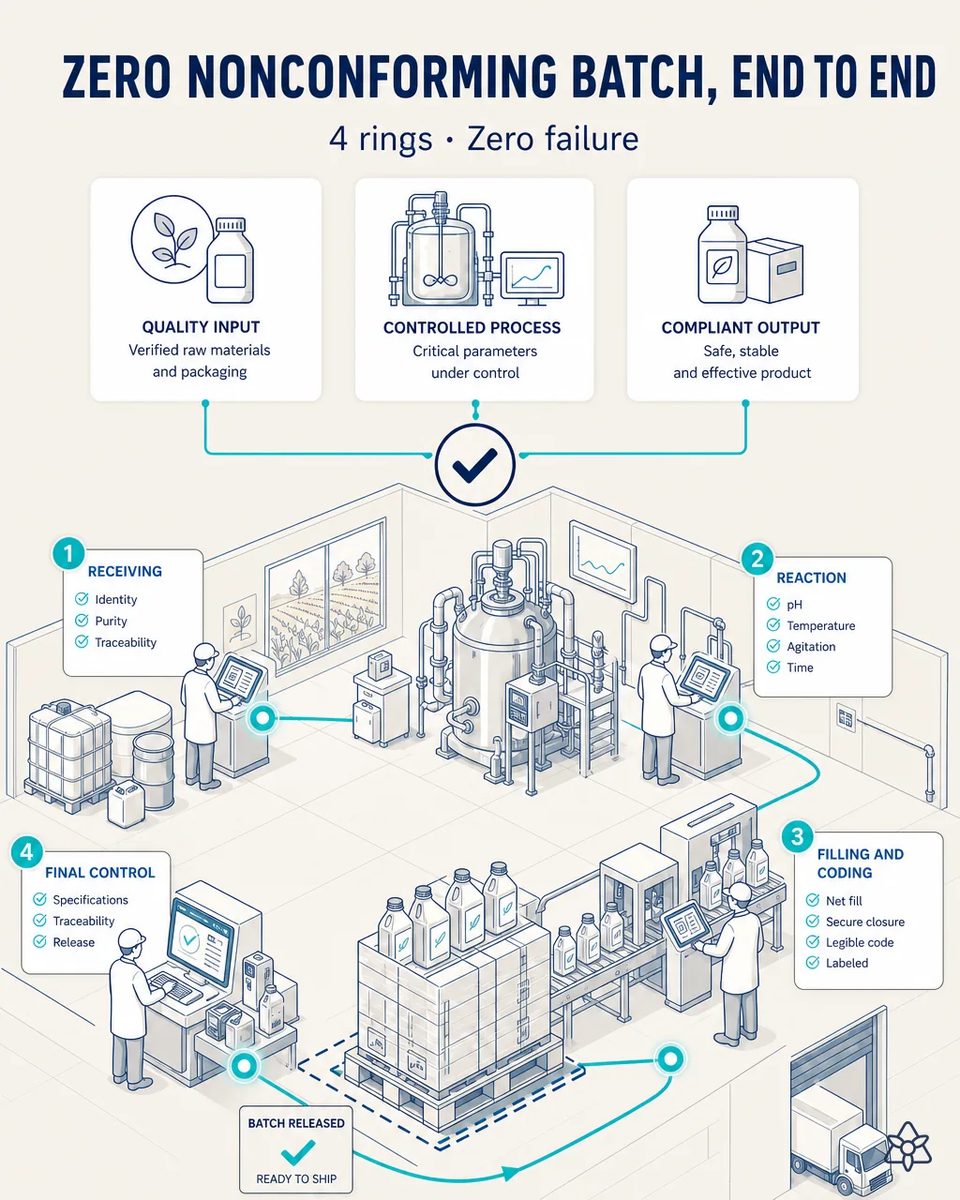
The pain is coordinating short-lived materials without losing a batch or the certificate.
Coordinating raw materials with short shelf life and specific storage needs against the production rhythm, without it costing a nonconforming batch or the organic certification that underpins exports: that's this plant's capital pain. Raw-material receiving gets validated by lot and expiry from minute one, via Connect. No expired or poorly traced ingredient enters a reactor unnoticed.
- Raw materials with short shelf life and specific storage needs — live strains, plant extracts, cold-chain inputs — have to meet a production rhythm that does not wait for a late truck or a slow lab result.
- Each control exists in some form: receiving, fermentation, cleaning, coding, release. Each one on its own looks acceptable.
- But a strain near expiry, a fermentation curve slightly off, a cleaning signed in a hurry and a hand-typed expiry add up to a nonconforming batch that passes every individual check and only fails in the grower's field, weeks later.
- And on a certified line, that batch does not only cost itself: it can cost the organic certification that underpins exports.
Four rings that verify each other — the previous eleven cases, orchestrated with JIDOKA AI and SMED AI.
The reactor only starts each batch after visual cleaning confirmation via Edge, and the coder prints batch and expiry straight from the active work order, no typing.
No ring is enough alone, and each already exists in part today. The strength is in the cross-check: when receiving, fermentation, cleaning and coding stop agreeing about a batch, JIDOKA AI stops it before the pallet, and SMED AI keeps the changeovers from eating the productivity that safety would otherwise cost.
Ring by ring, from strain receiving to released pallet
| Ring | Cases it draws on | What it guarantees |
|---|---|---|
| 1 · Receiving | Delivery note (7) + supplier alert (3) | No expired or poorly traced strain enters a fermenter |
| 2 · Process | Work order (1) + fermenter panel (2) + lab sheet (6) | Formula, curve and bioassay tied to each batch |
| 3 · Line | Organic cleaning (10) + container vision (9) | Clean vessel before organic batches, sound containers |
| 4 · Release | Coder (8) + tablet gate (5) + evidence pack (11) | Correct batch and expiry, signed, with its dossier |
| Cross-check in biosolutions | JIDOKA AI | The batch stops before the pallet if rings disagree |
| Changeovers in biosolutions | SMED AI | Productivity kept while every check runs |
Every batch ships with its auditable dossier cross-checking the three previous rings. If something doesn't match, JIDOKA AI stops the batch before the pallet, and SMED AI keeps productivity up during changeovers. Estimated payback 6 to 12 months against the first incident avoided.
Impact estimate — set against one serious certification incident.
The block below is an estimate to be validated against your plant's actual data. We put it forward so the committee has an order of magnitude; we refine it during the assessment.
- Estimated payback 6-12 months against the first incident avoided.
- Protection against loss of organic certification and against nonconforming batches reaching growers and distributors, where the cost is counted in reputation as well as money.
- Every batch ships with an auditable dossier that cross-checks the three previous rings, so a complaint is answered with evidence, not reconstruction, and the containment covers one batch instead of a season.
- And changeovers between organic and conventional batches stay productive, because SMED AI organizes them while the checks run, instead of the checks being skipped to save time.
Protects against loss of organic certification and nonconforming batches · estimated payback 6-12 months against the first incident avoided.
And the fair question from the production manager
“Do we have to deploy all twelve to get here?” — no, and planning it that way would be the surest way never to start. The rings are built in layers and each case pays on its own. When the rings cross-check, comparing a batch's data across sources is an anchored task where the best models drop below 1.5% error [1]; JIDOKA AI stops only on a verifiable discrepancy, and a person decides. Start with receiving and the work order, and the first ring is working within weeks.
[1] OpenAI paper "Why Language Models Hallucinate", 2025 — on the reliability of AI in anchored tasks.
What people ask about the zero nonconforming batch system
Which ring is usually built first in biosolutions?
Receiving and the formulation work order, because they have the fewest dependencies and they protect everything downstream. Each one pays back on its own, so the system is never a bet on the last ring.
Why is the cross-check worth more than each control?
Because the nonconforming batch is made of small deviations that each pass their own check. Only comparing receiving, fermentation, cleaning and coding together shows it, before the batch is on a pallet.
Can JIDOKA AI stop a batch by mistake?
It stops on a discrepancy between sources that a person can verify, not on model doubt. When the model is unsure, the case goes to quality instead of stopping the line. Every stop is recorded with the discrepancy that caused it.
What does SMED AI do in a bioinput plant?
It organizes changeovers — especially conventional to organic — so cleaning, verification and format change run in parallel and the line is not idle longer than needed, which is where safety usually loses the argument against productivity.
Can the return be sized before committing to all four rings?
Yes: with your batch volume, your organic share and the cost of your last nonconforming batch, the return is estimated per ring before choosing the order, and validated with your numbers.
More cases from this series
- Zero typing error on the final labelNo manual typing: the coder receives batch, expiry and registration number straight from the active work…
- Same reactor, now it talksAn external camera reads the reaction curve of a 15-20 year old reactor without touching it, for…
- Humans in command, in two tapsNothing iLEAN captures enters a bioinput manufacturer's ERP without a human validating it first.
- The batch exists in the system from second zeroHow a bioinput manufacturer digitizes the work order with a phone photo, without changing the operator's…
- From the shared folder to the ERP, no re-typingiLEAN detects the lab's analysis spreadsheet, validates it and posts it to the ERP, cutting…
- Talk to the AI without stopping to walkAn earpiece and iLEAN voice capture the plant lead's operational knowledge while he walks, without…
Tell us what your last nonconforming batch cost you, in money and in certification risk.
We work on your plant's real data, not ours. Assessment with no commitment.
Request estimated ROI within 48h ‹ See all cases of agricultural biosolutions See chemicals