The quality sign-off, backed by visual evidence
The same line that formulates a certified organic batch today formulates a conventional batch tomorrow. A trace of conventional ingredient left over when the next organic batch starts can break its certification.
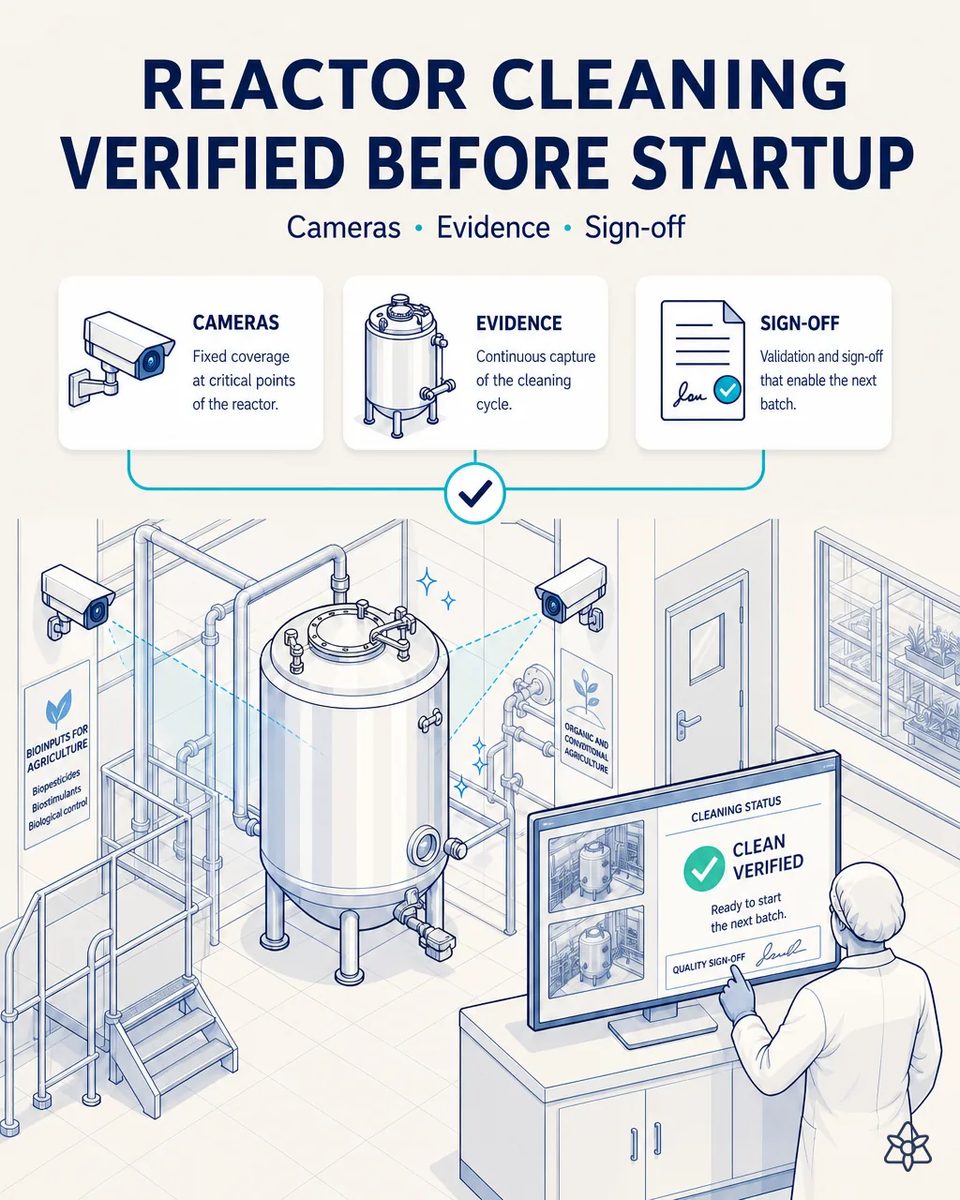
One trace of conventional ingredient can cost the organic certificate.
The same line that formulates a certified organic batch today formulates a conventional batch tomorrow. A trace of conventional ingredient left over when the next organic batch starts can break its certification. Today, cleaning relies on a human signing off 'clean' with no visual evidence to back it up. One oversight can put the whole plant's certification at risk.
- The same line that formulates a certified organic batch today formulates a conventional batch tomorrow.
- A trace of conventional ingredient left in the reactor when the next organic batch starts can break its certification, and the residue is not always where the cleaning crew looks first.
- Today cleaning relies on someone signing “clean” on a sheet, with no visual evidence behind it. Nobody can show afterwards what the vessel looked like, and the person who signed may not have looked inside at all.
- And one oversight does not cost one batch: it can put the whole plant's organic certification at risk, and with it the premium margin and export access.
Multi-point Edge with JIDOKA AI — the organic batch is blocked until every camera agrees.
iLEAN Edge places fixed cameras at the reactor's critical points, with a CNN trained to recognize 'clean reactor' versus 'conventional raw-material residue', comparing against a reference state.
The sign-off does not disappear; it gains evidence. The cameras compare each critical point with its clean reference, and the next organic batch cannot start until all of them confirm and the quality lead signs on what they actually saw. JIDOKA AI turns that rule into a hard stop, not a reminder.
Cleaning signed on paper versus cleaning verified by camera
| Aspect | Today | With iLEAN Edge |
|---|---|---|
| Evidence that the reactor is clean | A signature | Images of every critical point |
| Conventional residue at an outlet or valve | Depends on who looks | Compared against the clean reference |
| Start of the organic batch | Whenever the sheet is signed | Blocked until all cameras confirm |
| Quality lead's sign-off | On trust | On real visual evidence |
| What the organic certifier sees | A checklist | Before and after images with time |
| Changeover from conventional to organic | The riskiest moment, unrecorded | The best-documented moment |
The next batch doesn't start until every camera confirms cleanliness and the quality lead signs off on real visual evidence. This protects the organic certification that underpins the premium margin and export access.
Why we do not put a payback range on this case.
The block below is an estimate to be validated against your plant's actual data. We put it forward so the committee has an order of magnitude; we refine it during the assessment.
- No fixed payback range: we do not set one because it depends on how much of your mix runs on certified organic lines. The more organic batches share equipment with conventional ones, the faster it pays, and we estimate it with your actual production mix.
- What it protects is the organic certification itself, which underpins the premium margin and access to export markets.
- Each cleaning leaves visual evidence that the next audit can consult, instead of a signature that has to be taken on trust. That evidence feeds the organic dossier directly.
- And the risk of one oversight compromising the whole plant's certificate is closed at the point where it is born: the start of the batch, not the audit months later.
Protects organic certification · payback depends on the certified line's share of the mix.
And the fair question from the production manager
“And if the camera misses a residue the eye would see?” — comparing a critical point against its own clean reference image is an anchored task, where the best models drop below 1.5% error [1]. Even so, the camera does not replace the quality lead: it blocks the start until every point is green, and the lead still signs — now with the images in front of them, and with the record of which point was checked and when.
[1] OpenAI paper "Why Language Models Hallucinate", 2025 — on the reliability of AI in anchored tasks.
What people ask about camera-verified cleaning between organic and conventional batches
Which points of the reactor are covered?
Those where residue tends to stay: manway, agitator shaft, outlet valve, spray-ball shadows and sampling points. They are agreed with quality for each vessel, and each one has its own clean reference image.
Can it see residue the eye cannot see?
No, and we do not claim it. It sees visible residue consistently and leaves evidence; chemical residue testing, where your certifier requires it, stays in place. The cameras add the visual proof that today is missing.
Is it only applied when switching from conventional to organic?
That is where the risk is, so the block is mandatory there. Between two organic batches it can run as evidence only, without blocking, so the line is not slowed where the risk is low.
Can quality override a red point in biosolutions?
Only with a recorded reason and a signature. The override is part of the evidence, so it is visible at the next audit and nobody can skip the check silently.
Does it make the changeover longer in biosolutions?
Very little: the cameras check in seconds once cleaning ends. What it removes is the doubt, and the re-cleaning done just in case, which often takes longer than the check itself.
More cases from this series
- Zero typing error on the final labelNo manual typing: the coder receives batch, expiry and registration number straight from the active work…
- Same reactor, now it talksAn external camera reads the reaction curve of a 15-20 year old reactor without touching it, for…
- Humans in command, in two tapsNothing iLEAN captures enters a bioinput manufacturer's ERP without a human validating it first.
- The batch exists in the system from second zeroHow a bioinput manufacturer digitizes the work order with a phone photo, without changing the operator's…
- From the shared folder to the ERP, no re-typingiLEAN detects the lab's analysis spreadsheet, validates it and posts it to the ERP, cutting…
- Talk to the AI without stopping to walkAn earpiece and iLEAN voice capture the plant lead's operational knowledge while he walks, without…
Tell us how many times a month a reactor goes from conventional to organic.
We work on your plant's real data, not ours. Assessment with no commitment.
Request estimated ROI within 48h ‹ See all cases of agricultural biosolutions See chemicals