The defect gets diverted before it reaches packing
At the line's real speed, the human eye tires and lets through bottles with incorrect filling, a poorly closed cap, or a crooked or illegible label.
On a registered bioinput, a crooked label is a compliance problem.
At the line's real speed, the human eye tires and lets through bottles with incorrect filling, a poorly closed cap, or a crooked or illegible label. In a bioinput carrying a sanitary registration, an illegible label or a cap that might leak isn't a cosmetic flaw — it's a safety and regulatory compliance problem.
- At the line's real speed, the human eye tires and lets through containers with incorrect fill, a poorly closed cap, or a crooked or illegible label. Late in the shift, after thousands of identical bottles, that is not a matter of diligence.
- On a biopesticide or biostimulant carrying a sanitary registration, an illegible label or a cap that might leak is not cosmetic: it is a safety and regulatory problem.
- Today the check is a 1-2% sample. Everything between samples goes out uninspected, and the gaps are guaranteed. When the defect comes from a capper drifting slowly, the sample catches it hours late.
- A leaking jerrycan of live culture in a distributor's warehouse is a complaint, a return and a question about every other container in that batch, which then has to be checked by hand.
Edge — a container-by-container model per format, inferring in milliseconds.
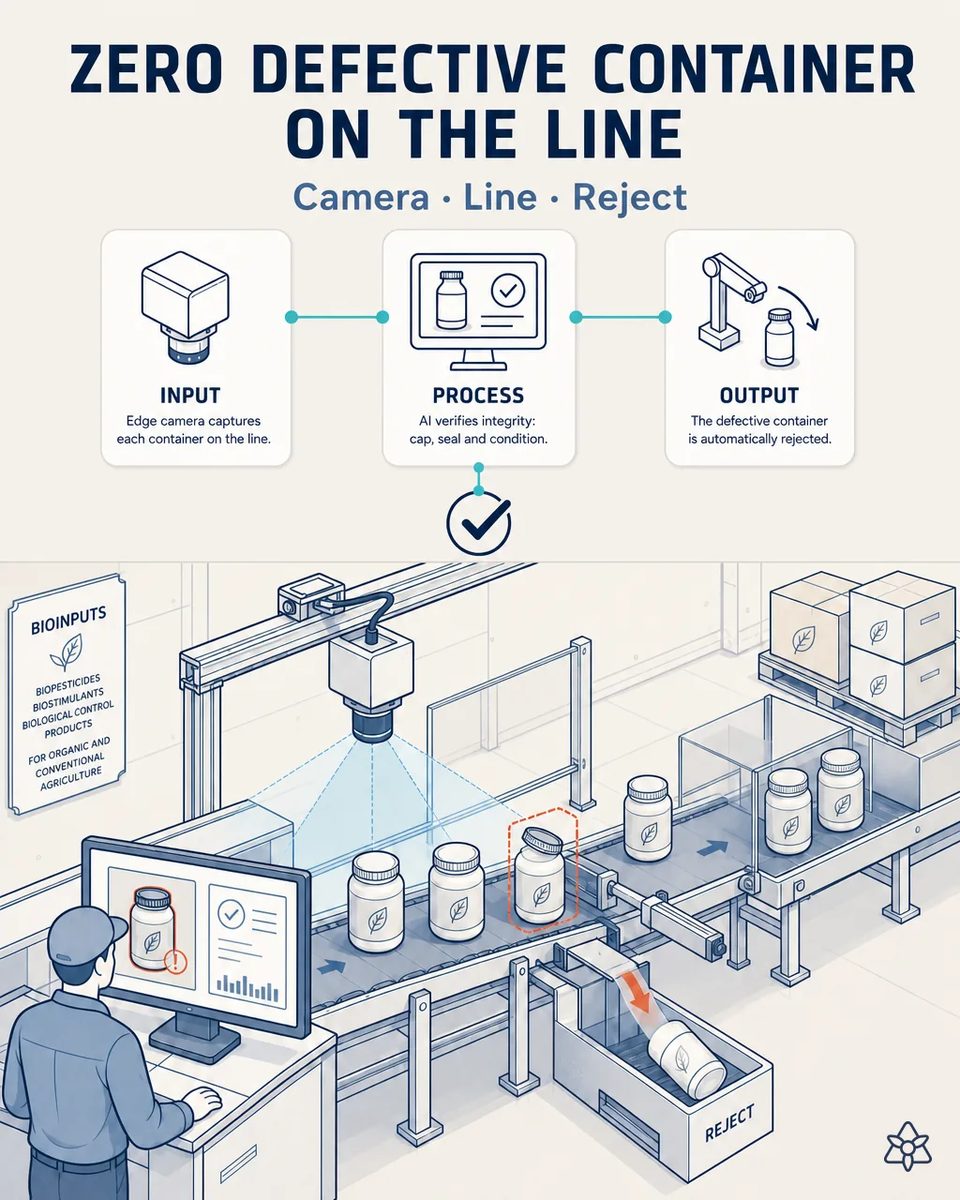
iLEAN Edge places an overhead camera over the line, with a CNN trained on good and bad containers for each concrete format: bottle, drum, jug. It infers in milliseconds per unit.
The model is trained on good and bad containers for each concrete format — bottle, drum, jerrycan — on your own line and lighting, not on a generic catalog of containers. It decides at line speed and diverts the defective unit; it does not stop the line for a borderline case, it escalates it. The operator sees the image and decides in seconds, and that decision trains the next version of the model.
Sampling at the bottling line versus Edge inspection
| Aspect | Visual sampling | With iLEAN Edge |
|---|---|---|
| Containers inspected | 1-2% | 100% |
| Cap not fully closed | Found if it happens to be sampled | Detected and diverted |
| Fill level | Checked by eye on a sample | Checked on every unit |
| Illegible registration or batch print | Reaches the distributor | Stopped before packing |
| Format change bottle to jerrycan | Same tired eye | Model switched with the format |
| Borderline container | Passes | Escalated to a person |
Before: 1 to 2% sampling, guaranteed gaps. After: 100% container inspection, diverting the defective one before final packing. Estimated payback 5 to 12 months depending on the current defect ratio.
Impact estimate on the line — to be validated with your current defect ratio.
The block below is an estimate to be validated against your plant's actual data. We put it forward so the committee has an order of magnitude; we refine it during the assessment.
- Estimated payback 5-12 months, depending on your current defect ratio.
- From spot sampling of 1-2% to 100% container inspection, with the defective unit diverted before final packing and logged against the batch it belongs to.
- Fewer complaints and returns from distributors for leaking caps or unreadable labels on registered products, which are the claims that damage the relationship most.
- And every rejected container is stored with its image, which shows whether the defect comes from the capper, the labeler or the filler, so maintenance fixes the cause instead of the symptom.
Estimated payback 5-12 months · from spot sampling to 100% container inspection.
And the fair question from the production manager
“Won't it reject good bottles and slow the line?” — the false reject is the real risk, which is why the model is trained on your formats and your line's lighting, not on a generic catalog. Classifying a cap, a fill level or a label against a known reference is an anchored task where the best models drop below 1.5% error [1], and borderline units are escalated to a person instead of being thrown away. Every decision the operator takes on those units is fed back into training.
[1] OpenAI paper "Why Language Models Hallucinate", 2025 — on the reliability of AI in anchored tasks.
What people ask about container vision on the bottling line
Can it see a cap that looks closed but is not torqued?
It sees what is visible: height, angle and seating of the cap relative to the neck. A cap that sits high or crooked is caught; torque itself is still checked by the capper. Between the two, the leaking jerrycan stops reaching the distributor.
Does it read the label or just check its position?
Both: position and skew, and whether the batch, expiry and registration print is legible. Reading the content lets it detect a smudged or partial code, which is what makes a registered product unsellable.
How many containers are needed to train a format?
Fewer than expected, because the defect catalog per format is short. What matters is that the images come from your line and your containers, with the defects you actually see.
Does it depend on the plant network?
No. Inference runs locally at the line in milliseconds per unit; the network is only used to store images and statistics for later analysis.
What about a translucent bottle with a dark biostimulant inside?
Fill level is measured with lighting chosen for that container and liquid. Formats with very different optics get their own model, selected automatically with the active work order.
More cases from this series
- Zero typing error on the final labelNo manual typing: the coder receives batch, expiry and registration number straight from the active work…
- Same reactor, now it talksAn external camera reads the reaction curve of a 15-20 year old reactor without touching it, for…
- Humans in command, in two tapsNothing iLEAN captures enters a bioinput manufacturer's ERP without a human validating it first.
- The batch exists in the system from second zeroHow a bioinput manufacturer digitizes the work order with a phone photo, without changing the operator's…
- From the shared folder to the ERP, no re-typingiLEAN detects the lab's analysis spreadsheet, validates it and posts it to the ERP, cutting…
- Talk to the AI without stopping to walkAn earpiece and iLEAN voice capture the plant lead's operational knowledge while he walks, without…
Tell us what share of your containers is actually inspected today.
We work on your plant's real data, not ours. Assessment with no commitment.
Request estimated ROI within 48h ‹ See all cases of agricultural biosolutions See chemicals