The alert that used to arrive late, now arrives on time
A supplier of a microbial strain or a plant extract flags a delay or a change in the received batch's concentration. Or a regional distributor flags a field incident over WhatsApp.
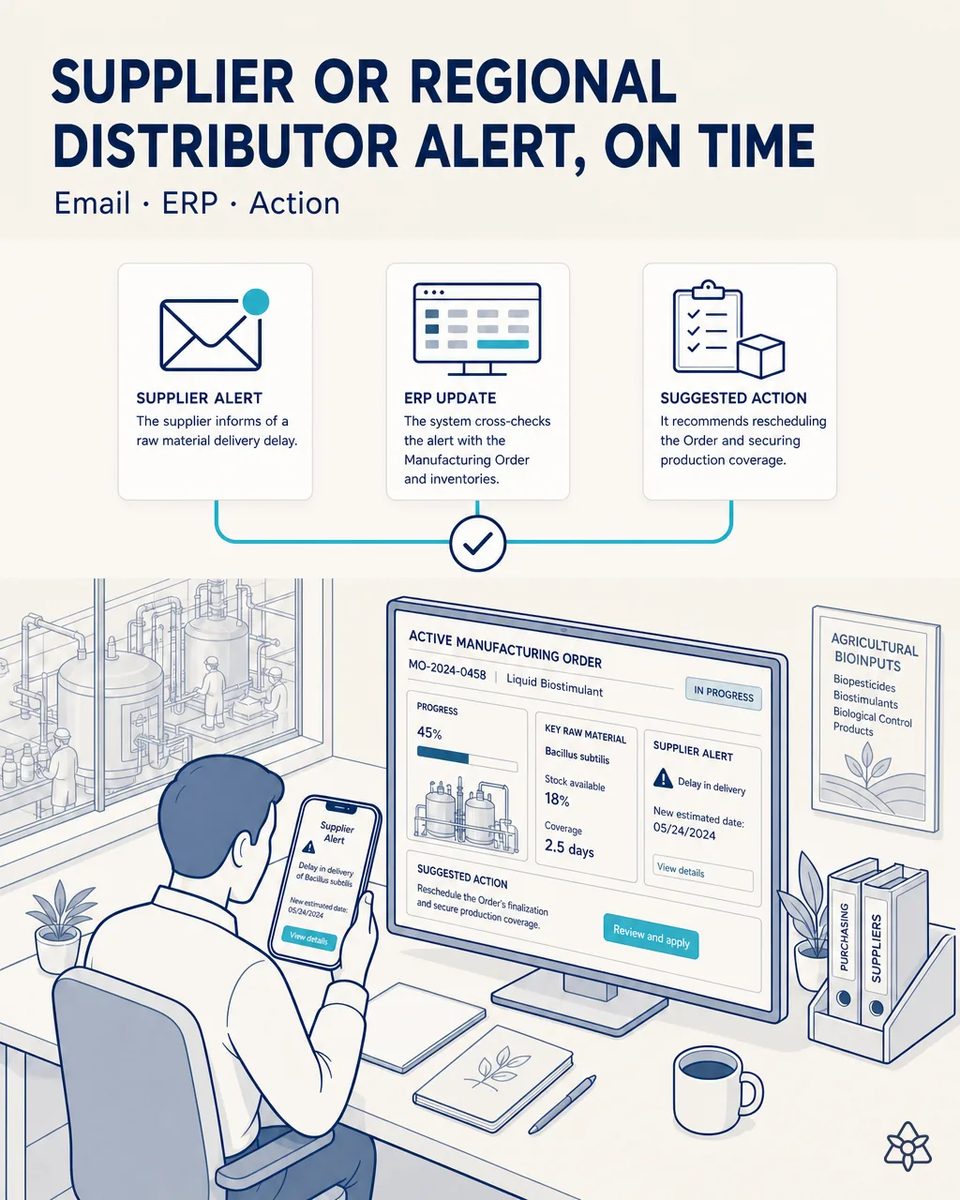
The warning that changes the week arrives in somebody's personal inbox.
A supplier of a microbial strain or a plant extract flags a delay or a change in the received batch's concentration. Or a regional distributor flags a field incident over WhatsApp. That alert lands in a personal inbox read hours later, when there's already a work order planned with that raw material or a batch already shipped to the field.
- A supplier of a microbial strain or a plant extract warns of a delay, or of a change in the concentration of the lot already received. That changes the dose of the next formulation.
- Or a regional distributor reports a field incident over WhatsApp: a grower complaining that a biopesticide did not perform, a jerrycan that arrived swollen. Those reports are the earliest signal of a batch problem, and today they depend on someone forwarding a chat.
- Those messages land in a personal inbox or phone and are read two to three hours later, when a work order using that raw material is already planned or a batch has already shipped.
- With live cultures and short-shelf-life extracts, a late reaction is not just a sequence change: it can mean dosing a lot whose viability has already dropped.
Connect in chaotic-sources mode — silent copy on the supplier channels, around the clock.
iLEAN Connect sits in silent copy on the supplier email or WhatsApp. In zero seconds it extracts the intent, cross-checks active work orders in the ERP, and suggests the concrete action to the right role.
Reading the message sooner is not enough. What counts is knowing which work orders use that strain lot, how many days of coverage are left and who has to move. That is what comes back, already crossed with the ERP, to the person who can act. With live cultures, those hours are the difference between adjusting a dose and losing a batch.
The strain warning in an inbox versus the warning acted on
| Aspect | Today, in the inbox | With iLEAN Connect |
|---|---|---|
| Time until someone decides | 2-3 hours | Seconds |
| Concentration change in a received lot | Discovered at dosing | Flagged against the work orders using it |
| Days of strain coverage | Calculated by hand, if at all | Shown with the alert |
| Field incident from a distributor | Stays on a phone | Tied to the shipped batch |
| Who receives it | Whoever the sender knew | Planning, quality or purchasing, by topic |
| Who reschedules | The planner — iLEAN proposes | The planner — iLEAN proposes, with data |
Before: 2 to 3 hours until someone decides what to do. After: rescheduling in seconds, based on real-time data. Estimated payback 3 to 6 months depending on how often critical alerts arrive.
Impact estimate — to be validated with your record of supplier incidents.
The block below is an estimate to be validated against your plant's actual data. We put it forward so the committee has an order of magnitude; we refine it during the assessment.
- Estimated payback 3-6 months, depending on how often critical alerts arrive.
- From two to three hours of waiting to minutes to reschedule a batch, based on real-time data instead of memory.
- Fewer formulations dosed with a strain or extract lot whose concentration had already changed, which is where a batch becomes nonconforming without anyone noticing.
- Field incidents reported by distributors linked to the right batch from the first message, instead of being reconstructed weeks later from screenshots and memory.
Estimated payback 3-6 months · from hours of waiting to minutes to reschedule a batch.
And the fair question from the production manager
“Will it read the purchasing team's mail?” — no. iLEAN sits in copy on a dedicated supplier mailbox and a company messaging number, and only sees what reaches those operational channels. Classifying whether a message is a delay, a concentration change or a field incident is an anchored task where the best models drop below 1.5% error [1] — and the rescheduling is decided by a person.
[1] OpenAI paper "Why Language Models Hallucinate", 2025 — on the reliability of AI in anchored tasks.
What people ask about strain and extract supplier alerts
Does it tell a concentration change from a simple delivery confirmation?
Yes, and that is the distinction that matters: a confirmation is filed without interrupting anyone, while a CFU or concentration change on a received lot is escalated to quality before the next dosing.
How does it know which work orders are affected?
By crossing the strain or extract lot named in the message with the active work orders and stock in the ERP. The result is a list of batches with their planned dates, not a generic warning that someone then has to interpret.
Can it handle a distributor's voice note about a field complaint?
Yes. Voice notes are transcribed and treated like any other message: intent, product, batch if mentioned, and the role that should take it. The original audio is kept attached to the record.
Does it place purchase orders or move batches on its own?
No. It suggests the action with the data attached; the planner or the purchasing lead decides and executes it. What changes is that they decide in minutes, with coverage and affected batches already on screen.
Do suppliers have to change how they write to us in biosolutions?
No. They keep their email or messaging habits. The point of the case is precisely to read what arrives unformatted, in whatever language or tone each supplier uses.
More cases from this series
- Zero typing error on the final labelNo manual typing: the coder receives batch, expiry and registration number straight from the active work…
- Same reactor, now it talksAn external camera reads the reaction curve of a 15-20 year old reactor without touching it, for…
- Humans in command, in two tapsNothing iLEAN captures enters a bioinput manufacturer's ERP without a human validating it first.
- The batch exists in the system from second zeroHow a bioinput manufacturer digitizes the work order with a phone photo, without changing the operator's…
- From the shared folder to the ERP, no re-typingiLEAN detects the lab's analysis spreadsheet, validates it and posts it to the ERP, cutting…
- Talk to the AI without stopping to walkAn earpiece and iLEAN voice capture the plant lead's operational knowledge while he walks, without…
Tell us how long your last strain delay took to reach planning.
We work on your plant's real data, not ours. Assessment with no commitment.
Request estimated ROI within 48h ‹ See all cases of agricultural biosolutions See chemicals