Paperless Build Sheet at Unit Start
In a mixed-model assembly plant, every body shell starts its journey with a paper build sheet defining exactly which variant is being built. Any last-minute handwritten note is lost if nobody transcribes it before the unit moves on. With iLEAN Connect, the line-start operator photographs the build sheet and the unit's full sequence already exists in the central system at zero second, without changing the operator's routine at all.
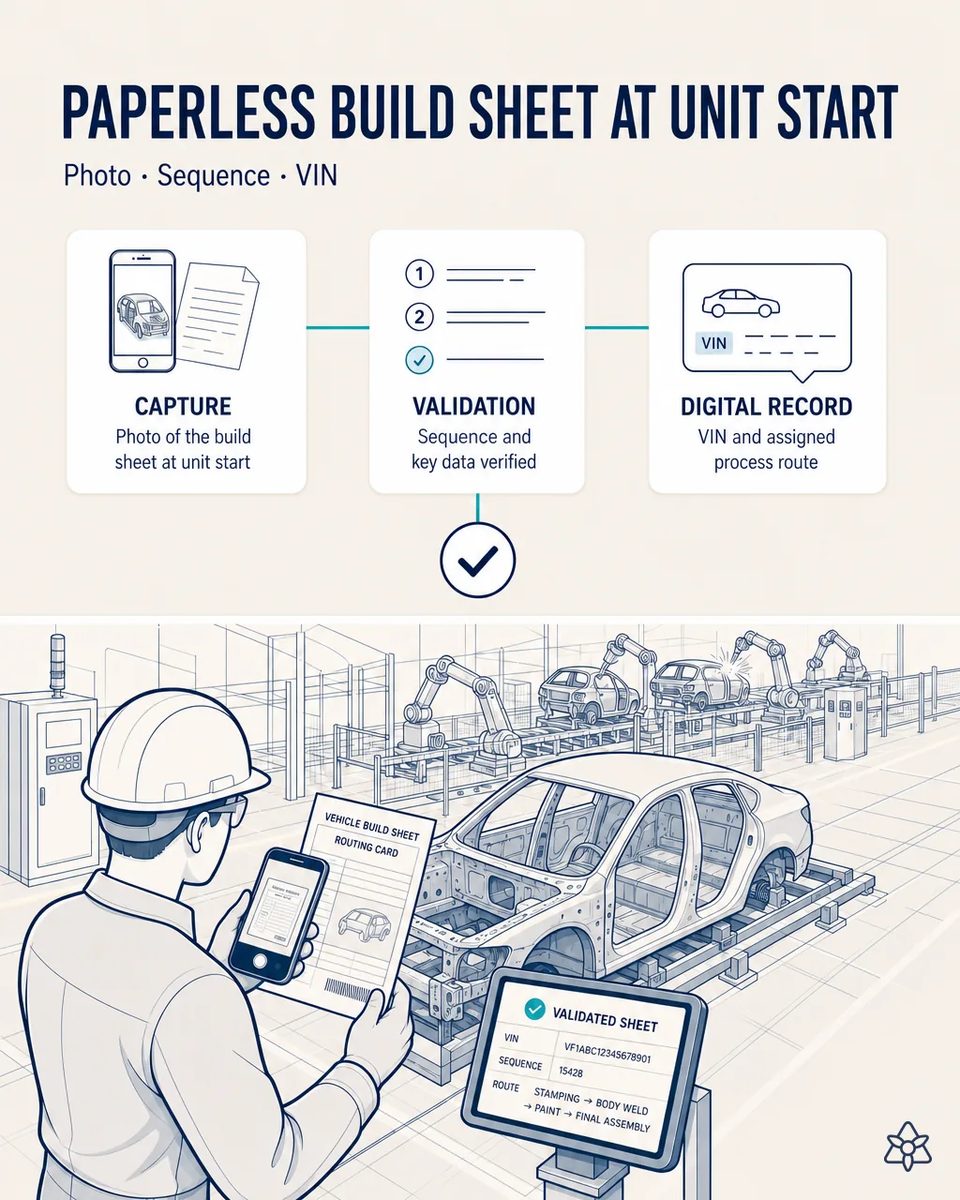
The build sheet knows what the unit is, but only on paper.
The paper build sheet is the physical source of truth for every unit, but any last-minute note (option change, prior issue, delivery priority) only lives on paper until someone transcribes it, sometimes several stations later. That lag causes rework on mis-built options and forces a manual reconstruction of what happened to a specific unit whenever an issue surfaces.
- In a mixed-model plant every body shell starts with a printed build sheet: model, body color, trim level, destination market and option content. It is the physical reference every station builds from.
- Last-minute changes are written on it by hand — an option swapped, a prior issue on that unit, a delivery priority. That note exists on one sheet of paper riding on one skid.
- Someone transcribes it several stations later, if at all. Meanwhile the downstream stations build from the MES content, which does not know about the change yet.
- When a unit comes off the line with the wrong option, rebuilding what happened to that VIN means walking the line, asking people and hunting for the sheet.
Connect in photo mode — the build sheet keeps riding with the body.
Connect photo mode: the operator photographs the build sheet with a phone or tablet; a grounded LLM extracts model, color, trim, market and notes, tying them to the unit number in central memory. Early human verification confirms the read before it crosses into the MES.
Nothing changes at line start: the sheet is still printed and still travels with the unit. One photo is added, and from that second the handwritten note stops being a secret between one piece of paper and whoever happens to read it. It is the case with the least friction on the floor in this matrix, which is why it usually opens the door.
The build sheet on paper versus the build sheet captured at line start
| Aspect | Today, on paper | With iLEAN Connect |
|---|---|---|
| Last-minute option change | Visible only to whoever reads that sheet | Pushed to every downstream station |
| When the VIN's content is complete | Stations later, after transcription | Second zero, at line start |
| Mis-built option rework | Found at end-of-line inspection | Avoided before the station builds it |
| Reconstructing a unit's history | Walk the line and hunt for the sheet | One query by VIN |
| Delivery priority noted by hand | Lost if nobody types it | Structured and tied to the unit |
| Line-start operator's routine | — | Unchanged: one photo per body |
A last-minute note that depends on someone physically seeing it → available to every downstream station from zero second.
Impact estimate — to be validated with your numbers.
The block below is an estimate to be validated against your plant's actual data. We put it forward so the committee has an order of magnitude; we refine it during the assessment.
- Estimated payback 4-9 months, depending on the number of units started per day.
- The return comes from mis-built options that stop needing rework, and from transcription time recovered at line start and in the office.
- From hours of lag between the handwritten note and the MES to a record that exists at second zero.
- And when an issue surfaces on a specific VIN, its history is queried in seconds instead of rebuilt from memory and paper.
Estimated payback 4-9 months depending on daily unit volume. *Figure to be validated*. (Payback 4-9 months · from hours of lag to zero-second record)
And the fair question from the production manager
“What if it misreads a trim code or the handwritten market on the sheet?” — reading fields from a build sheet whose layout never changes is an anchored task, where the best models drop below 1.5% error [1]. And there is a second net before the MES: the line-start operator sees the read on the station tablet and confirms it, and any option code that does not exist for that model is flagged instead of accepted.
[1] OpenAI paper "Why Language Models Hallucinate", 2025 — on the reliability of AI in anchored tasks.
What people ask about capturing the build sheet at unit start
Do we have to redesign the vehicle build sheet?
No. The sheet keeps the layout your MES prints today. The model learns where model, color, trim and market sit, and treats the handwritten margin as one more field.
Which fields are read from each build sheet?
Model, body color, trim level, destination market, option codes and the handwritten notes, all tied to the unit number and the VIN. The notes carry the most value, because that is where the change nobody has typed yet is written.
Does a phone photo keep pace with line takt?
Yes. The photo takes a couple of seconds and is taken while the body is already waiting on its skid, so it does not add to takt. A fixed tablet at the first station works just as well if the operator prefers not to carry a phone.
What happens when the option change arrives after the unit has moved on?
The change is still written on the sheet that travels with the body; whoever adds it takes a new photo and every downstream station receives the update. The record keeps both versions and who made the change.
Do we need to touch the MES to start?
No. The case runs against iLEAN's central memory from the first unit, and the push to the MES is connected once the value has been proven on the line.
More cases from this series
- The Color Change Won't Start Without ProofA paint color change requires a certified nozzle purge; leftover pigment contaminates the first units of…
- The Line Leader Dictates Hands-FreeThe line leader walks the entire shift between stations with hands full. Key observations that die at…
- The IATF Dossier That Builds ItselfOn IATF 16949 audit day, or during a corporate process audit, someone today spends weeks reconstructing…
- The JIT Delivery Note Enters ERP AloneA JIT supplier's truck arrives at the dock on a minute-tight delivery window. With iLEAN Connect, the…
- The Vintage Press Panel That Starts TalkingMany stamping shops live with at least one older-generation press, critical for a specific body part,…
- The Paint Defect That Never Reaches the OvenAt paint-line cadence, the human eye tires and misses subtle finish defects. iLEAN Edge places a camera…
Tell us how many stations a handwritten change travels before your MES knows about it.
We work on your plant's real data, not ours. Assessment with no commitment.
Request estimated ROI within 48h ‹ See all cases of vehicle assembly See automotive