Harness Delay Alert Before the Line Stops
Mid-morning, a Tier 1 supplier emails a delay warning for the truck carrying wire harnesses specific to a variant entering sequence that afternoon. With iLEAN Connect, the system reads the email at zero second, cross-checks the active MES sequence, and alerts planning with the concrete action before the line has to stop.
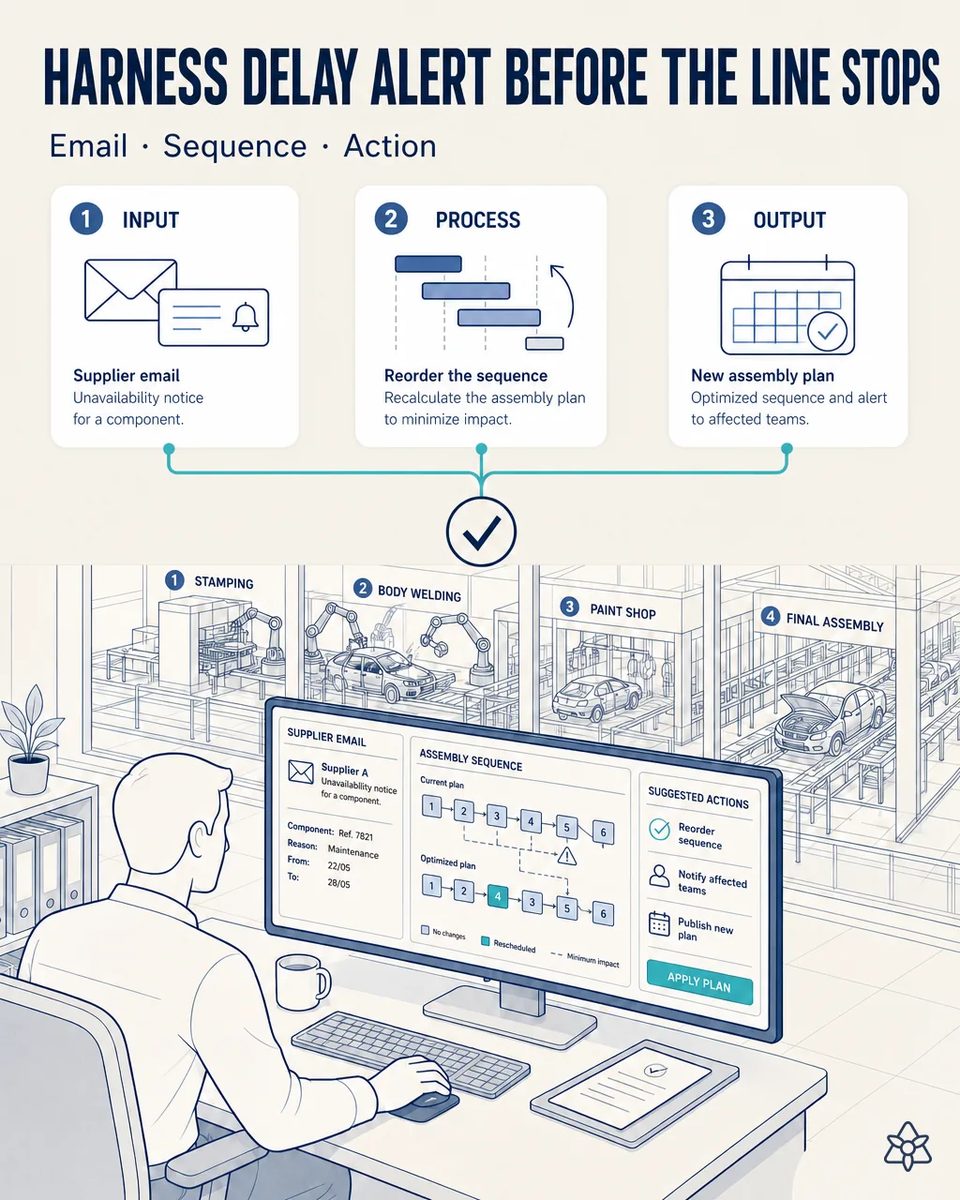
The warning arrives in time. It is read too late.
Critical alerts from JIT/JIS suppliers arrive by email or WhatsApp to specific people who can't watch the inbox in real time while running the live line. By the time they're read, sequencing decisions have already been made and break, causing line stoppages or out-of-sequence assembly.
- A wire harness is variant-specific: it goes into one exact VIN in the JIS sequence. When the truck carrying it is late, the variants that need it cannot be built.
- The supplier warns by email or WhatsApp, mid-morning, to the material planner or the logistics coordinator — who is on the floor running the live line, not reading the inbox.
- By the time someone reads it, the afternoon sequence is frozen, the bodies are already in paint and the only options left are a line stoppage or an out-of-sequence build.
- Each out-of-sequence unit then needs its own handling downstream, and the original warning sits in a personal inbox nobody else can see.
Connect in chaotic-sources mode — a mailbox that reads itself.
Connect chaotic-sources mode: a dedicated mailbox is copied 24/7; the LLM extracts intent (delay), entities (supplier, part reference, time) and cross-checks the active MES sequence, returning the concrete resequencing action to the right role.
The channel is not redesigned and the supplier is not asked to change anything: a dedicated mailbox is copied, and Connect reads it around the clock. What arrives as an unformatted sentence leaves as a supplier, a part number, a delay and the VINs it affects, delivered to the role that can still do something about it.
A harness delay read by a person versus a harness delay read by Connect
| Aspect | Today | With iLEAN Connect |
|---|---|---|
| Time to read the supplier warning | 1-3 hours, when someone checks | Seconds, 24/7 |
| Variants affected | Worked out by hand against the sequence | Crossed with the active MES sequence |
| Who receives it | Whoever the supplier happened to email | The role that owns resequencing |
| Decision still available | Stop the line or build out of sequence | Resequence while there is room |
| Warnings sent by WhatsApp | Lost in a personal phone | Read like any other source |
| Trace of the decision | A memory and a forwarded email | Recorded with the alert that caused it |
1-3 hours of human latency until someone reads the alert → seconds, with resequencing based on real-time data.
Impact estimate — to be validated with your numbers.
The block below is an estimate to be validated against your plant's actual data. We put it forward so the committee has an order of magnitude; we refine it during the assessment.
- Estimated payback 3-7 months, depending on how often critical supplier alerts arrive.
- From 1-3 hours of human latency to seconds between the supplier's warning and planning's decision.
- Fewer out-of-sequence builds, each of which drags extra handling and a broken JIS sequence downstream.
- And every resequencing decision keeps the alert that triggered it, which is exactly what the materials team asks for when the same supplier fails again.
Estimated payback 3-7 months depending on critical-alert frequency. *Figure to be validated*. (Payback 3-7 months · from hours of latency to seconds)
And the fair question from the production manager
“What if it misunderstands a supplier's email and resequences for nothing?” — extracting supplier, part number and time from a delay warning, against your supplier master and the live sequence, is an anchored task where the best models drop below 1.5% error [1]. And Connect does not resequence on its own: it proposes the action, and the planner confirms it before anything changes in the MES.
[1] OpenAI paper "Why Language Models Hallucinate", 2025 — on the reliability of AI in anchored tasks.
What people ask about supplier delay alerts on the assembly line
Do our harness suppliers have to change how they warn us?
No. They keep writing the way they do today, in their own words and from their own address. The only change on your side is copying a dedicated mailbox.
Does it understand messages in several languages or with informal wording?
Yes. The model extracts intent, supplier, part reference and time from natural language, and anything with low confidence goes to a person instead of being guessed. Voice notes and photos of a printed notice are read the same way.
How does it know which VINs are affected?
It crosses the part reference with the bill of materials of the units in the active MES sequence, so it returns the specific variants that need that harness and when they reach the station. Units that do not need it are listed too, because those are the ones planning can pull forward.
Who on the shift receives the harness delay alert?
The role you define for each type of warning: material planning, logistics or the shift manager. The goal is that the person who can resequence sees it, not whoever happened to be copied. If nobody acknowledges it within the time you set, it escalates to the next role on the shift.
Does it cover other JIT parts besides harnesses?
Yes. Harnesses are the usual starting point because they are variant-specific, but the same mailbox reads warnings about cockpits, wheels or any part delivered in sequence.
More cases from this series
- The Color Change Won't Start Without ProofA paint color change requires a certified nozzle purge; leftover pigment contaminates the first units of…
- The Line Leader Dictates Hands-FreeThe line leader walks the entire shift between stations with hands full. Key observations that die at…
- The IATF Dossier That Builds ItselfOn IATF 16949 audit day, or during a corporate process audit, someone today spends weeks reconstructing…
- The JIT Delivery Note Enters ERP AloneA JIT supplier's truck arrives at the dock on a minute-tight delivery window. With iLEAN Connect, the…
- The Vintage Press Panel That Starts TalkingMany stamping shops live with at least one older-generation press, critical for a specific body part,…
- The Paint Defect That Never Reaches the OvenAt paint-line cadence, the human eye tires and misses subtle finish defects. iLEAN Edge places a camera…
Tell us how long a supplier delay warning waits in an inbox before someone acts on it.
We work on your plant's real data, not ours. Assessment with no commitment.
Request estimated ROI within 48h ‹ See all cases of vehicle assembly See automotive