Two Taps Before It Hits the MES
Nothing iLEAN captures enters the central system without a human seeing it first. On an assembly plant that means an industrial tablet at the station: the operator confirms any capture with 2 taps before it crosses into the MES/ERP.
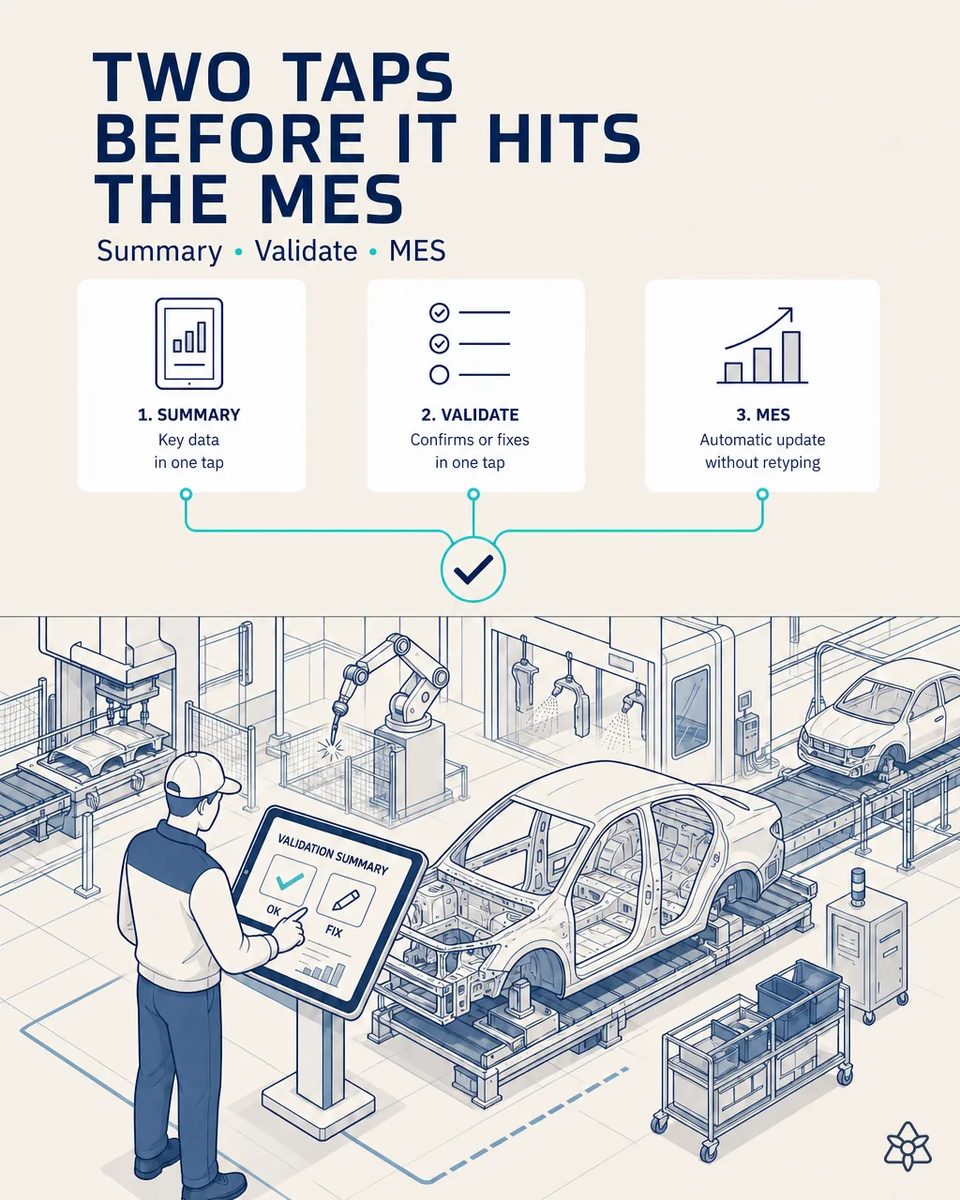
Nobody signs off AI that writes into the MES on its own.
The fear that AI might 'enter data on its own and then someone has to clean up the MES/ERP master' is the main cultural blocker to digitization in a regulated environment like automotive. At the same time, the operator doesn't want to type either: they need a validation step that doesn't steal cycle time.
- In a regulated environment the first objection to any capture is always the same: if the AI enters a wrong VIN or option, who cleans up the MES master afterwards?
- That fear is reasonable, and it is the main cultural reason digitization projects stall in automotive before they ever reach the line.
- At the same time, the station operator does not want to type either. Every second spent at a keyboard is taken from a cycle measured in takt.
- So data ends up either unvalidated in the MES or not captured at all, and both outcomes show up at the next IATF 16949 process audit.
Connect with early human verification — the operator has the last word.
Connect early human verification mode: every capture (photo, voice, parsed email) reaches a station-side tablet as a 2-second visual summary; the operator confirms with 2 taps before the data crosses into the MES/ERP.
This is the piece that makes the other eleven approvable. The AI captures and proposes; a person at the station confirms in two taps, and only then does anything enter the MES or the ERP. The human stays in command, and the master stays clean. It is also what makes the conversation with the floor and with quality a short one.
Captures straight into the MES versus captures confirmed at the station
| Aspect | Today | With iLEAN Connect |
|---|---|---|
| Who confirms a capture | Nobody, or someone days later | The station operator, in seconds |
| Time taken from the cycle | Typing, or nothing captured | Two taps on a two-second summary |
| State of the MES master | Cleaned up after the fact | Clean on entry |
| Captures nobody trusts | Never made | Made and confirmed |
| Evidence for the process audit | Who typed what, unclear | Who confirmed what, and when |
| Quality's position on AI captures | Blocked | Signed off with a human gate |
Unvalidated data contaminating the MES/ERP, or data not captured out of distrust → captured and validated data with seconds of latency, clean master.
Impact estimate — the gate every other case passes through, with no payback of its own.
The block below is an estimate to be validated against your plant's actual data. We put it forward so the committee has an order of magnitude; we refine it during the assessment.
- No standalone payback: it is the enabling piece of the whole matrix, and we do not put a number on it in isolation.
- Without a human in command, quality does not sign off the other cases, so its value is the value of every case it unblocks.
- Data that used to arrive unvalidated, or not at all, now enters the MES confirmed and with only seconds of latency.
- And the MES and ERP masters stop needing clean-up campaigns before every audit, because nothing enters them without a name and a time.
Strategic value enabling the whole iLEAN matrix; not monetizable on its own. (Enabling value · without the human in command, the rest doesn't get signed off)
And the fair question from the production manager
“Two taps per capture — won't operators just tap OK without looking?” — the summary highlights only the fields that matter, and reading those fields is an anchored task where the best models drop below 1.5% error [1], so most confirmations are genuinely quick. Where confidence is low the field is highlighted and cannot be confirmed blindly, and every tap is logged with the operator and the time.
[1] OpenAI paper "Why Language Models Hallucinate", 2025 — on the reliability of AI in anchored tasks.
What people ask about tablet verification at the assembly station
How much cycle time does the confirmation take?
About two seconds to read the summary and two taps to confirm or correct it. It is designed to fit inside the station's takt, not next to it, and it happens at the moment of capture rather than in a queue at the end of the shift.
What does the station operator see on the two-second summary?
A short summary of what was captured — the VIN, the field read and its value — with any low-confidence field highlighted. Nothing else competes for attention.
What happens if the operator corrects a value?
The corrected value is what enters the MES, and the correction is kept as training material so the same misread becomes less likely. Over the first weeks, corrections become rarer and the two taps get faster.
Does every capture in the plant go through a station tablet?
Every capture that will write into the MES or the ERP, yes. That is the rule that lets quality approve the rest of the cases. Captures that only feed iLEAN's central memory can be reviewed later in bulk if you prefer.
Does it help with the IATF 16949 process audit?
Yes, because every entry carries who confirmed it and when. The auditor's question of who put this data in the system finally has an answer, with the original photo or dictation attached to the record.
More cases from this series
- The Color Change Won't Start Without ProofA paint color change requires a certified nozzle purge; leftover pigment contaminates the first units of…
- The Line Leader Dictates Hands-FreeThe line leader walks the entire shift between stations with hands full. Key observations that die at…
- The IATF Dossier That Builds ItselfOn IATF 16949 audit day, or during a corporate process audit, someone today spends weeks reconstructing…
- The JIT Delivery Note Enters ERP AloneA JIT supplier's truck arrives at the dock on a minute-tight delivery window. With iLEAN Connect, the…
- The Vintage Press Panel That Starts TalkingMany stamping shops live with at least one older-generation press, critical for a specific body part,…
- The Paint Defect That Never Reaches the OvenAt paint-line cadence, the human eye tires and misses subtle finish defects. iLEAN Edge places a camera…
Tell us what quality would need to see before letting AI captures reach your MES.
We work on your plant's real data, not ours. Assessment with no commitment.
Request estimated ROI within 48h ‹ See all cases of vehicle assembly See automotive