The AI doesn't touch your ERP without your sign-off
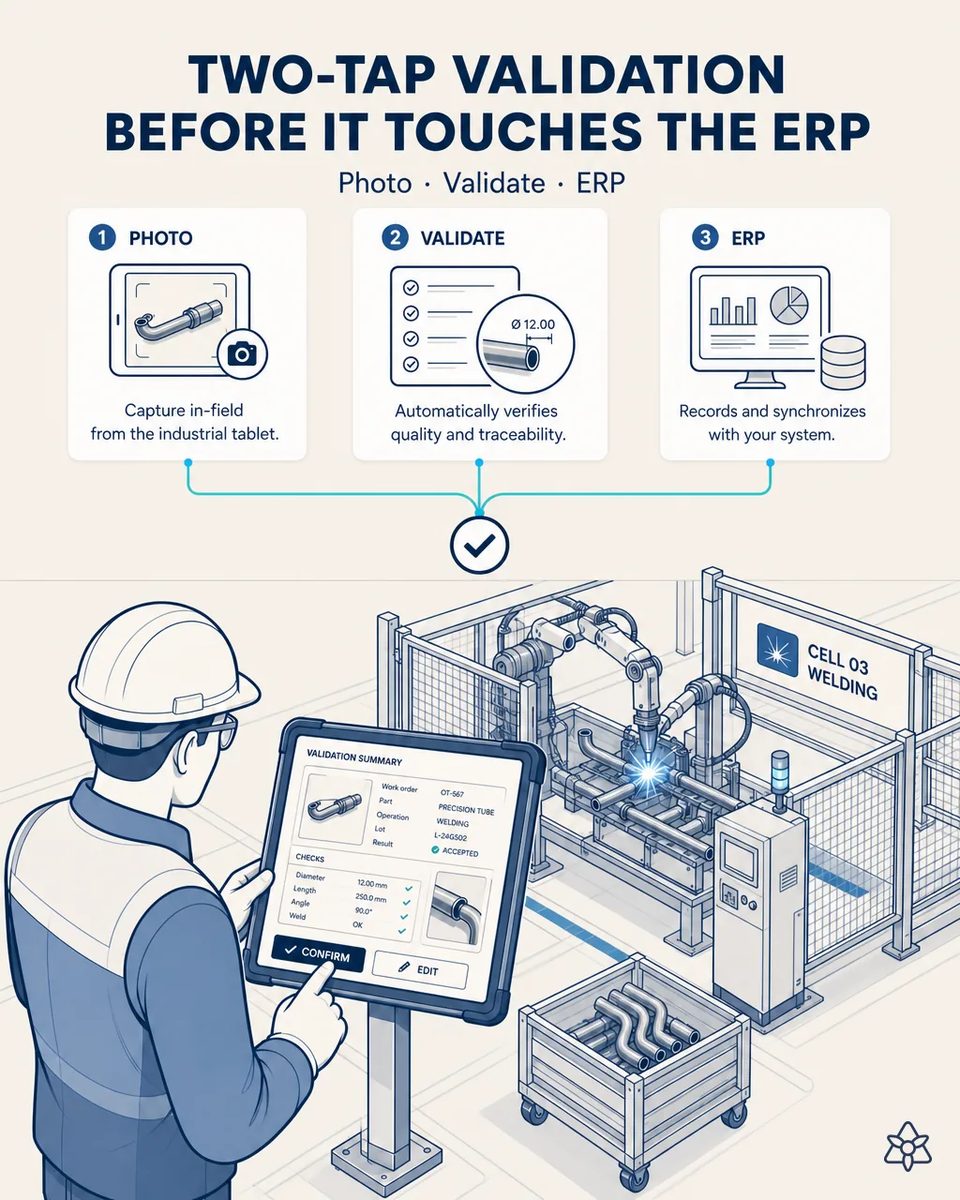
What sets iLEAN apart from an "autonomous" AI agent that enters data without a signature is this: nothing iLEAN captures enters the central system before a human has seen it. On a precision tubing floor, that means an industrial tablet at every weld cell, where the welder or inspector confirms with two taps.
At an IATF 16949 plant, a data point nobody signed is a finding waiting to happen.
the fear that AI will "contaminate the ERP master" is the most common cultural pushback to digitalization at an IATF 16949-certified plant. But operators don't want to type either.
- The most common pushback to digitalization in a certified tube plant is cultural, not technical: the fear that AI will contaminate the ERP master with a wrong heat number or weld result.
- At the same time, the welder and the inspector do not want to type: their job is the seam and the tube, not a terminal. So data is either entered unvalidated, or not captured at all out of distrust.
- Both outcomes break the same thing: an auditor or an OEM asking who confirmed a weld result and on what evidence.
- Without an answer to that fear, none of the other eleven cases gets signed off by quality, however good its business case looks on paper.
Connect with early human verification — the AI proposes, the weld cell signs.
Connect's early human-verification mode. Every capture reaches the tablet as a visual summary before crossing into the master. UI designed for 2-second validation, not data entry.
It is the piece that decides whether the rest gets approved. Every capture reaches the tablet as a two-second visual summary, and nothing crosses into the master without a name attached to it. And every correction the welder makes is stored, so the system learns where its extraction fails.
Unvalidated capture versus capture signed at the weld cell
| Aspect | Today | With iLEAN |
|---|---|---|
| Entry into the ERP master | Typed later, or pushed unchecked | Only after a human confirmation |
| Welder's or inspector's effort | Data entry at a terminal | Two taps at the cell |
| A wrong heat number in a capture | Travels into the master | Corrected before it crosses |
| Answering an IATF auditor | Whoever typed it | Who confirmed, when, and what they saw |
| Quality's stance on AI | Blocks the project | Signs off, with the gate in place |
| Every correction made | Lost | Stored and fed back to the model |
unvalidated data contaminating the ERP, or data not captured out of distrust → captured and validated data with seconds of latency, a clean, traceable master.
Estimated impact — to validate with your own numbers.
The block below is an estimate to be validated against your plant's actual data. We put it forward so the committee has an order of magnitude; we refine it during the assessment.
- No standalone payback: this is an enabling piece for the whole matrix, with strategic value rather than a directly monetizable saving.
- Without early human verification, none of the other pieces gets signed off at an audited plant.
- The ERP master stays clean and traceable, with data captured and validated within seconds. The alternative is a master that is either late or contaminated.
- And the question an auditor always asks — who confirmed this — gets a name, a timestamp and the exact summary that person saw when they confirmed.
the enabling piece for the whole iLEAN matrix — without early human verification, none of the other pieces get signed off at an audited plant. *Strategic value, not directly monetizable*.
And the fair question from the production manager
“Two taps at every capture, every shift — won't the welders just tap through?” — the summary is built to be read in two seconds, and what it asks is narrow: extracting a program, a heat number or a weld result is an anchored task, where the best models drop below 1.5% error [1], so most taps are confirmations. Fields the model is unsure of are highlighted, not hidden, so attention goes where it is needed. And every correction is stored with its author, which is how the system learns where its extraction fails.
[1] OpenAI paper "Why Language Models Hallucinate", 2025 — on the reliability of AI in anchored tasks.
What people ask about validating at the weld cell
What exactly does the welder see on the tablet?
A visual summary of the capture — program, lot, weld parameters or measurements — with any low-confidence field highlighted. Confirm or edit, nothing else. There are no forms to fill and no menus to navigate.
Where does the tablet go on a guarded weld cell?
At the cell's operator station, outside the guarding, where the welder or inspector already stands. It is an industrial tablet rated for the floor. It is built to be used with gloves, dust and weld flash around it.
Who is allowed to confirm a weld result?
Whoever your control plan names for that operation. Roles are set per station, so an operator cannot confirm something reserved for a quality inspector. Every confirmation carries the name of the person who made it.
What happens to a capture nobody confirms?
It waits in the queue and never reaches the ERP. After a set time it is escalated to the shift lead, so nothing gets stuck silently. The queue is visible to quality at all times.
Is it only for weld data?
No. It is the single gate for every capture — travel cards, steel receiving, metrology, dictated issues — which is why it goes in first or alongside the first case. Every other piece of the matrix passes through it.
More cases from this series
- The travel card no longer gets lost on paperiLEAN Connect photographs the travel card at batch startup and makes the tube lot traceable in the…
- Talk to the AI without stopping your walkWith a headset, the line lead dictates issues hands-free; iLEAN structures and saves them within seconds.
- Zero hand-typed weld parametersiLEAN stitches the laser weld cell to the ERP: the correct parameter arrives on its own, with no manual…
- Two worlds that finally talk: spreadsheet and ERPiLEAN absorbs the dimensional-measurement spreadsheet in real time and uploads it to the ERP after…
- The truck no longer waits on your receiving dockOne photo of the delivery note and heat-lot labels is enough for iLEAN to push the data to the ERP after…
- No critical alert gets read too late againiLEAN catches steel delays and OEM specification changes at zero latency and suggests the specific…
Tell us what your quality manager would need to see before letting AI near the ERP.
We work on your plant's real data, not ours. Assessment with no commitment.
Request estimated ROI within 48h ‹ See all cases of precision automotive tubing See automotive