First part validated by vision after every die change
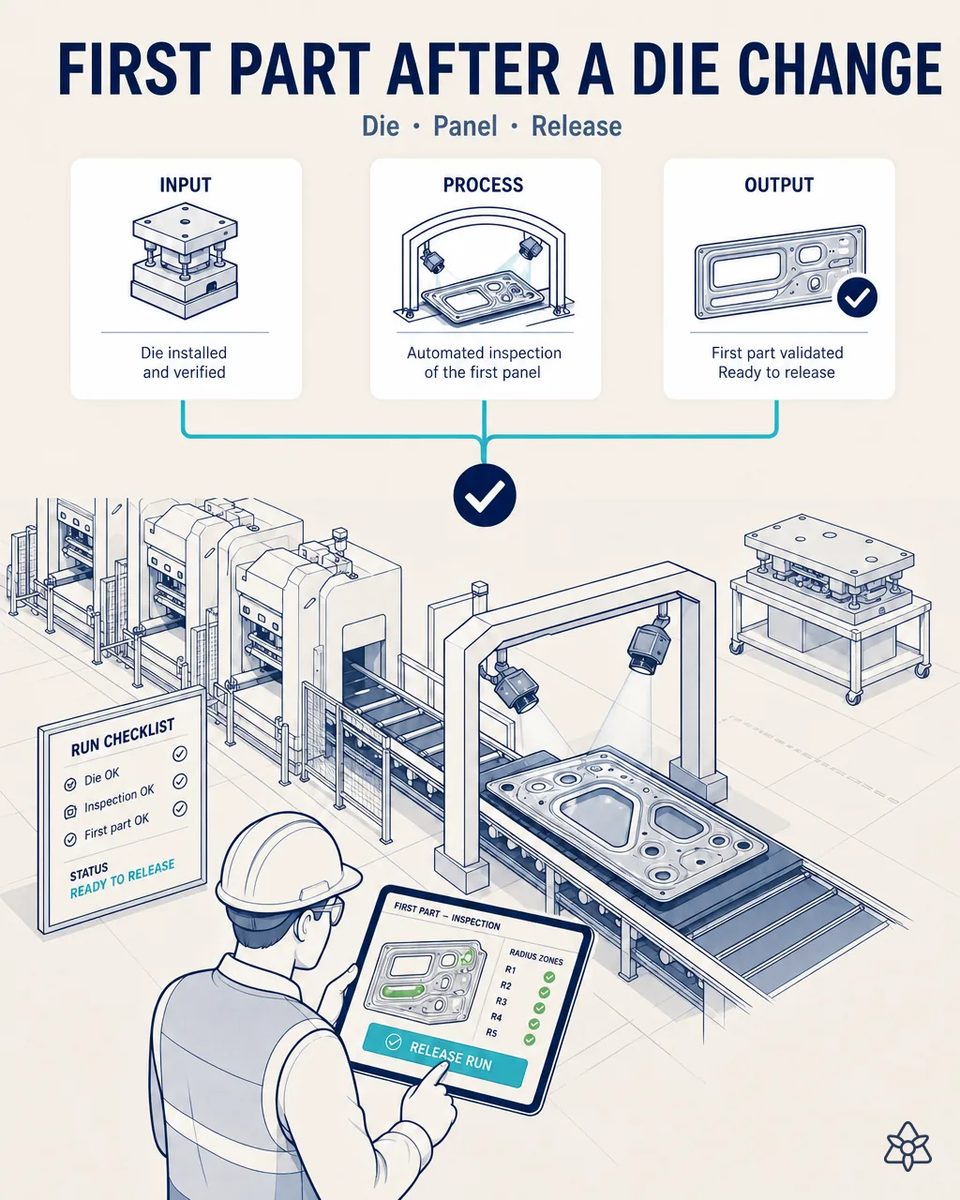
In pickup body stamping, every die change is a risky start-up: an undetected split or wrinkle on the first part turns into hundreds of bad panels. iLEAN Edge checks the first part with cameras and controlled lighting, and JIDOKA AI does not release the run until vision and the press line leader give the OK.
Every die change restarts the risk, and the first panel is released by eye.
- Press lines change dies several times per shift to produce doors, hoods, fenders and box panels. Each change requires releasing the first part quickly so production is not lost. - The costliest stamping defects (fine splits, necking on radii, flange wrinkles) are hard to see with the naked eye and in a hurry, and they propagate to the body shop and paint.
- Press lines change dies several times per shift to stamp doors, hoods, fenders and cargo bed panels. Each change is a new start-up, under pressure to recover production.
- The costliest defects — fine splits, necking on radii, flange wrinkles — are hard to see with the naked eye, in a hurry and under the wrong light.
- If the first panel is released with one of them, hundreds of bad panels are stamped before anyone notices.
- They travel to the body shop and sometimes on to paint, where the cost of each one has multiplied and the root cause is hard to trace back to one die change.
Edge with JIDOKA AI — the run starts only after the first panel passes.
Edge + JIDOKA AI: camera arch with diffuse lighting at end of line, comparison with the part master, check of critical zones, release blocked until vision OK and leader confirmation. Images are stored by die and by coil.
A camera arch with diffuse lighting at the end of the press line compares the first panel with the panel master and checks radii and critical zones in milliseconds. JIDOKA AI holds the run until the cameras say OK and the press line leader confirms. The decision stays human; it is simply no longer made by eye. The images are filed by die and by coil, so the next start-up of that die can be compared with this one.
First panel released by eye versus released on vision evidence
| Aspect | Today | With iLEAN Edge + JIDOKA AI |
|---|---|---|
| Basis for releasing the run | A visual check under pressure | Vision OK plus the leader's confirmation |
| Fine split or necking on a radius | Often missed until the body shop | Seen on the first panel |
| Lighting for the inspection | Whatever the press line has | Controlled, diffuse, repeatable |
| Comparison reference | The inspector's memory | The panel master for that die |
| Run started with a bad first panel | Hundreds of panels to scrap or rework | Held before it multiplies |
| Record of each start-up | A signature, maybe | Images by die and by coil |
Release by a glance → release with evidence. Defect found in the body shop → detected on the first part.
Impact estimate — to be validated with your numbers.
The block below is an estimate to be validated against your plant's actual data. We put it forward so the committee has an order of magnitude; we refine it during the assessment.
- Estimated payback 5-12 months, to be validated with the number of die changes per shift.
- The return comes from start-up scrap and rework avoided, because a bad first panel stops turning into a bad run.
- Defects that used to be found in the body shop are detected on the first part, at the press.
- And every release carries its images by die and coil, which is the evidence a later investigation needs.
Estimated payback of 5 to 12 months from scrap and rework avoided. Estimate to be validated with die change frequency.
And the fair question from the production manager
“Won't the vision system hold the run every time a panel looks slightly different?” — comparing a stamped panel with its own master under fixed, controlled light, on defined critical zones, is an anchored task where the best models drop below 1.5% error [1]. JIDOKA AI holds on a measurable difference in those zones, not on general doubt, and the press line leader makes the final call with the images in front of them.
[1] OpenAI paper "Why Language Models Hallucinate", 2025 — on the reliability of AI in anchored tasks.
What people ask about first-panel vision after a die change
Where does the camera arch go on the press line?
At the end of the line, where the finished panel comes out onto the conveyor. The arch carries the cameras and the diffuse lighting, so every panel is seen under the same light.
Which stamping defects can it see on the first panel?
Fine splits, necking on radii, flange wrinkles and other surface defects in the critical zones defined for each panel. Bring photos of your most frequent ones and we check those first.
Does the check slow down getting the press back to production after a die change?
It takes milliseconds per panel. What used to slow the start-up was the doubt and the second look, and SMED AI can also help shorten the change itself so validation does not cost press output.
Who can release the run if the cameras are unavailable?
The press line leader, as a recorded exception. A missing vision result is never treated as an OK, and the exception is filed with the start-up record.
Is a panel master needed for every die?
Yes, one per panel, built from good parts of that die at commissioning. When a die is reworked, its master is refreshed before the next run.
More cases from this series
- Zero defects escaping to the customer, from press to yardiLEAN links stamping, body, paint and assembly by VIN, panel and coil so no defect escapes to the…
- Every pickup with its own audit-ready evidence packiLEAN gathers photos, torques and validated repairs into an evidence pack per VIN, sorted by audit…
- From the audit spreadsheet to the ERP without retypingiLEAN reads audit and dimensional sheets, has a person validate them and pushes them to the ERP: -50 to…
- Steel coils traced into the ERP with one photoPhotograph each steel coil's label and certificate: iLEAN extracts heat, grade and thickness, gets them…
- Quality findings dictated while walking the lineQuality engineers dictate findings by voice while walking the line and iLEAN structures them by station,…
- Veteran stamping presses that finally share their dataAn external camera reads the stamping press panel and links tonnage and alarms to every panel defect,…
Bring photos of your three most frequent stamping defects and see how the camera would see them.
We work on your plant's real data, not ours. Assessment with no commitment.
Request estimated ROI within 48h ‹ See all cases of pickup truck assembly See automotive