Veteran stamping presses that finally share their data
Body-stamping presses with years of service are still the heart of the area, but their operator panel is not networked. Tonnage, stroke count and alarms vanish on the screen. iLEAN Connect reads that panel with an external camera and stores it in central memory by die and by coil, without touching the press control.
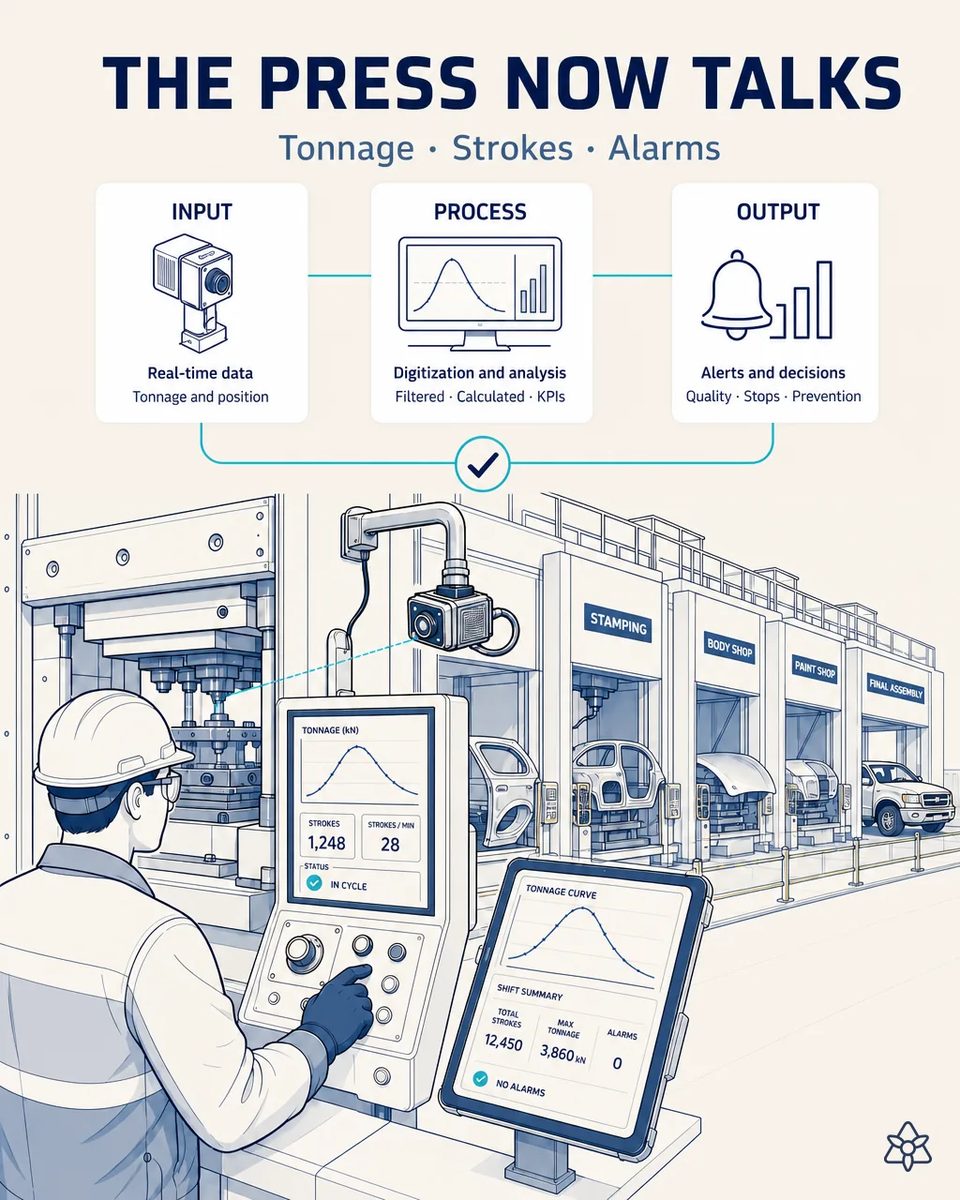
The press that forms the box side shows everything and remembers nothing.
- Press lines that turn sheet steel into doors, hoods, fenders and pickup boxes mix new equipment with veteran presses. The veteran ones display exactly what quality would need to explain a split or a wrinkle, but they do not export it. - A control retrofit means a heavy investment and weeks without the press. Meanwhile, stamping defect analysis is done blind to what the machine actually did.
- Press lines that turn coil into doors, hoods, fenders, cab panels and cargo bed sides mix new equipment with presses that have run for many years and are still critical.
- Their HMI shows tonnage per stroke, stroke count, clutch temperature and double-blank alarms. None of it is exported: it lives on the screen for a few seconds.
- When a split or a wrinkle turns up on a panel, nobody can say what the press was doing on that stroke or which coil lot was feeding it. The investigation turns into an argument between stamping, the body shop and the steel supplier.
- A control retrofit costs heavy money and weeks without the press — weeks the body shop cannot go without that panel.
Connect in panel-capture mode — a camera reads the HMI, the wiring stays shut.
Connect panel-capture mode: fixed industrial camera in front of the HMI, periodic reading with anchored OCR, structuring of tonnage, strokes and alarms by die and coil lot, cross-referenced with the quality records of the stamped panel.
The veteran press keeps its control and its wiring exactly as they are. What changes is that every stroke leaves a trace in central memory, tied to the die in the press and the coil lot being stamped. When quality finds a split box side, the tonnage of that stroke and the ones before it is a query, not a guess. And the retrofit discussion changes tone, because it is finally argued with stroke data instead of fear.
Veteran press data lost on screen versus filed by die and coil
| Aspect | Today | With iLEAN Connect |
|---|---|---|
| Tonnage per stroke | Gone when the screen refreshes | Stored as a curve per stroke |
| Double-blank and clutch alarms | Acknowledged and lost | Logged with die and coil lot |
| Split box side or wrinkled hood | Explained by opinion | Matched to the stroke that formed it |
| Root cause on a stamping defect | Days of hypotheses | Minutes with the curve in view |
| Press wiring and control program | — | Not touched |
| Retrofit decision | Urgent, without data | Postponable, with evidence |
No press data → stroke-level curve in central memory. Root cause in days → minutes. Urgent retrofit → can be postponed.
Impact estimate — to be validated with your numbers.
The block below is an estimate to be validated against your plant's actual data. We put it forward so the committee has an order of magnitude; we refine it during the assessment.
- Estimated payback 5-10 months, before counting the retrofit investment it lets you postpone.
- Less stamping scrap once tonnage can be put next to each split, wrinkle or double-blank event.
- Root cause on a panel defect drops from days to minutes, because the curve of that stroke and the coil lot are already filed together.
- And the control retrofit is decided on evidence: the press gets new electronics when the data says it needs them, not because it is blind.
Estimated payback of 5 to 10 months plus postponed retrofit CAPEX. Estimate to be validated with current stamping scrap.
And the fair question from the production manager
“Can a camera reading a screen really be precise enough for tonnage?” — reading values that always appear in the same place on the same HMI, inside the physical limits of that press, is an anchored task where the best models drop below 1.5% error [1]. A reading above the press's rated tonnage is discarded instead of stored, and the stroke counter, which only ever goes up, is used as a continuity check on every frame.
[1] OpenAI paper "Why Language Models Hallucinate", 2025 — on the reliability of AI in anchored tasks.
What people ask about reading veteran press panels in a pickup plant
Which values can be read from a veteran press HMI?
Whatever the screen shows: tonnage per stroke, stroke count, strokes per minute, clutch temperature and active alarms such as double blank. If a value sits on a secondary screen, the camera reads it whenever that screen is displayed.
How is each reading tied to the die and coil being run?
The die comes from the production schedule or the die change record, and the coil lot from receiving. Each stroke is filed under both, so a panel can be traced to its press data and to its steel.
Does the camera survive the vibration and oil mist of the press line?
It is an industrial camera on an isolated mount, with a housing rated for that environment. Installation and calibration take one shift, usually during a planned stop.
Can a split cargo bed panel found in the body shop be traced back to its stroke?
Yes, by combining the panel's position in the run with the stroke log. Quality then sees whether that stroke ran higher tonnage, followed an alarm or came from a different coil lot.
Does this mean the press never needs a retrofit?
No. It means the retrofit can wait until the data justifies it. Some plants confirm the press is fine; others find a real drift and retrofit with a clear business case.
More cases from this series
- Zero defects escaping to the customer, from press to yardiLEAN links stamping, body, paint and assembly by VIN, panel and coil so no defect escapes to the…
- Every pickup with its own audit-ready evidence packiLEAN gathers photos, torques and validated repairs into an evidence pack per VIN, sorted by audit…
- From the audit spreadsheet to the ERP without retypingiLEAN reads audit and dimensional sheets, has a person validate them and pushes them to the ERP: -50 to…
- Steel coils traced into the ERP with one photoPhotograph each steel coil's label and certificate: iLEAN extracts heat, grade and thickness, gets them…
- Quality findings dictated while walking the lineQuality engineers dictate findings by voice while walking the line and iLEAN structures them by station,…
- Repair tags: from paper to VIN-level data in secondsCapture handwritten repair tags by VIN with one photo and get a live defect Pareto in full-size pickup…
Send us a photo of your oldest press panel and tell us which pickup panel it forms.
We work on your plant's real data, not ours. Assessment with no commitment.
Request estimated ROI within 48h ‹ See all cases of pickup truck assembly See automotive