From the audit spreadsheet to the ERP without retyping
In pickup truck plants, product audit and body dimensional measurements are recorded in shared spreadsheets that someone later retypes into the official system. iLEAN Connect reads those sheets as soon as they are saved, has the owner validate them and pushes them to the ERP via API, with direct savings on quality-module licenses.
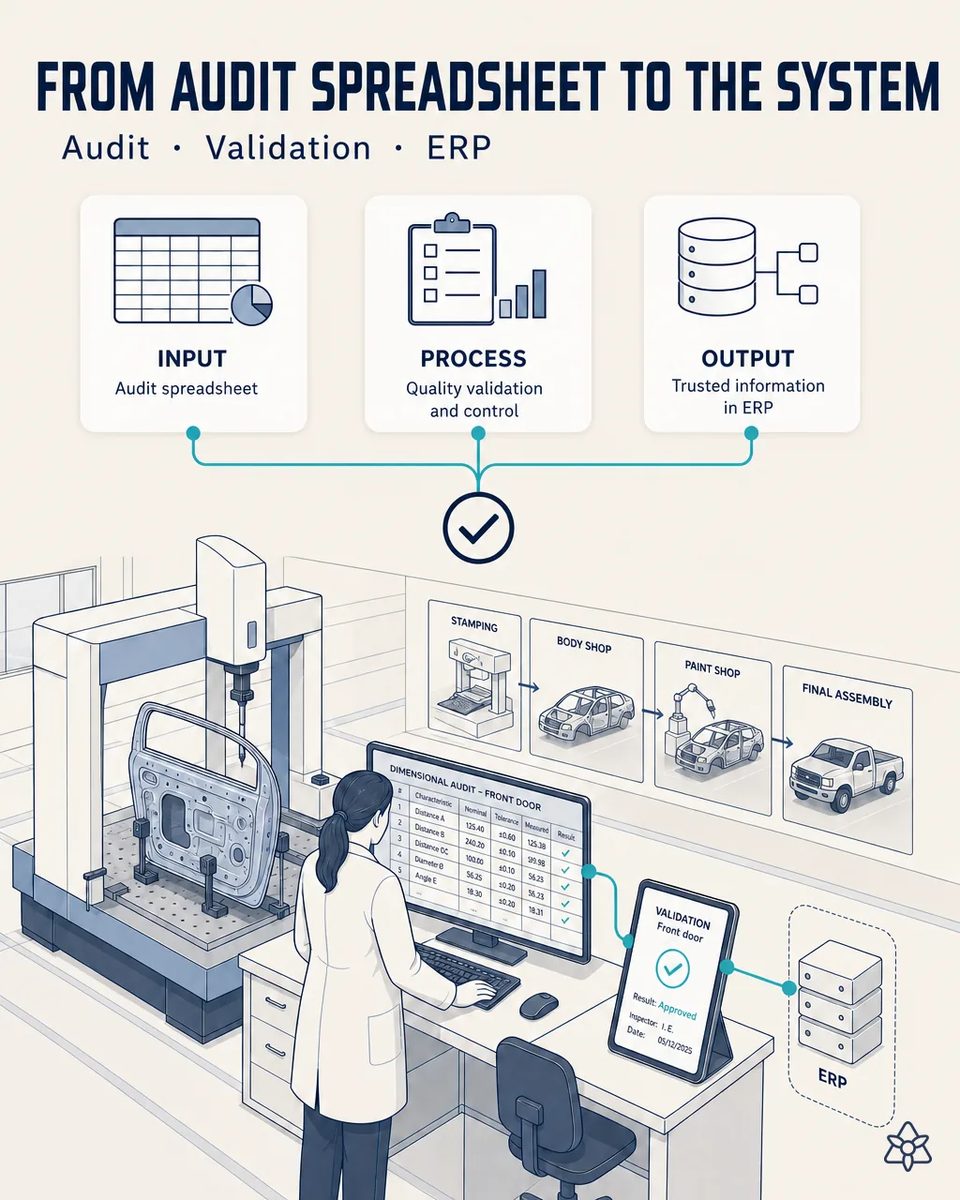
The audit result lives in a spreadsheet; the ERP hears about it days later.
- Real quality data (product audit, flush and gap measurements, CMM results) is produced in spreadsheets because that is fastest for the team. The official system always lags behind. - Retyping eats hours every month, introduces errors and forces the plant to keep ERP licenses for people who only log in to type.
- Product audit scores, flush and gap measurements on cab and cargo bed, and CMM results on doors and closures are filled into shared spreadsheets every shift, because that is fastest for the team.
- For that data to reach the ERP or the official quality system, someone retypes it, with copy errors and a lag of days.
- The plant keeps quality-module licenses for people who only log in to type, and pays for them every year.
- And when a customer audit asks for the dimensional history of a period, two versions of the same data have to be reconciled by hand.
Connect listening inward — it reads the folder, not the people.
Connect inward listening: it observes the shared folder, reads the delta when the file is saved, structures it with an anchored model, presents it for validation and writes it to the ERP or quality system via API.
The team keeps the spreadsheet it trusts. When a sheet is saved, Connect reads only what changed, structures it against the audit template, shows it to the owner for validation and pushes it to the ERP through the API. The retyping goes, and so do most of the licenses that only existed for it. Body engineering sees a cab-to-bed gap drifting the same day it is measured, not the following week, while there is still time to correct the fixture.
Audit spreadsheets retyped by hand versus pushed from the shared folder
| Aspect | Today | With iLEAN Connect |
|---|---|---|
| Lag from audit bench to ERP | Days | Minutes after saving |
| Monthly retyping hours | Several people, several hours | Zero |
| Flush or gap value in the wrong cell | Enters as valid data | Stopped by tolerance and range checks |
| Cab-to-bed gap history for a period | Two versions to reconcile | One validated record |
| Licenses held only for data entry | One per person who types | Typically 50-80% fewer |
| Who approved each entry | Unclear | The sheet owner, with time |
Days of lag → minutes. Hours of retyping per month → zero. Several data-entry licenses → one validation license.
Impact estimate — to be validated with your numbers.
The block below is an estimate to be validated against your plant's actual data. We put it forward so the committee has an order of magnitude; we refine it during the assessment.
- Estimated payback 4-9 months, plus recurring license savings every year, to be validated with your ERP invoice.
- A typical 50-80% reduction in quality-module licenses, because only the person who validates needs to log in.
- From days of lag to minutes, and from hours of retyping per month to zero.
- And the dimensional data a customer auditor sees is the same data the team measured, without a reconciliation exercise before the visit.
Estimated payback of 4 to 9 months plus recurring savings on quality-module licenses (typically -50 to -80%). Estimate to be validated with the ERP invoice.
And the fair question from the production manager
“What if it reads a gap value into the flush column?” — parsing a sheet against your own audit template, where every column has a meaning and a tolerance, is an anchored task where the best models drop below 1.5% error [1]. Each value is checked against the nominal and tolerance of that characteristic before the owner sees it, and nothing reaches the ERP until the owner confirms.
[1] OpenAI paper "Why Language Models Hallucinate", 2025 — on the reliability of AI in anchored tasks.
What people ask about audit spreadsheets in a pickup plant
Do the audit and metrology teams have to give up their spreadsheets?
No. The sheets stay with their tabs and formulas. Connect reads them; if the template changes, it is updated once and reading continues without interrupting the audit team.
Is software installed on the metrology or audit workstations?
No. Connect watches the shared folder where the files are saved. The people and their computers are not tracked, and their way of working does not change, which is usually what gets the metrology team on board.
How does it avoid sending the same audit twice to the ERP?
It reads only the delta since the last save. A row edited later is sent as a correction, with the previous value kept, so the ERP history shows both what was first measured and what was corrected.
Can CMM results be tied to the VIN or body they came from?
Yes, when the sheet carries the VIN or body number, which audit sheets usually do. The dimensional result then sits next to that truck's repair tags and torques, so a gap complaint on one pickup can be checked against how its cab and cargo bed measured on the day they were built.
Which users stop needing an ERP quality-module seat?
Those who open the module only to key in audit data. Once the data arrives on its own, those seats are no longer needed; typically 50 to 80 percent of them. The people who analyze and approve keep their access.
More cases from this series
- Zero defects escaping to the customer, from press to yardiLEAN links stamping, body, paint and assembly by VIN, panel and coil so no defect escapes to the…
- Every pickup with its own audit-ready evidence packiLEAN gathers photos, torques and validated repairs into an evidence pack per VIN, sorted by audit…
- Steel coils traced into the ERP with one photoPhotograph each steel coil's label and certificate: iLEAN extracts heat, grade and thickness, gets them…
- Quality findings dictated while walking the lineQuality engineers dictate findings by voice while walking the line and iLEAN structures them by station,…
- Veteran stamping presses that finally share their dataAn external camera reads the stamping press panel and links tonnage and alarms to every panel defect,…
- Repair tags: from paper to VIN-level data in secondsCapture handwritten repair tags by VIN with one photo and get a live defect Pareto in full-size pickup…
Share the structure of one audit sheet, without data, and see the push to your ERP.
We work on your plant's real data, not ours. Assessment with no commitment.
Request estimated ROI within 48h ‹ See all cases of pickup truck assembly See automotive