Zero defects escaping to the customer, from press to yard
In a pickup truck plant the core pain is the defect born at one stage and discovered several stages later, or in the customer's hands. iLEAN coordinates Connect, Edge and Agents across stamping, body shop, paint and general assembly, links every defect to its origin by VIN, panel, die and coil, and turns containment into a precise list of suspect units.
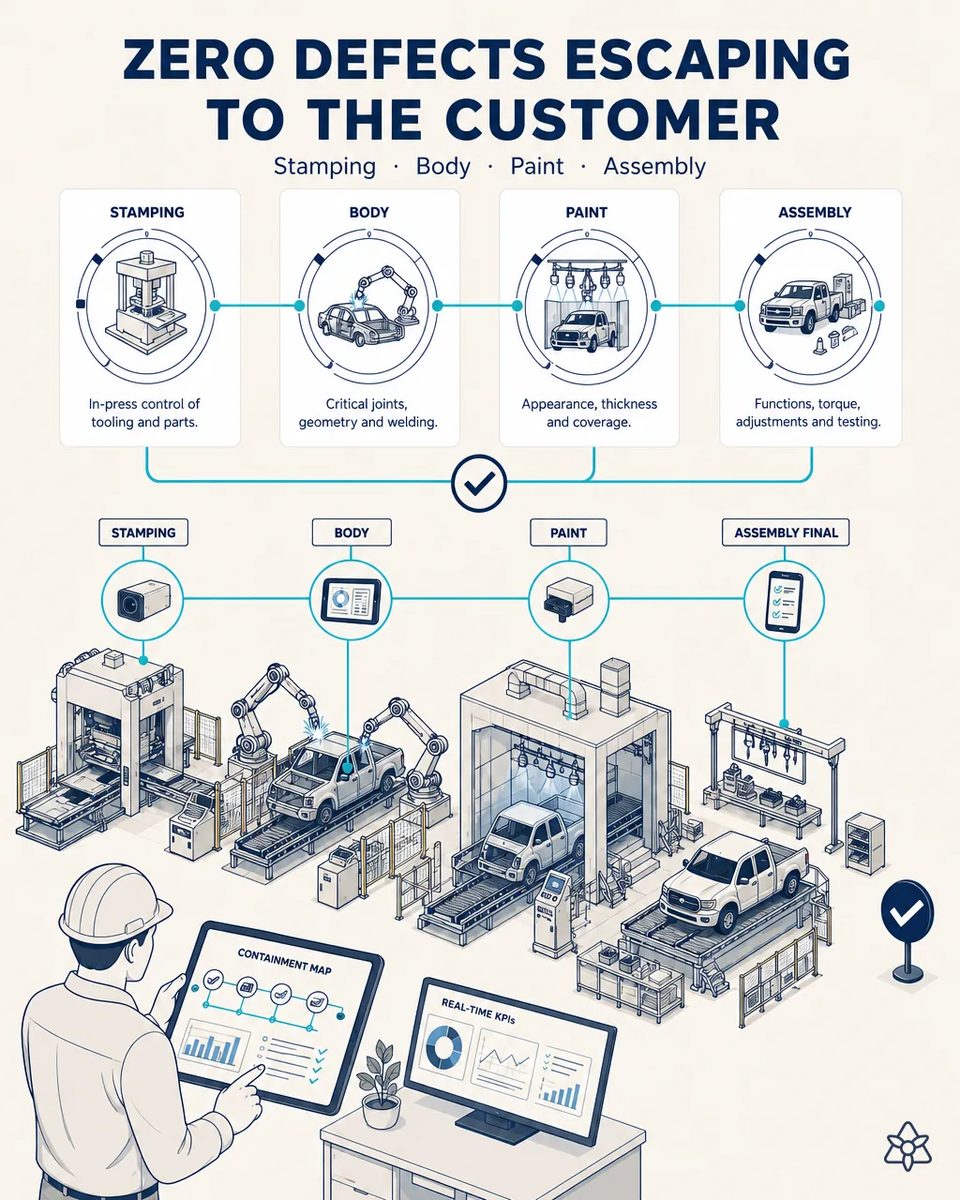
A defect born at the press can be welded, painted and assembled before anyone links it to its origin.
- The process is sequential and long: a panel with a stamping defect can be welded, painted and assembled before anyone sees it. The later it is caught, the more expensive it is: complex rework, held units, warranty claims and damage to perceived quality. - Each area has its own controls and records, but there is no shared memory linking effect and origin. Containments are oversized for lack of precision.
- Body-on-frame pickups are built in a long sequence: coil to stamped panel, panel to welded cab and cargo bed, body to paint, painted body married to the frame on the final line. A defect born at one stage is often discovered several stages later.
- Each area has its own controls and records, but no shared memory. Stamping does not know what the final line found; the final line does not know which coil or die the panel came from.
- So containment is decided with partial information and sized to be safe: hundreds of trucks held in the release yard and sorted by hand.
- The later the defect is caught, the more it costs — complex rework, held units, warranty claims and damage to perceived quality.
Connect, Edge and Agents linked across the four shops — origin and effect in one memory.
Agentic flagship. Connect (repair tags, supplier alerts, coil certificates, press panel, torques), Edge (first part after a die change, zones before they go blind), Agents (correlation by VIN, panel, die and coil; evidence pack per VIN) and JIDOKA AI (proposal to stop the station of origin, always with a human decision). SMED AI speeds up die changes so validation does not cost production.
No single case contains a defect on its own. The repair tag says what was found, the press panel and the coil certificate say how the panel was made, the first-panel check and the blind-zone camera say what was seen, and the agents join it all by VIN, panel, die and coil. When the pattern is serious, JIDOKA AI proposes stopping the station of origin, and the quality team decides.
The layers of the system and what each one contributes
| Ring | Cases feeding it | What it tells you |
|---|---|---|
| 1 · Material and press | Coil certificate (7), press panel (2) | Which heat and which stroke made the panel |
| 2 · First panel | First part after a die change (10) | Whether the run started clean |
| 3 · Before closing | Blind zone (9), torque by VIN (8) | How hidden zones and critical joints were built |
| 4 · Found downstream | Repair tags (1), supplier alerts (3) | What was detected, where and on which VIN |
| 5 · Origin and effect | Agents, VIN evidence pack (11) | Which other trucks share the same origin |
| 6 · Decision | JIDOKA AI and SMED AI | Stop proposed at origin; die changes kept short |
Defect found at the end or by the customer → detected at its stage of origin. Containment of hundreds of units → precise VIN list. Root cause in days → minutes.
Impact estimate — to be validated with your numbers.
The block below is an estimate to be validated against your plant's actual data. We put it forward so the committee has an order of magnitude; we refine it during the assessment.
- Estimated payback 6-12 months, measured against the first major containment avoided, to be validated with your warranty and rework data.
- Containment shrinks from a sweep of hundreds of trucks to a precise list of suspect VINs, sorted by where each one is: line, repair or release yard.
- Defects are detected at their stage of origin instead of at the end or by the customer, and root cause drops from days to minutes.
- And lower warranty cost over time, because the same origin stops feeding the same defect into the field.
Estimated payback of 6 to 12 months against the first major containment avoided, plus lower warranty cost. Estimate to be validated with warranty and rework data.
And the fair question from the production manager
“Do we need all twelve cases live before containment gets any better?” — no. The layers are added one at a time, and repair tags plus coil traceability already narrow the first containments. Linking a defect to its die and coil through records the plant already keeps is an anchored task where the best models drop below 1.5% error [1], and no station is stopped and no truck is released without the quality team deciding.
[1] OpenAI paper "Why Language Models Hallucinate", 2025 — on the reliability of AI in anchored tasks.
What people ask about defect containment from stamping to the final line
Which cases should a pickup plant connect first for containment?
Repair tags and coil certificates, because together they link what was found on a VIN to the steel behind its panels. Each pays back on its own before the layers are joined.
How does it decide which other trucks share a defect's origin?
By following the chain backwards from the VIN: panel, die, run, coil and supplier lot. Every truck built with the same chain inside the suspect window ends up on the list.
Does JIDOKA AI stop a station by itself?
No. It proposes the stop at the station of origin with the evidence behind it, and the quality team decides. The same applies to holding or releasing trucks in the yard.
What does SMED AI have to do with containment?
It shortens die changes, so validating the first panel every time does not cost press output. Without it, the temptation is to skip the check when the schedule is tight.
Can you estimate the return from one of our past containments?
Yes. With how many trucks were held, how many really had the defect and what the sort and rework cost, plus warranty history for the same defect, we calculate how far it could have been narrowed and which layer would have made the difference.
More cases from this series
- Every pickup with its own audit-ready evidence packiLEAN gathers photos, torques and validated repairs into an evidence pack per VIN, sorted by audit…
- From the audit spreadsheet to the ERP without retypingiLEAN reads audit and dimensional sheets, has a person validate them and pushes them to the ERP: -50 to…
- Steel coils traced into the ERP with one photoPhotograph each steel coil's label and certificate: iLEAN extracts heat, grade and thickness, gets them…
- Quality findings dictated while walking the lineQuality engineers dictate findings by voice while walking the line and iLEAN structures them by station,…
- Veteran stamping presses that finally share their dataAn external camera reads the stamping press panel and links tonnage and alarms to every panel defect,…
- Repair tags: from paper to VIN-level data in secondsCapture handwritten repair tags by VIN with one photo and get a live defect Pareto in full-size pickup…
Bring your last big containment and let's calculate how far it could have been narrowed.
We work on your plant's real data, not ours. Assessment with no commitment.
Request estimated ROI within 48h ‹ See all cases of pickup truck assembly See automotive