Steel coils traced into the ERP with one photo
In pickup body stamping, every steel coil arrives with its label and mill certificate. Today that data is typed into the ERP or lost, and coil-to-panel traceability breaks. With iLEAN Connect, one photo of the label and one of the certificate are enough: after a one-tap validation, heat, grade and thickness are in the ERP.
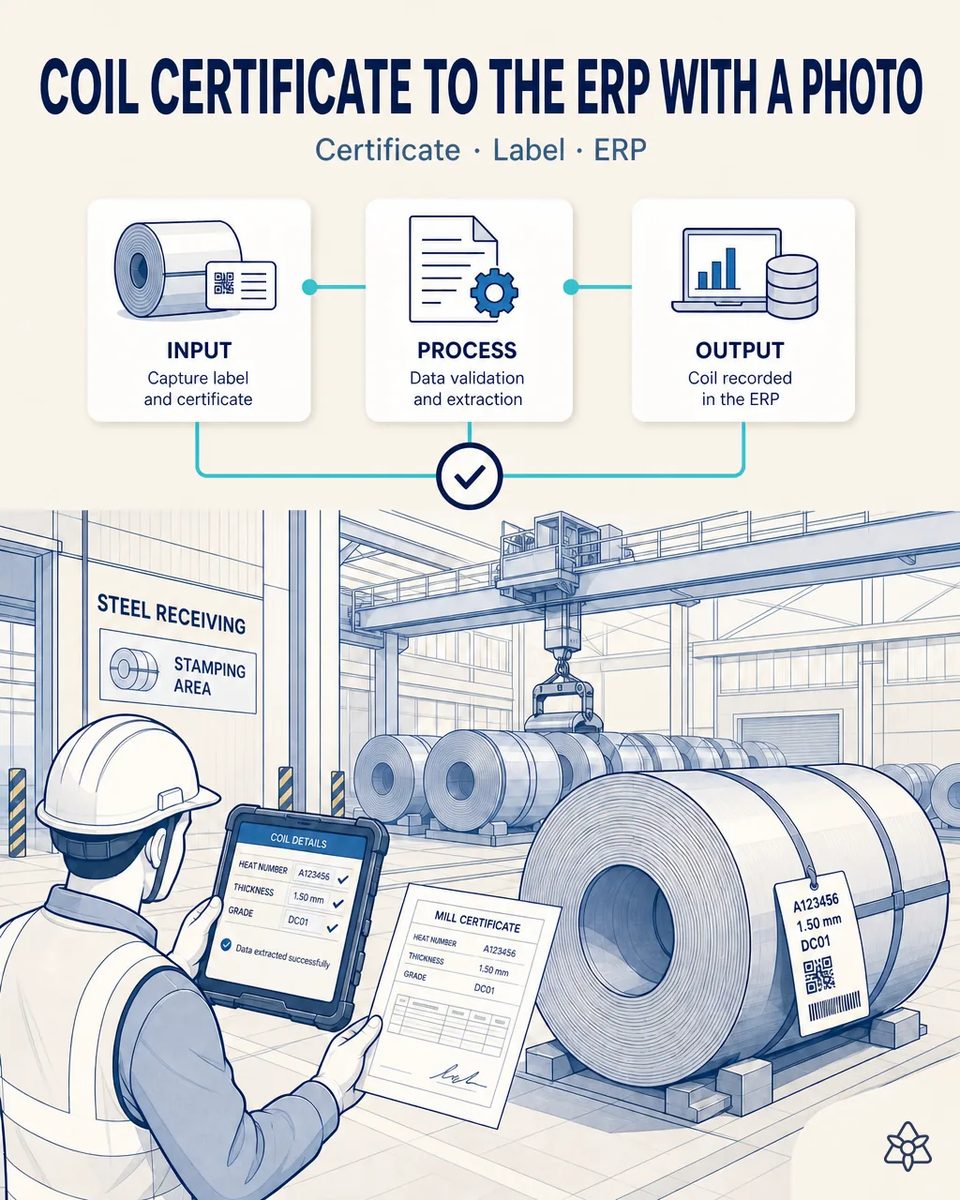
The coil arrives with its heat on paper, and the link to the panel breaks at receiving.
- Steel receiving moves many metric tons per shift. Each coil must be recorded with its heat number and properties, because they drive how it behaves in the press. - When capture is manual, traceability suffers exactly where it is needed most: when investigating a recurring split or wrinkle on a stamped panel.
- Steel receiving for body stamping moves many metric tons per shift. Each coil comes with a label and a mill certificate: heat number, grade, thickness, mechanical properties.
- Those properties decide how the coil behaves in the die. If they are not recorded against the coil, nobody can use them later.
- Today the receiving lead types them into the ERP coil by coil, or postpones it when trucks queue at the dock. A postponed entry is often an entry that never happens.
- When a recurring split shows up on a cargo bed side or a fender, nobody can tell which heat it came from, and the investigation stops there.
Connect from paper to ERP — two photos and one tap at receiving.
Connect paper capture → ERP: capture of the label (barcode, QR or plain OCR) and the quality certificate; structured extraction; one-tap validation on a tablet; write to the ERP via API and link to the die and the panels stamped from that coil.
The receiving lead photographs the label and the certificate. iLEAN reads codes and text, extracts heat, grade and thickness, shows them for one tap and writes them to the ERP. From then on, every panel stamped from that coil can be traced back to its steel, which is exactly what is missing when a split keeps coming back. Stamping engineering stops guessing between die wear and material, because the material side of the question finally has an answer.
Coil receiving typed by hand versus captured from two photos
| Aspect | Today | With iLEAN Connect |
|---|---|---|
| Recording a coil at receiving | Typed field by field | Two photos and one tap |
| Heat number and grade | Entered late or missing | Extracted and validated on arrival |
| Label barcode or QR | Scanned separately, if at all | Read and cross-checked with the certificate |
| Coil-to-panel link | Broken at receiving | Complete through die and run |
| Split investigation on a stamped panel | Stops at which coil | Reaches the heat and its properties |
| Receiving-module seats | Several, for data entry | Typically 50-70% fewer |
Manual entry coil by coil → one photo and one tap. Broken coil-to-panel traceability → complete. Several receiving licenses → one.
Impact estimate — to be validated with your numbers.
The block below is an estimate to be validated against your plant's actual data. We put it forward so the committee has an order of magnitude; we refine it during the assessment.
- Estimated payback 3-8 months, plus recurring license savings.
- A typical 50-70% reduction in receiving-module licenses, since data entry no longer needs several active seats.
- Receiving time per coil drops to one pair of photos and one tap, even when trucks queue at the dock.
- And root cause on stamping splits gets faster, because the heat and its properties travel with the coil to the die.
Estimated payback of 3 to 8 months plus recurring savings on receiving-module licenses (typically -50 to -70%). Estimate to be validated.
And the fair question from the production manager
“What if it reads the wrong heat number off a crumpled certificate?” — extracting heat, grade and thickness from documents whose layout is known for each mill is an anchored task where the best models drop below 1.5% error [1]. The heat on the label and the heat on the certificate are compared against each other, and any mismatch stops at the tablet. Nothing is written to the ERP until the receiving lead confirms it.
[1] OpenAI paper "Why Language Models Hallucinate", 2025 — on the reliability of AI in anchored tasks.
What people ask about capturing steel coil certificates
Does every steel mill's certificate layout work?
Yes. Each mill's layout is learned from a few samples; a new mill or a redesigned certificate is picked up the same way, without asking the mill to change anything. Service center coils with their own labels are handled the same way.
What if the coil label has no barcode?
The label is read by OCR. When there is a barcode or a QR code, it is read too and compared with the printed text, so a damaged code does not stop receiving.
How is a coil linked to the die and the panels it fed?
When the coil is loaded on the press line, its lot is tied to the die and the run in progress. Each stamped panel then inherits the coil, and the coil carries its heat and properties.
Can the mechanical properties be checked against our material specification?
Yes. Yield, tensile and elongation from the certificate can be compared with the specification for that part, and an out-of-window coil is flagged before it is loaded. The decision to run it, hold it or move it to a less demanding panel stays with stamping engineering.
How much training does the receiving lead need?
A few minutes. The routine is two photos and one confirmation, and the tablet shows only the fields that need a look. The rest of the receiving process stays as it is.
More cases from this series
- Zero defects escaping to the customer, from press to yardiLEAN links stamping, body, paint and assembly by VIN, panel and coil so no defect escapes to the…
- Every pickup with its own audit-ready evidence packiLEAN gathers photos, torques and validated repairs into an evidence pack per VIN, sorted by audit…
- From the audit spreadsheet to the ERP without retypingiLEAN reads audit and dimensional sheets, has a person validate them and pushes them to the ERP: -50 to…
- Quality findings dictated while walking the lineQuality engineers dictate findings by voice while walking the line and iLEAN structures them by station,…
- Veteran stamping presses that finally share their dataAn external camera reads the stamping press panel and links tonnage and alarms to every panel defect,…
- Repair tags: from paper to VIN-level data in secondsCapture handwritten repair tags by VIN with one photo and get a live defect Pareto in full-size pickup…
Send us one anonymized coil certificate and get back the fields iLEAN extracts.
We work on your plant's real data, not ours. Assessment with no commitment.
Request estimated ROI within 48h ‹ See all cases of pickup truck assembly See automotive