Repair tags: from paper to VIN-level data in seconds
In plants that build full-size pickup trucks, every defect travels with the truck on a handwritten repair tag. That information is the raw material of quality engineering, but it gets typed in late, wrong or never. With iLEAN Connect one phone photo is enough: the defect lands in central memory, structured by VIN, and the Pareto updates live.
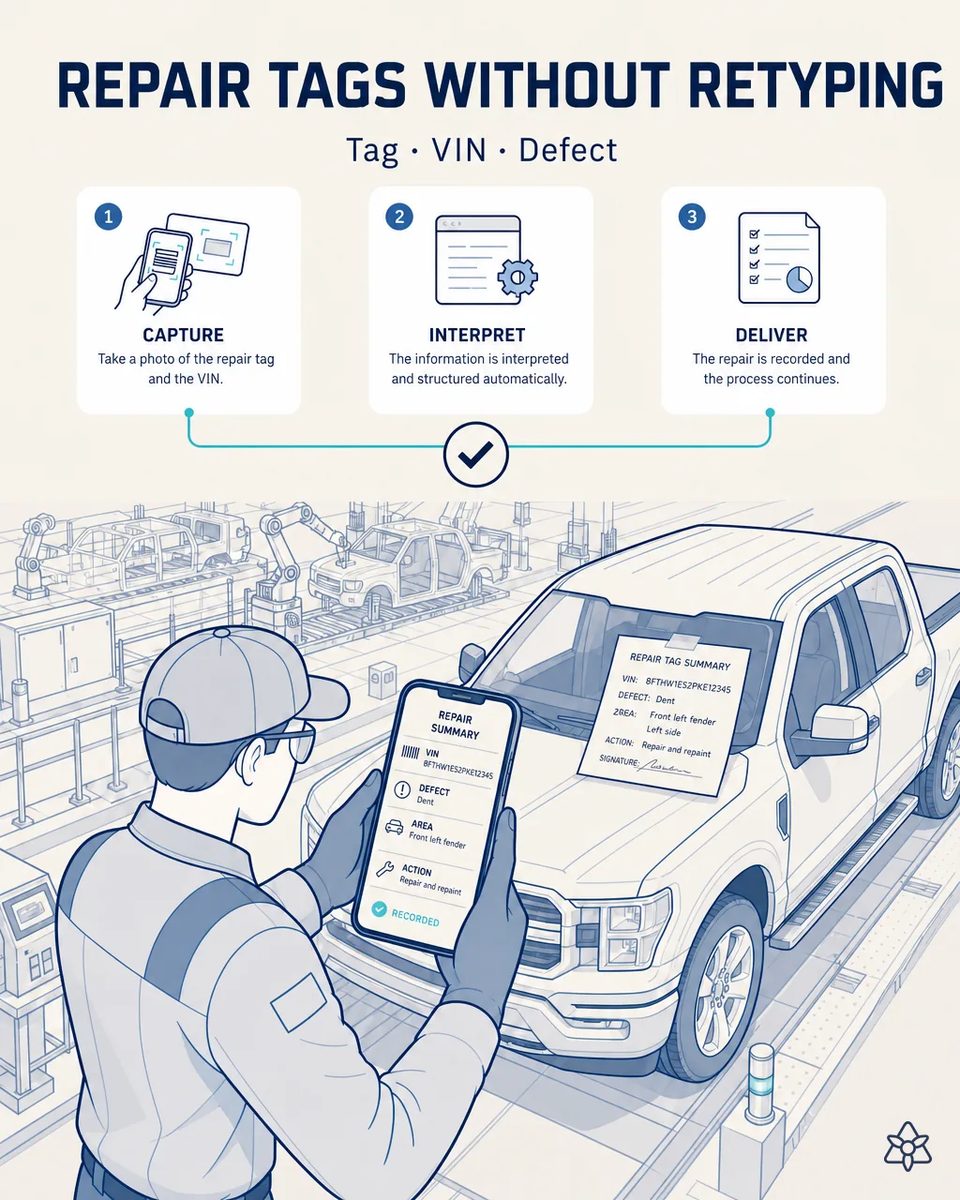
The repair tag holds the best defect data in the plant, and it ends the shift in a box.
- End-of-line repair stations and product audit generate dozens of tags per shift. Each one carries VIN, vehicle zone, defect type, station of origin and action taken, handwritten in a hurry. - Tags are collected at the end of the shift and someone retypes them. The result is a defect analysis a day late, with gaps from lost tags and reading errors that pollute the Pareto.
- End-of-line repair bays and product audit fill dozens of tags per shift. Each one carries the VIN, the zone of the truck — cab, cargo bed, frame, underbody — the defect, the station of origin and the action taken, written fast and by hand.
- The tags are collected when the shift ends and someone retypes them. The defect Pareto engineering works from is always one shift old.
- Some tags never reach the typing desk; others are read wrong. A smudged VIN digit or a misread zone sends the defect to the wrong truck or the wrong area.
- By the time a trend shows up — the same dent on the same fender, the same loose clip in the cab — the final line has built hundreds more pickups with it.
Connect in photo mode on the repair tag — the paper stays, the delay goes.
Connect paper-capture mode: the technician photographs the tag; iLEAN reads the handwriting, extracts VIN, zone, defect and action with a model anchored to the plant's defect catalog, shows it for a two-tap validation and stores it in central memory. The data is available by VIN, by station and by shift.
The technician keeps the routine: write the tag, hang it on the truck, fix the defect. One photo is added, and the tag stops dying in a box at the end of the shift. Quality engineering reads the same information an hour into the shift instead of the next morning, while the line can still do something about it.
Repair tags typed at shift end versus repair tags read in seconds
| Aspect | Today | With iLEAN Connect |
|---|---|---|
| Delay between repair and record | One full shift | Seconds after the photo |
| Tags lost before typing | Gone, with their defect | Every photographed tag kept |
| Smudged VIN digit | Typed as read, or skipped | Checked against VINs actually built |
| Defect Pareto by cab, bed and frame zone | Yesterday's picture | Updated live |
| Repeating defect on one zone | Seen the next day | Flagged in the first hour |
| Technician's routine | Write, hang, repair | Write, hang, photograph, repair |
One shift of latency → seconds. Lost or unreadable tags → complete record validated by the technician. Yesterday's Pareto → live Pareto.
Impact estimate — to be validated with your numbers.
The block below is an estimate to be validated against your plant's actual data. We put it forward so the committee has an order of magnitude; we refine it during the assessment.
- Estimated payback 4-9 months, depending on repair volume per shift.
- The return comes mainly from repeat defects stopped earlier, because the same fault stops being built into hundreds of pickups before anyone sees the trend.
- On top of that, typing hours recovered at the end of every shift, and no more Pareto gaps from tags lost between the repair bay and the desk.
- From one shift of latency to seconds, with a complete record validated by the technician who did the repair.
Estimated payback of 4 to 9 months from recovered typing hours and repeat defects stopped earlier. Estimate to be validated with repair volume per shift.
And the fair question from the production manager
“What if it misreads a handwritten VIN or a scrawled defect code?” — reading a tag whose fields are always in the same place, against your own defect catalog and the list of VINs actually built that day, is an anchored task where the best models drop below 1.5% error [1]. A VIN that does not exist in the build record is rejected rather than guessed, and the technician confirms the read with two taps before it enters central memory.
[1] OpenAI paper "Why Language Models Hallucinate", 2025 — on the reliability of AI in anchored tasks.
What people ask about digital repair tags in pickup assembly
Do we have to change the repair tag we use today?
No. iLEAN learns the layout of your current tag: where VIN, zone, defect and action are written. If the tag is redesigned later, the template is updated once.
Can it read tags written in a hurry with a marker?
Yes, within reason. The model reads handwriting against your defect catalog and the VINs built that day, so a sloppy code is matched to a real one. When it cannot decide, the field is highlighted for the technician instead of being filled in.
How are defect zones on a pickup structured?
With the zones your plant already uses: cab, cargo bed, frame, underbody, engine compartment, interior, and finer subzones if you have them. The Pareto can then be cut by zone, by station of origin and by shift.
Who receives the alert when a defect starts repeating?
The quality engineer who owns that zone or station, and the area supervisor if you want. The alert carries the VINs involved and the photos of their tags, so the conversation starts with evidence.
Do the findings from product audit go into the same record?
Yes. Product audit findings and repair bay tags land in the same central memory by VIN, so a defect caught at audit and one fixed at repair on the same zone are seen together.
More cases from this series
- Zero defects escaping to the customer, from press to yardiLEAN links stamping, body, paint and assembly by VIN, panel and coil so no defect escapes to the…
- Every pickup with its own audit-ready evidence packiLEAN gathers photos, torques and validated repairs into an evidence pack per VIN, sorted by audit…
- From the audit spreadsheet to the ERP without retypingiLEAN reads audit and dimensional sheets, has a person validate them and pushes them to the ERP: -50 to…
- Steel coils traced into the ERP with one photoPhotograph each steel coil's label and certificate: iLEAN extracts heat, grade and thickness, gets them…
- Quality findings dictated while walking the lineQuality engineers dictate findings by voice while walking the line and iLEAN structures them by station,…
- Veteran stamping presses that finally share their dataAn external camera reads the stamping press panel and links tonnage and alarms to every panel defect,…
Tell us how many repair tags your plant writes per shift and when they get typed.
We work on your plant's real data, not ours. Assessment with no commitment.
Request estimated ROI within 48h ‹ See all cases of pickup truck assembly See automotive