Every pickup with its own audit-ready evidence pack
System audits, customer audits and warranty claims all ask for the same thing: evidence of how a unit was built. Today it is rebuilt by hand over days. With iLEAN Edge and Agents, every VIN generates its pack (blind-zone photos, torques, validated repairs, coil traceability) sorted by requirement and available in minutes.
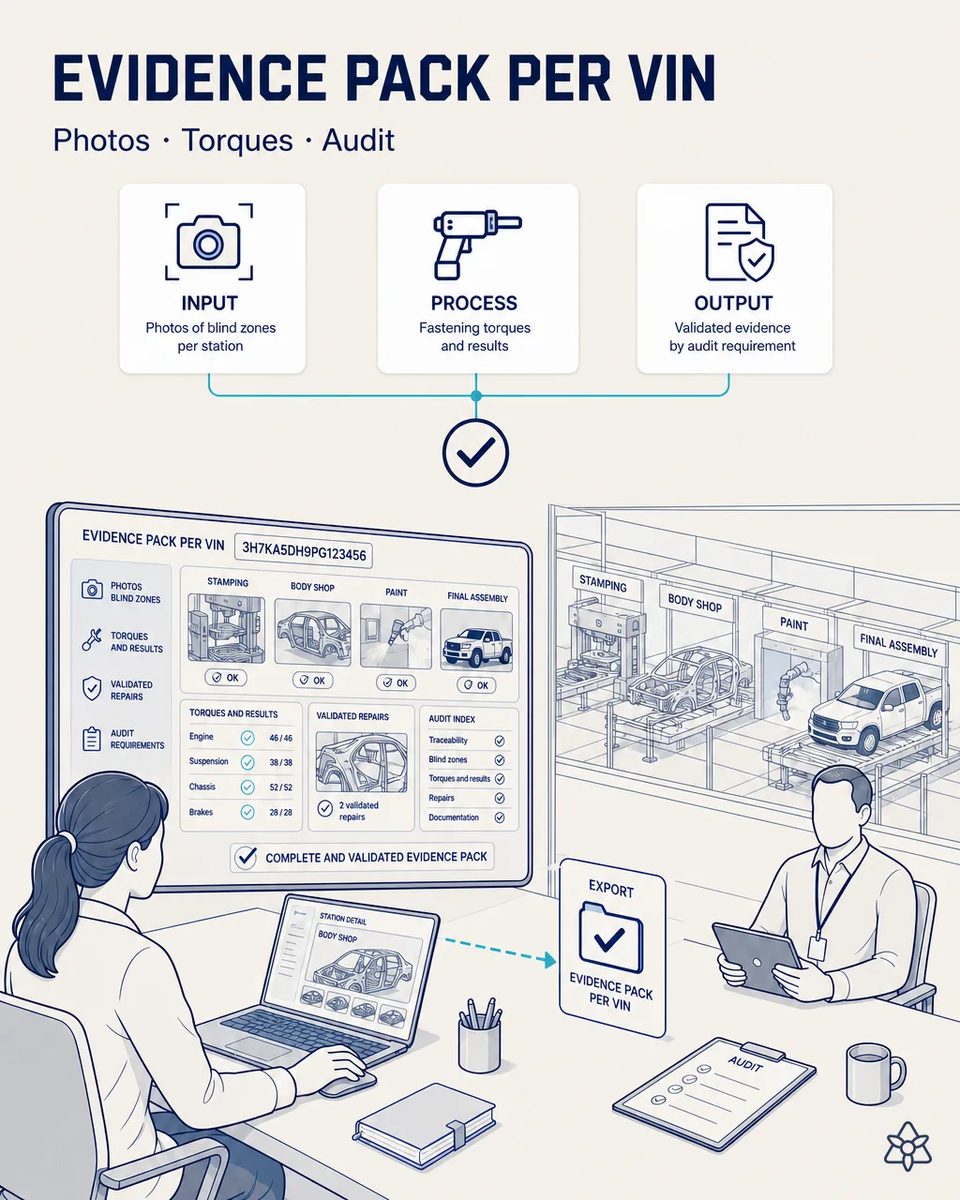
Every audit and every warranty claim asks how one truck was built, and the answer takes weeks.
- A unit's quality evidence is spread across controllers, spreadsheets, repair tags and supplier systems. Gathering it for an IATF 16949 audit or a customer review takes weeks. - When a warranty claim questions how a truck was built, the lack of organized evidence makes it hard to challenge or learn from quickly.
- System audits, customer audits and warranty claims all ask for the same thing: evidence of how a given unit or lot was built.
- That evidence exists, but it is spread across fastening controllers, audit spreadsheets, repair tags, coil records and supplier systems.
- Gathering it for an IATF 16949 audit or a customer review means days or weeks of searching, and any gap becomes a non-conformity, even when the truck itself was built right.
- When a warranty claim questions how a truck was built, the lack of organized evidence makes the claim hard to challenge, and hard to learn from.
Edge and Agents — every VIN builds its own pack as it moves down the line.
Edge + Agents: Edge captures (blind zones, first part) and Connect captures (tags, torques, coils) are consolidated per VIN; iLEAN agents organize the pack by standard or control plan requirement and generate an exportable package for the auditor or the warranty analysis.
The cases already running feed one pack per truck: blind-zone photos, first-panel images, torque results, validated repairs and the coil behind each stamped panel. iLEAN agents sort it by requirement, for example IATF 16949 or the control plan. When the auditor or the warranty analyst asks, the pack already exists. Nobody in the plant spends the weeks before a visit rebuilding what happened to a truck that left months ago.
Rebuilding a truck's history versus opening its evidence pack
| Aspect | Today | With iLEAN Agents |
|---|---|---|
| Answering how one VIN was built | Days across systems and paper | Minutes, one pack |
| Blind-zone photos | Not kept | Filed under the VIN |
| Critical-joint torques | In separate controllers | Inside the pack |
| Coil behind each stamped panel | Usually untraceable | Linked by heat and lot |
| Sorting by IATF 16949 or control plan | Manual, per audit | Done by the agents as evidence arrives |
| Warranty claim analysis | Argued without data | Worked with photos and torques per VIN |
Weeks rebuilding → minutes checking. Non-conformities from documentation gaps → complete evidence. Claims without data → analysis with photos and torques per VIN.
Impact estimate — to be validated with your numbers.
The block below is an estimate to be validated against your plant's actual data. We put it forward so the committee has an order of magnitude; we refine it during the assessment.
- Estimated payback 6-12 months, to be validated with your current audit preparation hours.
- Weeks of rebuilding evidence become minutes of checking, for system audits, customer audits and internal reviews.
- Non-conformities caused by documentation gaps drop, because missing evidence is detected when it should have been created.
- And warranty claims are analyzed with the photos and torques of that VIN, so they are better resolved and teach the plant something.
Estimated payback of 6 to 12 months. Estimate to be validated with current audit preparation hours.
And the fair question from the production manager
“Isn't this just a folder of files named after the VIN?” — the difference is that the evidence is created at the station while the truck is built, and filing each item against a requirement is an anchored task where the best models drop below 1.5% error [1]. The quality team reviews any pack before it leaves the plant, and nothing is shared with an auditor or a customer without that sign-off.
[1] OpenAI paper "Why Language Models Hallucinate", 2025 — on the reliability of AI in anchored tasks.
What people ask about VIN evidence packs in pickup assembly
What goes into the evidence pack of a single pickup?
Blind-zone photos, first-panel images for its stamped parts, critical-joint torques, validated repairs from its tags and the coil lot behind its panels. Other evidence can be added as more cases are connected, from supplier lot records to product audit results for that truck.
Can a pack be built for a lot or a date range instead of one VIN?
Yes. Packs can be pulled by VIN, by lot, by period or by supplier part, and exported as one package for that scope. A supplier lot question gets every VIN that carries it.
How is the pack organized for an IATF 16949 audit?
By requirement: each item is filed under the clause or control plan line it evidences, so the auditor finds what they ask for without browsing. A customer-specific requirement adds a view, not a new collection effort.
Who finds out if a truck passes a station without its evidence?
The station owner and the quality lead, at that moment. The gap is fixed in the same shift instead of discovered in front of an auditor, which turns a future non-conformity into a routine correction.
Does the warranty team get access to the plant's systems?
No. They receive the pack for the VINs in question, read-only, without access to the MES, the ERP or the controllers behind it. An external auditor gets the same kind of limited view, scoped to the period and the requirement being audited.
More cases from this series
- Zero defects escaping to the customer, from press to yardiLEAN links stamping, body, paint and assembly by VIN, panel and coil so no defect escapes to the…
- From the audit spreadsheet to the ERP without retypingiLEAN reads audit and dimensional sheets, has a person validate them and pushes them to the ERP: -50 to…
- Steel coils traced into the ERP with one photoPhotograph each steel coil's label and certificate: iLEAN extracts heat, grade and thickness, gets them…
- Quality findings dictated while walking the lineQuality engineers dictate findings by voice while walking the line and iLEAN structures them by station,…
- Veteran stamping presses that finally share their dataAn external camera reads the stamping press panel and links tonnage and alarms to every panel defect,…
- Repair tags: from paper to VIN-level data in secondsCapture handwritten repair tags by VIN with one photo and get a live defect Pareto in full-size pickup…
Pick a recent VIN and ask us what its evidence pack would contain.
We work on your plant's real data, not ours. Assessment with no commitment.
Request estimated ROI within 48h ‹ See all cases of pickup truck assembly See automotive