Check hoses and connectors before the zone goes blind
In pickup truck general assembly some zones go blind once certain components are installed, like the climate compartment after the condenser and compressor. A kinked hose there is a future warranty claim. iLEAN Edge checks routing and connectors right before closing, on every unit, and stores the photo linked to the VIN.
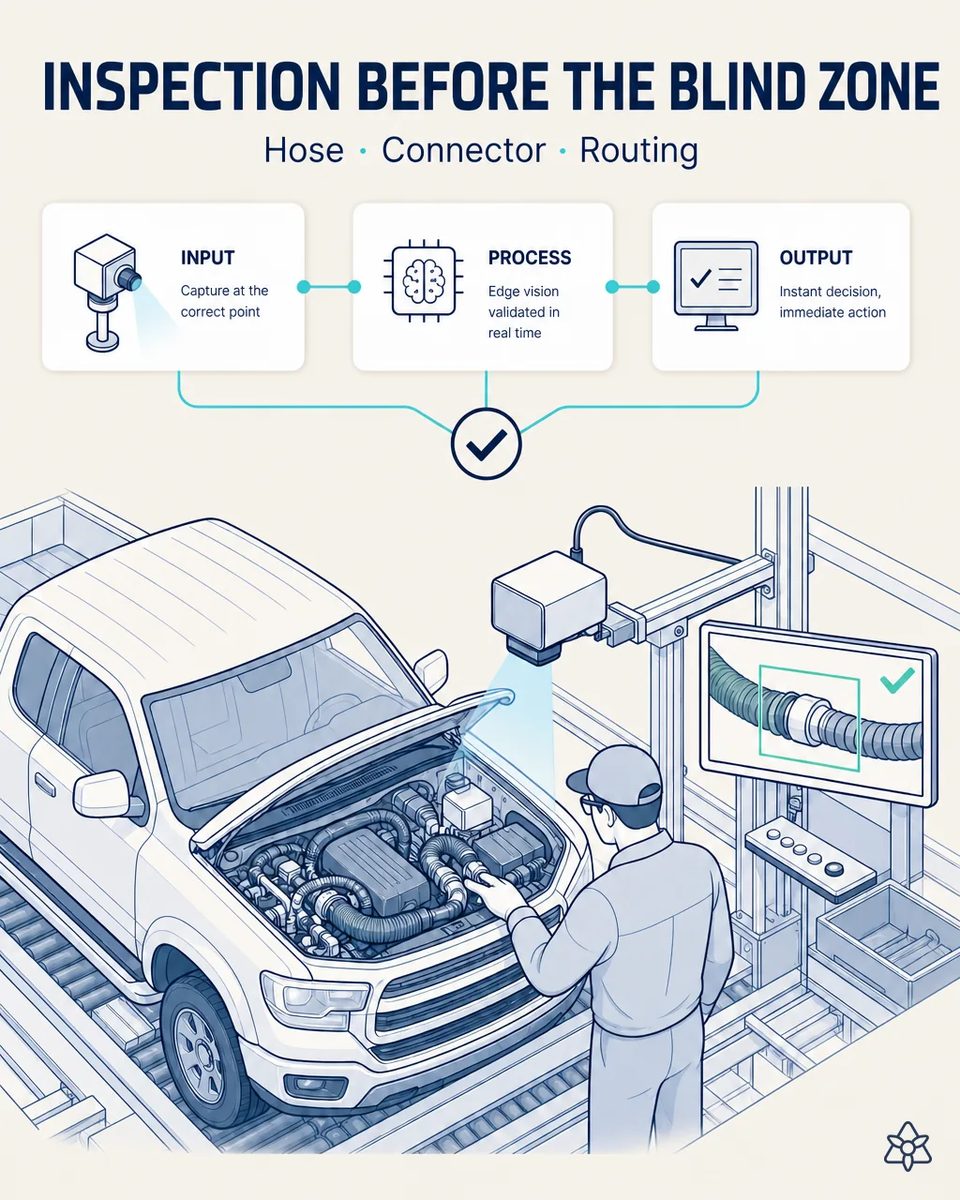
Some zones are seen once, for a few seconds, and never again until the truck comes back under warranty.
- Manual inspection of zones about to be hidden relies on a glance during a cycle of about a minute, in a tight space and sometimes without a line of sight. - Escaped defects do not show up at final audit: they appear months later in the customer's hands, with the warranty cost and the hit on perceived quality.
- On a pickup line some zones close for good: the climate compartment once the condenser and compressor go in, the brake and fuel lines along the frame rails once the cab-to-frame marriage and the cargo bed cover them.
- Inspection before closing relies on a glance during a cycle of about a minute, in a tight space and sometimes without a line of sight.
- A kinked hose or a half-seated connector does not show at final audit. It shows months later in the customer's hands, as an air conditioning failure or a leak.
- There is no room for a second manual inspection, and once the zone is closed, rework means taking the truck apart.
Edge right before closing — every truck checked, every check filed by VIN.
Edge: compact industrial camera at the station before closing, local inference with a CNN trained on examples of the specific model, a signal to the station (and optionally the PLC) on a NOK, and a photo stored per VIN. It works without sending images outside the plant.
A compact camera at the last station before the zone goes blind, a model trained on good and bad examples from that exact station, and a signal before the truck moves on. The operator corrects the hose or the connector on the spot. The photo stays with the VIN, so the zone is no longer blind in the record either. When a warranty claim arrives months later, the plant can see how that hose was routed on that exact truck.
A last glance before closing versus an Edge check on every truck
| Aspect | Today | With iLEAN Edge |
|---|---|---|
| Inspection before the zone closes | A glance, when the cycle allows | Every truck, in milliseconds |
| Kinked hose or half-seated connector | Found by the customer | Corrected at the station |
| Evidence of how the zone was closed | None | A photo filed under the VIN |
| Second chance after closing | Teardown or warranty | Not needed |
| Signal on a NOK | Depends on someone noticing | On screen, optionally to the PLC |
| Where the images are processed | — | Inside the plant, on local hardware |
A human glance with no second chance → 100% check on every unit. Defect found by the customer → corrected at the station.
Impact estimate — to be validated with your numbers.
The block below is an estimate to be validated against your plant's actual data. We put it forward so the committee has an order of magnitude; we refine it during the assessment.
- Estimated payback 5-12 months, depending on the current warranty cost of that zone on your platform.
- From a human glance with no second chance to a check on 100% of the trucks, at line rate.
- Defects that used to be found by the customer are corrected at the station, before the zone is closed.
- And a photo per VIN that turns a future warranty argument into a fact about how the zone was built.
Estimated payback of 5 to 12 months depending on the zone's warranty cost. Estimate to be validated.
And the fair question from the production manager
“Will the camera flag good hoses and hold trucks for nothing?” — checking routing and engagement at a fixed station, on one model, against good and bad examples from that station, is an anchored vision task where the best models drop below 1.5% error [1]. A NOK does not stop the line on its own: it is shown to the operator, who looks and decides, and every borderline case they confirm improves the model.
[1] OpenAI paper "Why Language Models Hallucinate", 2025 — on the reliability of AI in anchored tasks.
What people ask about inspecting blind zones in pickup assembly
Which zones of a pickup are usually checked first?
The ones with the highest warranty cost: the climate compartment behind the condenser, brake and fuel lines along the frame before the cab and cargo bed go on, and underbody connectors. Your warranty data decides the order.
How is the camera trained for one station and one model?
With good and bad examples captured at that station, including deliberately kinked hoses and half-seated connectors. Each cab or engine variant is trained on its own examples.
Does it need to send images to the cloud?
No. Inference runs on local hardware at the station and the images stay inside the plant. They are stored per VIN in your own environment, and the check keeps working if the plant network drops.
What happens if the operator disagrees with the camera?
The operator decides. That decision is recorded with the image, and disputed cases are reviewed to retrain the model, so the same doubt does not repeat.
Can the same approach cover several blind zones on the line?
Yes. Each zone gets its own camera and its own trained model. Plants usually start with the zone that costs the most warranty and add others once the first is proven, reusing the same local hardware where the stations are close.
More cases from this series
- Zero defects escaping to the customer, from press to yardiLEAN links stamping, body, paint and assembly by VIN, panel and coil so no defect escapes to the…
- Every pickup with its own audit-ready evidence packiLEAN gathers photos, torques and validated repairs into an evidence pack per VIN, sorted by audit…
- From the audit spreadsheet to the ERP without retypingiLEAN reads audit and dimensional sheets, has a person validate them and pushes them to the ERP: -50 to…
- Steel coils traced into the ERP with one photoPhotograph each steel coil's label and certificate: iLEAN extracts heat, grade and thickness, gets them…
- Quality findings dictated while walking the lineQuality engineers dictate findings by voice while walking the line and iLEAN structures them by station,…
- Veteran stamping presses that finally share their dataAn external camera reads the stamping press panel and links tonnage and alarms to every panel defect,…
Pick the blind zone that costs you the most warranty and we will propose where the camera goes.
We work on your plant's real data, not ours. Assessment with no commitment.
Request estimated ROI within 48h ‹ See all cases of pickup truck assembly See automotive