Critical torques stitched to the VIN, no double entry
The controlled nutrunners on a pickup truck line record torque and angle, but their data lives isolated from the VIN sequence and the repair station. iLEAN Connect stitches these systems together via API: an out-of-range tightening goes straight to repair linked to the VIN, and every truck keeps its critical-joint history.
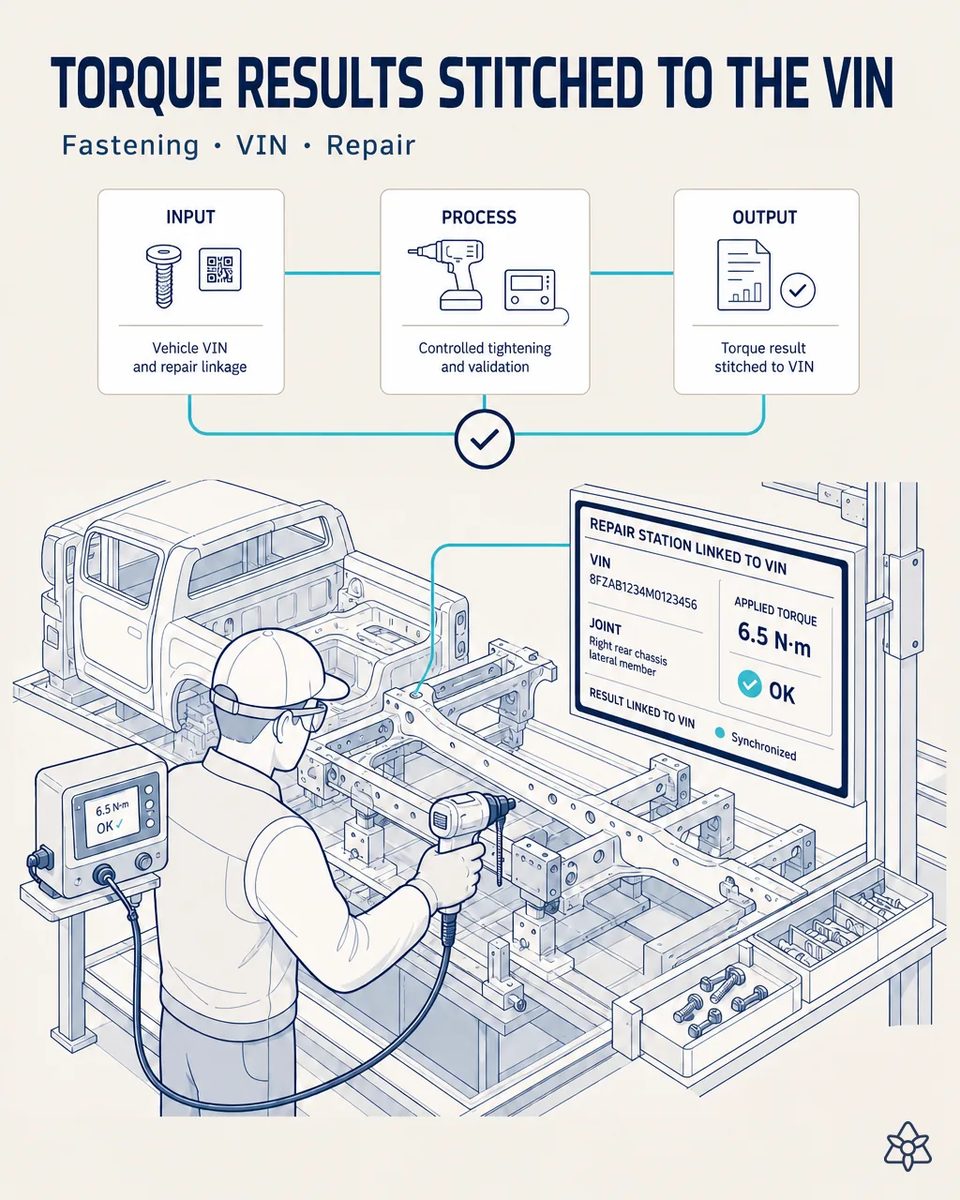
The nutrunner already knows the joint failed. A person still has to carry the news.
- Critical chassis, suspension and powertrain joints are tightened with modern controllers that already produce data. The problem is not a lack of data but that it does not travel. - When a tightening fails, the alert turns into paper and then into typing. Every manual step is a chance for a unit to leave unrepaired.
- Critical joints on the frame, suspension, brake line clips and powertrain mounts are tightened with controlled electric nutrunners that record torque and angle on every rundown.
- Those results stay in the controller or on a separate server, isolated from the VIN sequence and from the repair station.
- When a joint is out of range, someone writes it on the repair tag and someone else retypes it at repair. Two modern systems, and a human acting as the cable.
- Every manual step is a chance for a truck to reach the end of the line with an unrepaired critical joint, and on a frame or brake joint that is not a cosmetic issue.
Connect stitches controller, VIN sequence and repair — API to API.
Modern legacy integration: Connect stitches the fastening controller, the production sequence and the repair application together via API, without replacing any of them. Results are also stored in central memory by VIN.
Nothing is replaced: the controllers, the production sequence and the repair application all stay. Connect links them, so an out-of-range tightening shows up on the repair screen already tied to its VIN, and the result is also filed in central memory. If a warranty claim asks about a joint, the answer is there in seconds. The operator keeps tightening, the repair technician keeps repairing, and nobody acts as the cable between two machines anymore.
NOK joints carried on paper versus sent straight to repair
| Aspect | Today | With iLEAN Connect |
|---|---|---|
| Out-of-range tightening | Written on a tag, retyped at repair | On the repair screen with its VIN |
| Double entry per NOK | Every time | None |
| Truck leaving with an open joint | Possible if a tag is lost | Blocked until repair closes it |
| Torque and angle history per truck | Scattered across controllers | One query by VIN |
| Warranty question on a frame joint | Days of searching | Answered in seconds |
| Fastening hardware | — | Kept as it is |
Double entry for every NOK → zero. Scattered VIN history → checked in seconds. Risk of an unrepaired unit → closed by the system.
Impact estimate — to be validated with your numbers.
The block below is an estimate to be validated against your plant's actual data. We put it forward so the committee has an order of magnitude; we refine it during the assessment.
- Estimated payback 3-6 months, to be validated with your number of fastening NOKs per shift.
- Double entry for every NOK drops to zero, and with it the copy errors between tag and repair, plus the minutes each repair technician spent typing.
- The risk of a truck leaving with an unrepaired critical joint is closed by the system instead of by attention.
- And every pickup keeps its complete critical-joint history, ready when a warranty claim or an audit asks for it.
Estimated payback of 3 to 6 months. Estimate to be validated with the number of fastening NOKs per shift.
And the fair question from the production manager
“What if a result gets attached to the wrong truck?” — matching a controller result to the VIN in that station is an anchored task against your own production sequence, where even the best models drop below 1.5% error [1], and most of it is deterministic data exchange rather than interpretation. The second net is physical: the controller's cycle and the station's VIN scan must agree, and any mismatch is held for a person instead of filed.
[1] OpenAI paper "Why Language Models Hallucinate", 2025 — on the reliability of AI in anchored tasks.
What people ask about stitching torque results to the VIN
Which fastening controllers can be connected?
Any controller with a data interface, which covers the controlled nutrunners used on modern lines. We confirm the specific models before starting, and nothing on the controller is replaced.
Which joints are worth connecting first on a pickup?
Frame and body mounts, suspension, steering and brake joints, because those are the ones a warranty claim or a safety review asks about first. The cab and bed mounts that hold the body to the frame after the marriage usually come right after.
What does the repair technician see when a NOK arrives?
The VIN, the joint, the torque and angle achieved, the target window and the number of attempts. They repair and retighten, and the new result closes the item. Until it is closed, the truck carries an open item that the end of the final line can see.
Can the history of a single truck be pulled for a warranty claim?
Yes. Every critical joint of that VIN, with result, time and retries, comes back in one query and can be exported for the warranty analyst or the customer.
Does it change the tightening strategy or the programs on the controller?
No. Programs and strategies stay as your process engineers set them. Connect only moves the results to where they are needed: the repair screen, central memory and, later, the evidence pack of each VIN.
More cases from this series
- Zero defects escaping to the customer, from press to yardiLEAN links stamping, body, paint and assembly by VIN, panel and coil so no defect escapes to the…
- Every pickup with its own audit-ready evidence packiLEAN gathers photos, torques and validated repairs into an evidence pack per VIN, sorted by audit…
- From the audit spreadsheet to the ERP without retypingiLEAN reads audit and dimensional sheets, has a person validate them and pushes them to the ERP: -50 to…
- Steel coils traced into the ERP with one photoPhotograph each steel coil's label and certificate: iLEAN extracts heat, grade and thickness, gets them…
- Quality findings dictated while walking the lineQuality engineers dictate findings by voice while walking the line and iLEAN structures them by station,…
- Veteran stamping presses that finally share their dataAn external camera reads the stamping press panel and links tonnage and alarms to every panel defect,…
Tell us which fastening controllers your line uses and how a NOK reaches repair today.
We work on your plant's real data, not ours. Assessment with no commitment.
Request estimated ROI within 48h ‹ See all cases of pickup truck assembly See automotive