Supplier warnings that arrive in time to contain
When a component supplier flags a suspect lot, the warning often sits in an inbox for hours. On a line building dozens of pickups per hour, that multiplies the units to contain. iLEAN Connect reads the warning instantly, checks it against line-side inventory and the VINs already carrying the part, and gives the quality engineer a containment proposal in minutes.
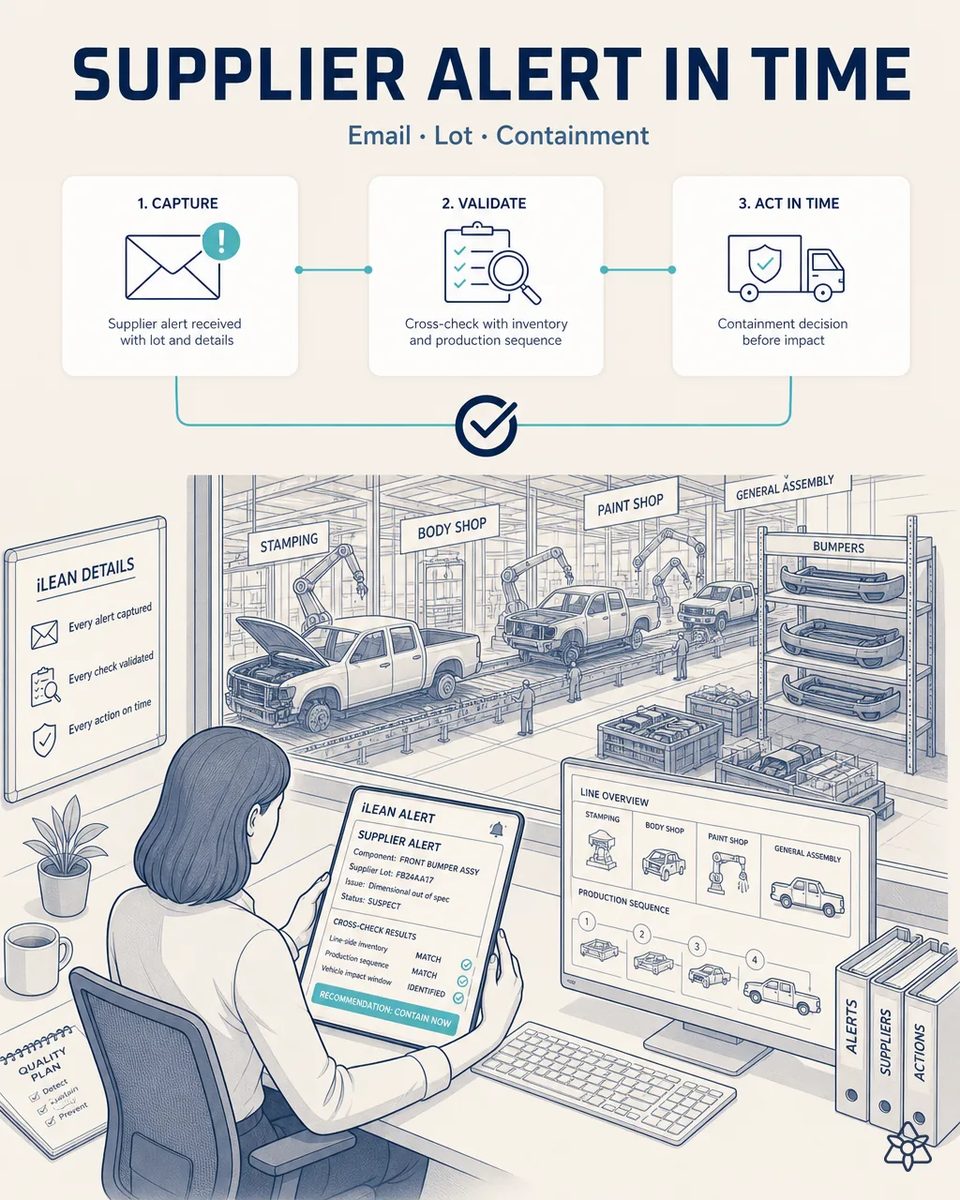
The supplier warned at seven. By the time it was read, the final line had built the problem in.
- A pickup truck plant's supply chain has hundreds of suppliers. Non-conformance notices, lot changes and holds arrive by email or messaging to specific people who cannot watch their inbox in real time. - By the time the warning is read, the line has installed the suspect part on many more units and containment means inspecting trucks in the yard.
- A full-size pickup plant buys from hundreds of suppliers. Non-conformance notices, lot changes and hold requests arrive by email or messaging to specific people.
- Those people are in the start-of-shift meeting, on the floor or at a supplier review. Nobody watches an inbox in real time.
- Every hour the warning waits, the line installs the suspect part on dozens more trucks. A containment that could have been one rack at line side becomes a sort of finished pickups in the release yard.
- And the engineer who finally reads it has to work out by hand which lot is where, and which VINs already carry it, by calling the warehouse, the line and the yard one after another.
Connect in chaotic-sources mode — the warning is read when it arrives, not when someone is free.
Connect chaotic-sources mode: dedicated mailbox and messaging number in silent copy; extraction of intent, part, lot and supplier; cross-check with line inventory and installed-VIN records; alert with a suggested action to the supplier quality engineer, who decides.
Suppliers keep warning the way they do today. Connect is copied on the supplier-quality mailbox and on the messaging channel of key suppliers, reads each warning as it lands and hands the engineer a concrete picture: this lot, this location, these VINs. The containment decision stays human; it simply starts hours earlier, while the suspect parts are still on a rack and not yet bolted into a cab or a cargo bed.
A suspect-lot warning read late versus read on arrival
| Aspect | Today | With iLEAN Connect |
|---|---|---|
| Warning sitting unread | Hours, depending on the meeting | Read in seconds |
| Where the suspect lot physically is | Searched by phone and on foot | Line-side and warehouse stock shown |
| Pickups already built with the part | Estimated from the schedule | Listed by VIN from install records |
| Containment scope | Hundreds of units, to be safe | Dozens, by real exposure |
| Trucks already in the release yard | Found during the sort | Flagged before they ship |
| Hold or sort decision | Taken with partial context | Taken by supplier quality, with full context |
Hours of latency → minutes. Suspect units in the hundreds → in the dozens. Decisions without context → decisions with inventory and VINs in view.
Impact estimate — to be validated with your numbers.
The block below is an estimate to be validated against your plant's actual data. We put it forward so the committee has an order of magnitude; we refine it during the assessment.
- Estimated payback 3-7 months, depending on how often suppliers send warnings and what each containment costs today.
- From hours of latency to minutes between the supplier's email and a containment decision.
- Suspect units drop from the hundreds to the dozens, because the line stops installing the lot much sooner.
- And fewer finished pickups pulled back from the release yard for a sort, which is the most expensive place to contain anything.
Estimated payback of 3 to 7 months depending on frequency and average cost of each containment. Estimate to be validated.
And the fair question from the production manager
“What if it misreads the lot number and we hold the wrong parts?” — extracting supplier, part number and lot from a warning, against your supplier master and the part numbers on your bill of materials, is an anchored task where the best models drop below 1.5% error [1]. And Connect holds nothing on its own: it proposes the containment, and the supplier quality engineer confirms the lot and the scope before any rack or truck is put on hold.
[1] OpenAI paper "Why Language Models Hallucinate", 2025 — on the reliability of AI in anchored tasks.
What people ask about supplier lot alerts in pickup assembly
Do suppliers have to send their warnings in a new format?
No. They keep using email or messaging, in their own words. The only change on your side is a dedicated mailbox and number copied on those conversations.
How does it know which trucks already carry the suspect part?
It crosses the part and lot with the installation records your line already keeps, such as traceability scans or the build record by VIN. Where a part is not scanned at install, it estimates the window from line-side consumption and says so.
Can it tell whether trucks with the part are already in the release yard?
Yes, if yard status is available by VIN. The proposal then separates units still on the line, units in repair and units waiting to ship, because each needs a different action.
What if the warning arrives at night or on a weekend?
It is read at once. The alert follows the escalation you define: the on-call supplier quality engineer first, then the shift quality lead if nobody acknowledges it.
Does it also read supplier notices about planned lot changes that are not defects?
Yes. A planned material or process change is extracted the same way and sent to its owner as information, so the first trucks built with the new lot are known in advance.
More cases from this series
- Zero defects escaping to the customer, from press to yardiLEAN links stamping, body, paint and assembly by VIN, panel and coil so no defect escapes to the…
- Every pickup with its own audit-ready evidence packiLEAN gathers photos, torques and validated repairs into an evidence pack per VIN, sorted by audit…
- From the audit spreadsheet to the ERP without retypingiLEAN reads audit and dimensional sheets, has a person validate them and pushes them to the ERP: -50 to…
- Steel coils traced into the ERP with one photoPhotograph each steel coil's label and certificate: iLEAN extracts heat, grade and thickness, gets them…
- Quality findings dictated while walking the lineQuality engineers dictate findings by voice while walking the line and iLEAN structures them by station,…
- Veteran stamping presses that finally share their dataAn external camera reads the stamping press panel and links tonnage and alarms to every panel defect,…
Forward us three anonymized supplier warnings and tell us how long each one waited.
We work on your plant's real data, not ours. Assessment with no commitment.
Request estimated ROI within 48h ‹ See all cases of pickup truck assembly See automotive