Every weld seam, inspected inline
A battery tray carries many meters of MIG or laser weld seam between profiles, cross members and frame. A pore, a lack of fusion or an interrupted seam is a path for a leak or a crack. With iLEAN Edge, a camera at the cell exit scans the seams and a neural network trained on your own good and bad examples detects pores, lack of fusion and spatter in milliseconds, locally, without sending images to the cloud.
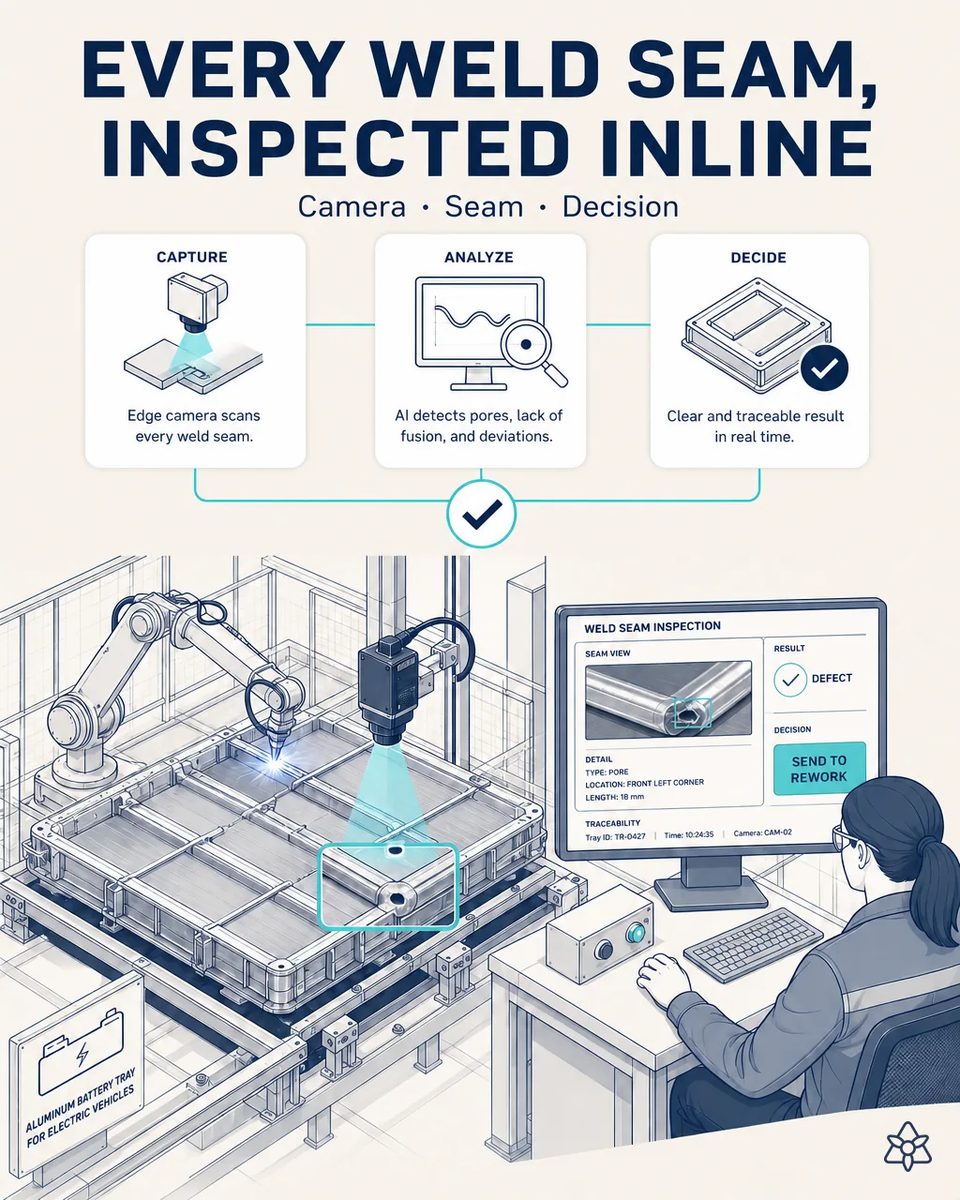
Meters of weld seam per tray, checked by sampling at line rate.
A battery tray carries many meters of MIG or laser weld seam between profiles, cross members and frame. A pore, a lack of fusion or an interrupted seam is a path for a leak or a crack. At line rate, the inspector checks by sampling or gets tired by the end of the shift. What slips through shows up later: at the leak test, with costly rework, or worse, at the customer.
- A battery tray carries many meters of MIG or laser weld seam between profiles, cross members and frame. Every meter is a potential leak path once the tray is sealed. A pore, a lack of fusion or an interrupted seam is a path for a leak or a crack.
- At line rate, the inspector checks by sampling or gets tired by the end of the shift. The borderline seams are exactly the ones that slip through. No one can look carefully at every meter of seam on every tray of a shift.
- What slips through shows up later: at the leak test, with costly rework, or worse, at the customer.
- And when defects cluster on one cell because of a worn nozzle or a drifting torch, nobody connects them until many trays have been affected.
Edge — local vision on every seam, in milliseconds, without sending images to the cloud.
Finding the pore at the cell exit instead of at the leak test means reworking an open frame, not a sealed tray. And defects grouped by cell become a maintenance signal: the nozzle, the torch or the wire feeder need attention before the next shift. Each diverted tray keeps its seam image, which is useful evidence for the customer.
- Edge vision on every seam, in milliseconds — With iLEAN Edge, a camera at the cell exit scans the seams and a neural network trained on your own good and bad examples detects pores, lack of fusion and spatter in milliseconds, locally, without sending images to the cloud.
- Earlier rework, and a signal for maintenance — The suspect tray is diverted to rework before sealing. And if defects cluster on one cell, maintenance gets the signal: nozzle, torch or wire feeder need attention.
Weld seam sampling versus Edge inspection of every seam
| Aspect | Visual sampling | With iLEAN Edge |
|---|---|---|
| Share of tray seams inspected | A sample per shift | 100% of seams |
| Pore or lack of fusion on a cross member | Found at leak test or by the customer | Found at the cell exit |
| Rework of a suspect tray | After sealing, costly | Before sealing |
| Defects clustering on one welding cell | Noticed weeks later | A signal for maintenance |
| Where seam images are processed | — | Locally, at the line |
| Borderline MIG or laser seam | Pass or fail by fatigue | Escalated to the inspector |
Visual sampling → 100% of seams inspected. Defect found at leak test or by the customer → found at the cell exit. Defects per cell → a signal for maintenance.
Impact estimate — to be validated with your numbers.
The block below is an estimate to be validated against your plant's actual data. We put it forward so the committee has an order of magnitude; we refine it during the assessment.
- Estimated payback 5-12 months, depending on current scrap. The higher today's leak rejects caused by seams, the shorter the payback.
- From sampling to 100% of seams inspected on every tray. Every image is kept with its verdict and the tray serial.
- Less late rework: the suspect tray goes to rework before sealing, not after a failed leak test. Reworking an open frame costs a fraction of reworking a sealed tray.
- And fewer complaints from the vehicle maker, plus a per-cell defect signal that tells maintenance where to look. A nozzle or wire feeder problem is visible within hours, not weeks.
Payback 5-12 months · from sampling to 100% of seams inspected (estimate to validate). From sampling to one hundred percent of seams inspected, less late rework and fewer complaints. Estimated payback of five to twelve months depending on current scrap; an estimate to validate.
And the fair question from the production manager
“What if it rejects good trays and floods rework?” — the model is trained on good and bad seams of your own trays, under that cell's lighting, not on a generic library. Classifying known seam defects on a fixed view is an anchored task where the best models drop below 1.5% error [1], and borderline seams are escalated to the inspector instead of being diverted automatically. Every decision the inspector takes is fed back into training, so the model learns your borderline cases.
[1] OpenAI paper "Why Language Models Hallucinate", 2025 — on the reliability of AI in anchored tasks.
What people ask about AI vision on battery tray weld seams
Which weld seam defects does it detect on the tray?
Pores, lack of fusion, interrupted seams and spatter, using a catalog built from good and bad examples from your own line. The location of each defect on the tray is stored with the image. New defect types are added as they appear, without starting over.
Does it work on laser and friction stir seams as well as MIG?
The approach is the same; each seam type is trained with its own examples and its own lighting. You start with the process that causes most leak rejects. The camera and lighting are adapted to each process, because laser and MIG seams look very different.
Does it keep up with the welding cell cycle time?
Yes. Inference runs locally in milliseconds, so the decision is available before the tray reaches the sealing station. No buffer is needed between welding and sealing. The line keeps its cycle time.
Does seam vision make the tray leak test unnecessary?
No. The leak test remains the final reference. What changes is that trays with visible seam defects stop reaching it and stop costing rework after sealing. Leak test capacity is spent on trays that deserve it.
Do images of our tray designs leave the plant?
No. Images are processed at the line and stay in the plant, which also removes any dependency on bandwidth. Your tray geometry and weld paths are not shared with anyone. That usually settles the question for the vehicle maker's engineering team too.
More cases from this series
- IATF evidence pack, always readyEvery inspection, leak test and work order generates evidence; iLEAN Agents builds the IATF and customer…
- A tray line without surprise stopsConnect, Edge, Agents and JIDOKA AI correlate every signal per cell and give the maintenance manager a…
- The legacy CNC that now talksAn external camera reads the panel of an offline CNC center: spindle load and alarms in central memory,…
- The downtime spreadsheet, straight to ERPiLEAN reads the downtime sheet on save and, after validation, pushes it to the ERP: up-to-date OEE and…
- Extrusion receiving with a certificate photoPhotograph the delivery note and material certificate: alloy, heat number and quantities into the ERP…
- Hands-free maintenance on the roundThe technician dictates observations while walking the line; iLEAN structures them per cell and shift so…
Bring good and bad weld seam samples and we will assess your tray line.
We work on your plant's real data, not ours. Assessment with no commitment.
Request estimated ROI within 48h ‹ See all cases of battery trays See automotive