The downtime spreadsheet, straight to ERP
In many battery tray plants the real log of downtime per cell, lost minutes and cause sits in a spreadsheet in the maintenance shared folder. That is the one updated live. The ERP gets the same data weeks later, typed in by hand. iLEAN Connect observes the shared folder, not the people. When the spreadsheet is saved, it reads what is new, interprets it and stores it in central memory. After the owner validates, it pushes it to the ERP through the API.
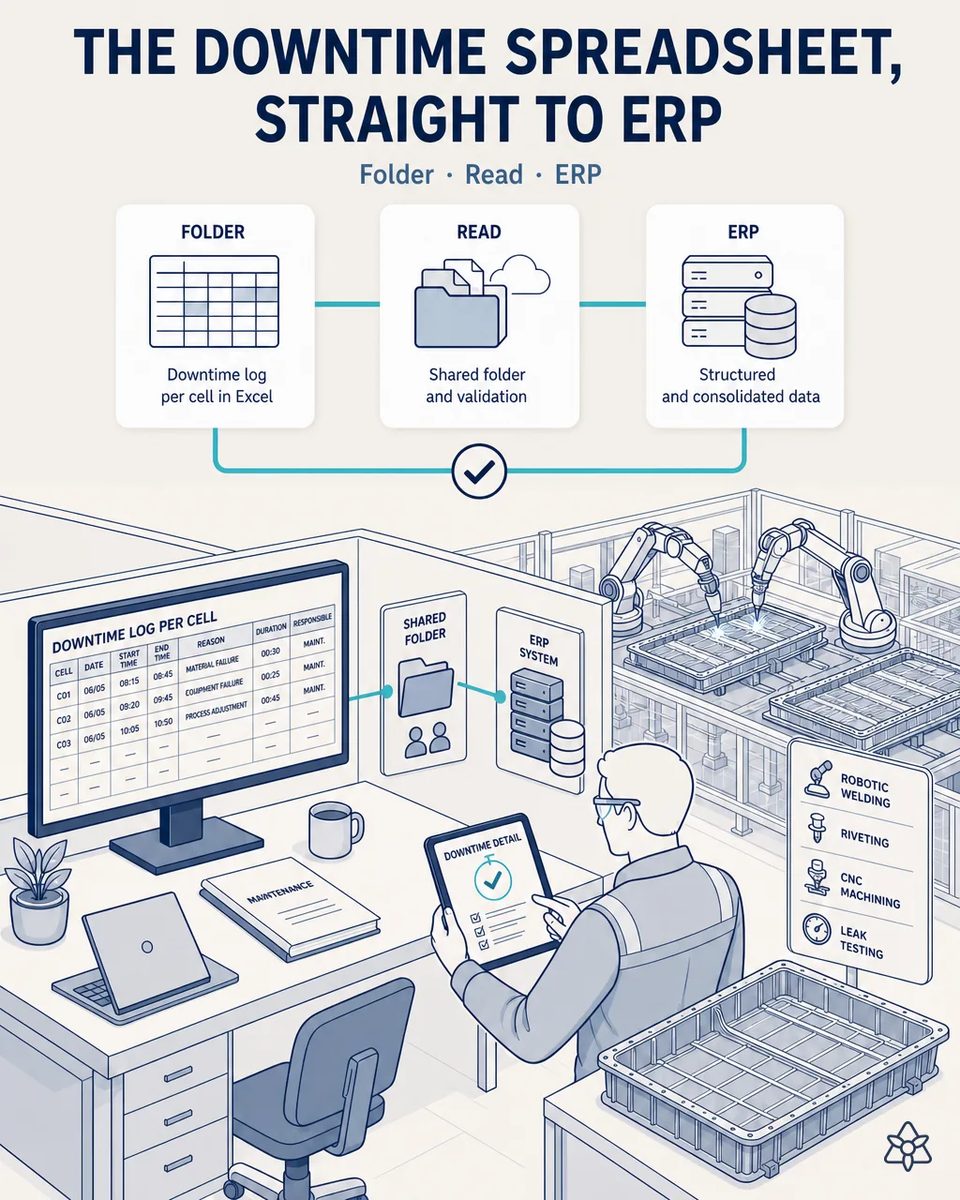
The real downtime log lives in a spreadsheet the ERP sees weeks later.
In many battery tray plants the real log of downtime per cell, lost minutes and cause sits in a spreadsheet in the maintenance shared folder. That is the one updated live. The ERP gets the same data weeks later, typed in by hand. To get the data into the ERP maintenance module, several people log in to type it, and each one needs a license. On top of that, the official OEE lags weeks behind what happens on the line.
- In many tray plants the real log of downtime per welding, riveting, CNC and leak test cell, lost minutes and cause sits in a spreadsheet in the maintenance shared folder. It is quick to fill in and everybody trusts it.
- That is the one updated live. The ERP gets the same data weeks later, typed in by hand. By then nobody remembers the context of a vague cause like adjustment or material.
- To get it into the ERP maintenance module, several people log in to type it, and each one needs a license. Those seats are paid every year just to move data from one screen to another.
- On top of that, the official OEE lags weeks behind what happens on the tray line, so decisions are taken on numbers nobody on the floor recognizes. The cell leaders stop trusting the official figures and keep their own.
Connect in listen-inward mode — it reads the maintenance folder, not the people.
The spreadsheet stays the same and the people who keep it change nothing. What disappears is the retyping, and with it most of the licenses that only exist to retype. And the official OEE finally matches what the cell leaders see on the floor.
- iLEAN observes the folder and reads the sheet on save — iLEAN Connect observes the shared folder, not the people. When the spreadsheet is saved, it reads what is new, interprets it and stores it in central memory. After the owner validates, it pushes it to the ERP through the API.
- CFO angle: from N licenses to one — If five people log into the ERP today just to record downtime and spare part usage, with Connect only the person who validates is needed. A typical reduction of fifty to eighty percent in that module's licenses, a recurring saving every year.
The downtime spreadsheet retyped versus read on save
| Aspect | Today | With iLEAN Connect |
|---|---|---|
| Lag between downtime sheet and ERP | Weeks | Immediate after validation |
| Lost minutes per tray line cell | Retyped by hand | Read from the sheet on save |
| ERP maintenance module seats | One per person retyping | One to validate (−50 to −80%) |
| Official OEE of the tray line | Weeks behind the floor | Up to date |
| Spreadsheet layout kept by maintenance | — | Unchanged |
| Who approves the push to the ERP | Nobody: it is just typed | The sheet owner |
Weeks of lag between spreadsheet and ERP → immediate. Several licenses to retype → one to validate (−50 to −80%, estimate to validate).
Impact estimate — to be validated with your numbers.
The block below is an estimate to be validated against your plant's actual data. We put it forward so the committee has an order of magnitude; we refine it during the assessment.
- Estimated payback 4-9 months, to validate against the ERP invoice. The licenses you actually pay for today are the starting point.
- −50 to −80% of maintenance module ERP licenses: if five people log in today just to record downtime and spare usage, only the validator is needed.
- A recurring saving every year, not a one-off. It adds up on top of the payback, because the seats stop being renewed.
- And an official OEE that is up to date, so the downtime discussed in the morning meeting is the same one the ERP reports. Plant management stops reconciling two versions of the same week.
Payback 4-9 months · −50 to −80% of maintenance module ERP licenses (estimate to validate). Estimated payback of four to nine months, plus recurring license savings and an official OEE that is up to date; an estimate to validate against the ERP invoice.
And the fair question from the production manager
“What if it reads a row wrong and the ERP ends up with bad downtime?” — reading new rows from a spreadsheet with a known structure is an anchored task, where the best models drop below 1.5% error [1]. And nothing is pushed until the sheet owner validates it, so a wrong cell or cause is caught before it reaches the ERP. Every validation is logged with the name of the person who approved it.
[1] OpenAI paper "Why Language Models Hallucinate", 2025 — on the reliability of AI in anchored tasks.
What people ask about pushing the downtime spreadsheet to the ERP
Do we have to standardize the downtime spreadsheet first?
No. iLEAN reads the layout maintenance already uses, including free-text cause columns. If the layout changes, it adapts instead of breaking. Maintenance keeps the spreadsheet it trusts, and nobody has to learn a new screen. Formulas, colors and extra tabs are left alone.
Does it read every save or only the end of shift?
Every save. It picks up what is new since the last reading, so lost minutes on a cell are in central memory minutes after they are written. The owner sees the pending rows and validates them in one pass. A cause written in free text is mapped to your downtime codes and shown for confirmation.
How real is the cut in maintenance module seats for downtime entry?
Typically fifty to eighty percent of the seats used only to retype downtime and spare usage. We validate it with you against the actual ERP invoice before committing. The saving repeats every year the licenses are renewed.
Does it track what people do in the shared folder?
No. It observes the file, not the people. It reads the content of the downtime sheet when it is saved, nothing else. It does not record who opened the file or how long they spent in it.
What if our ERP has no API for the maintenance module?
We look at the integration options of your ERP during discovery. Most current ERPs have one; when they do not, there are intermediate routes we assess case by case. The reading and validation part works from day one either way.
More cases from this series
- IATF evidence pack, always readyEvery inspection, leak test and work order generates evidence; iLEAN Agents builds the IATF and customer…
- A tray line without surprise stopsConnect, Edge, Agents and JIDOKA AI correlate every signal per cell and give the maintenance manager a…
- The legacy CNC that now talksAn external camera reads the panel of an offline CNC center: spindle load and alarms in central memory,…
- Extrusion receiving with a certificate photoPhotograph the delivery note and material certificate: alloy, heat number and quantities into the ERP…
- Hands-free maintenance on the roundThe technician dictates observations while walking the line; iLEAN structures them per cell and shift so…
- Leak tester stitched to the MESSerial number, test program and tightness curve flow between tester and MES with no typing: per-tray…
Tell us how many people retype downtime into your ERP today.
We work on your plant's real data, not ours. Assessment with no commitment.
Request estimated ROI within 48h ‹ See all cases of battery trays See automotive