A tray line without surprise stops
In a plant supplying battery trays to a vehicle maker, the heaviest risk is an unplanned stop on a critical cell: welding, riveting, machining or leak testing. A long stop can halt the customer's line. Connect captures checklists, panels, emails, voice and the downtime spreadsheet. Edge sees the seams and the state of each cell at restart. Everything enters central memory with human verification.
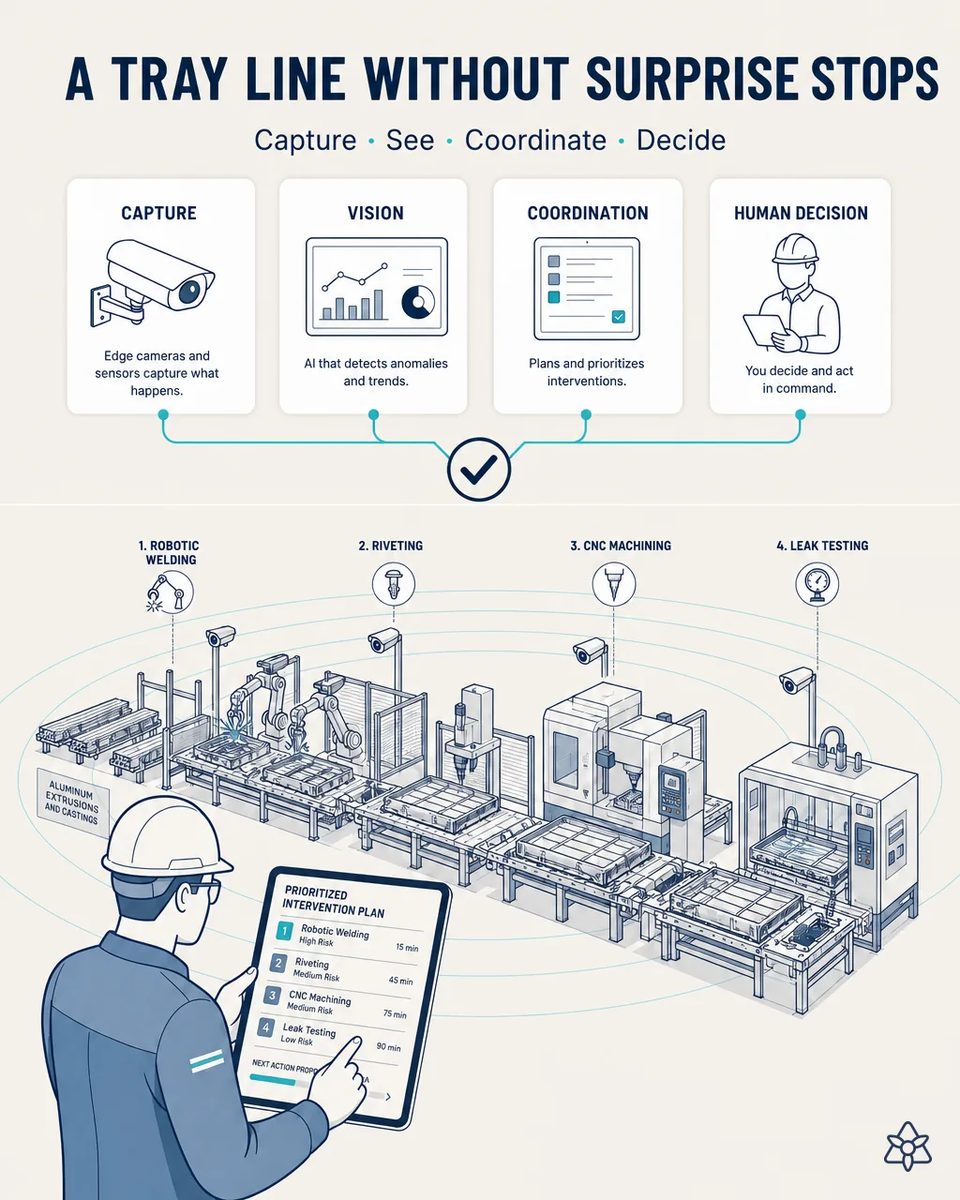
Each warning existed somewhere; nobody joined them before the cell stopped.
In a plant supplying battery trays to a vehicle maker, the heaviest risk is an unplanned stop on a critical cell: welding, riveting, machining or leak testing. A long stop can halt the customer's line. The checklist that flagged a loose clamp, the rising spindle load, the delayed spare part, the defects clustering on one cell, the tester taking longer. Each signal lives somewhere else and nobody connects them in time.
- In a plant supplying battery trays to a vehicle maker, the heaviest risk is an unplanned stop on a critical cell: welding, riveting, machining or leak testing.
- A long stop can halt the customer's line, with penalties and a supplier status that takes years to rebuild.
- The checklist that flagged a loose clamp, the rising spindle load, the delayed servo, the defects clustering on one cell, the tester taking longer to stabilize.
- Each signal lives somewhere else and nobody connects them in time. The stop is a surprise only because the signals were never seen together.
Agents with JIDOKA AI and SMED AI — four rings feeding one memory per cell.
No single case prevents the stop on its own. The strength is in the correlation: when a checklist, a spindle trend and a late spare point at the same cell, the maintenance manager sees it in one plan instead of three systems. Same team, now with every signal in hand.
- Rings 1 and 2: Connect captures, Edge sees — Connect captures checklists, panels, emails, voice and the downtime spreadsheet. Edge sees the seams and the state of each cell at restart. Everything enters central memory with human verification.
- Rings 3 and 4: Agents coordinates, JIDOKA AI protects — iLEAN Agents correlates the signals per cell and proposes a prioritized plan to the maintenance manager: what to service at the next planned stop and which spare to secure. JIDOKA AI stops in time what should not continue, and SMED AI shortens changeovers and restarts.
- Humans in command — The AI prioritizes and prepares; the maintenance manager decides what is done and when. Same team, now with every signal in hand.
The four rings of the tray line, and what each one adds
| Ring | Which cases it draws on | What it adds |
|---|---|---|
| 1 · Connect captures | TPM checklist (1), CNC panel (2), spare alert (3), voice round (4), downtime sheet (6) | Every early warning in central memory |
| 1 · Traceability inputs | Extrusion receiving (7) + leak tester (8) | Heat and tightness curve per tray serial |
| 2 · Edge sees | Weld seam (9) + cell restart (10) | Defects per cell and the state at restart |
| Tablet sign-off across the tray rings | Work order close-out (5) | Nothing unsigned in the CMMS |
| 3 · Agents coordinates | IATF evidence pack (11) + this plan | Prioritized plan per cell |
| 4 · JIDOKA AI protects | With SMED AI on changeovers | Stops what should not continue |
Scattered signals nobody connects → prioritized intervention plan per cell. Unplanned stops on critical cells → interventions at planned stops. Customer penalties → availability protected.
Impact estimate — to be validated with your numbers.
The block below is an estimate to be validated against your plant's actual data. We put it forward so the committee has an order of magnitude; we refine it during the assessment.
- Estimated payback 6-12 months, against the first long stop avoided; to validate with your history. A single stop that halts the customer's line can cost more than the whole system.
- Fewer unplanned stops on critical cells: interventions move into planned stops. Maintenance stops working only in reaction.
- Fewer customer penalties and higher availability on the cells that feed the vehicle maker just in time.
- And the same maintenance team, now with every signal in hand and a clear order of what to service and which spare to secure.
Payback 6-12 months · fewer unplanned stops on critical cells (estimate to validate). Fewer unplanned stops on critical cells, fewer customer penalties and higher availability. Estimated payback of six to twelve months against the first long stop avoided; an estimate to validate with your history.
And the fair question from the production manager
“Do we have to deploy all twelve cases before this works?” — no. The rings are built in layers and each case pays on its own. With the TPM checklist and the CNC panel you already have the first warnings in one memory. When Agents correlates them, linking a record to the right cell is an anchored task where the best models drop below 1.5% error [1], and the plan is always a proposal that the maintenance manager approves. Nothing is scheduled without a person deciding it.
[1] OpenAI paper "Why Language Models Hallucinate", 2025 — on the reliability of AI in anchored tasks.
What people ask about zero unplanned stops on a battery tray line
Where should a battery tray plant start?
With the cases that have the fewest dependencies, usually the TPM checklist and the CNC panel. Each one pays on its own and feeds the later rings. The order is decided with you, based on where your last stops came from.
What does the correlation catch that each case misses on its own?
The combination: a flagged clamp, a climbing spindle load and a late spare on the same cell. Each one looks minor alone; together they announce a stop. Agents is the piece that puts them side by side. It does it per cell, continuously, not once a month in a report.
Does Agents decide the maintenance plan?
No. It prioritizes and prepares the plan; the maintenance manager decides what is done and when. Humans in command throughout. The plan shows why each item is there, so the manager can disagree with reasons.
What do JIDOKA AI and SMED AI do on the tray line?
JIDOKA AI stops in time what should not continue, such as a cell restarting in a wrong state. SMED AI shortens changeovers and restarts between tray models. Both act on what the other rings captured. Neither one acts outside the rules your team defines.
Can the return be estimated before committing to all four rings?
Yes. With your downtime history, the cost of your last long stop and the customer penalty terms, we estimate the return layer by layer before deciding the order. The first long stop avoided is usually what pays for the system.
More cases from this series
- IATF evidence pack, always readyEvery inspection, leak test and work order generates evidence; iLEAN Agents builds the IATF and customer…
- The legacy CNC that now talksAn external camera reads the panel of an offline CNC center: spindle load and alarms in central memory,…
- The downtime spreadsheet, straight to ERPiLEAN reads the downtime sheet on save and, after validation, pushes it to the ERP: up-to-date OEE and…
- Extrusion receiving with a certificate photoPhotograph the delivery note and material certificate: alloy, heat number and quantities into the ERP…
- Hands-free maintenance on the roundThe technician dictates observations while walking the line; iLEAN structures them per cell and shift so…
- Leak tester stitched to the MESSerial number, test program and tightness curve flow between tester and MES with no typing: per-tray…
Tell us what your last long stop on a critical tray cell cost.
We work on your plant's real data, not ours. Assessment with no commitment.
Request estimated ROI within 48h ‹ See all cases of battery trays See automotive