The legacy CNC that now talks
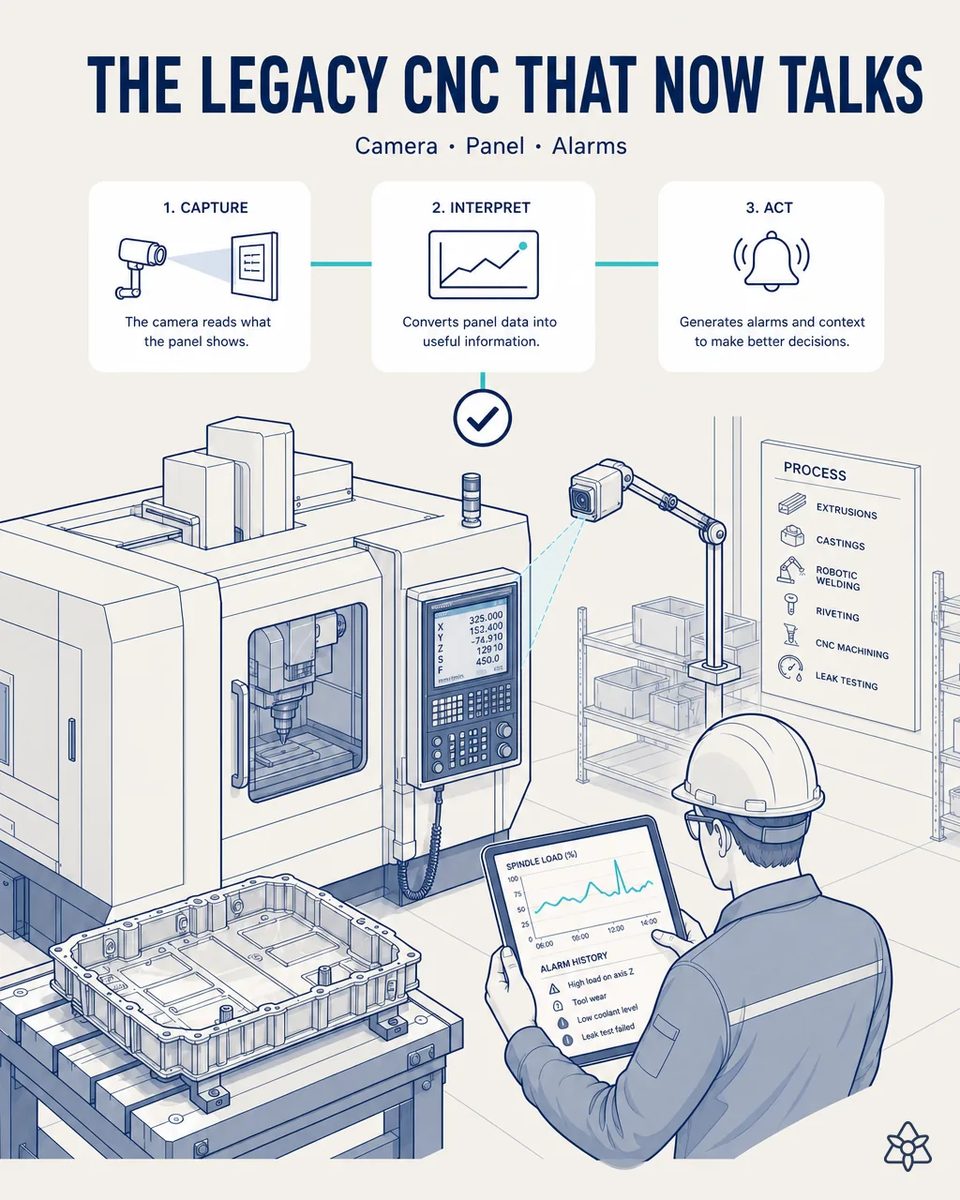
On the battery tray line there are machining centers that mill and drill the sealing faces and mounting points. Some are years old, with a proprietary control and no network connection. Their screen shows spindle load, alarms and counters, and all of it is lost. With iLEAN Connect a camera pointed at the panel is enough. iLEAN reads the screen every few seconds, interprets spindle load, alarms and status, and stores it in central memory linked to the part being machined. The machine stays the same, but now it talks.
The machining center mills the sealing faces and forgets everything it saw.
On the battery tray line there are machining centers that mill and drill the sealing faces and mounting points. Some are years old, with a proprietary control and no network connection. Their screen shows spindle load, alarms and counters, and all of it is lost. Connecting them through a control retrofit means a significant investment and days of downtime on a line that supplies the customer just in time. So the plant keeps running blind until the spindle complains too late.
- On the tray line, machining centers mill the sealing faces and drill the mounting points of welded frames and cast housings. Those faces are where the lid gasket seals, so their flatness matters for every leak test downstream. Some are years old, with a proprietary control and no network connection.
- Their screen shows spindle load, alarms and part counters, and all of it disappears when the screen refreshes. Nobody can say which trays were machined while the load was climbing. The counters are copied by hand at best, and the alarms are cleared without a trace.
- Connecting them through a control retrofit means a significant investment and days of downtime on a line that supplies the customer just in time.
- So the plant keeps running blind until the spindle complains too late, usually in the middle of a shift and with trays waiting for flatness on their sealing faces.
Connect in photo mode on the CNC panel — read from outside, the control untouched.
The machine stays exactly as it is, with no software installed and no port opened. What changes is that maintenance starts seeing the spindle load trend week after week and can book the bearing or spindle intervention into a planned stop instead of an emergency. The spindle load history also tells process engineering which tray programs push the machine hardest.
- An external camera reads the panel without touching the machine — With iLEAN Connect a camera pointed at the panel is enough. iLEAN reads the screen every few seconds, interprets spindle load, alarms and status, and stores it in central memory linked to the part being machined. The machine stays the same, but now it talks.
- Trends for maintenance, not just alarms — Maintenance sees the spindle load trend week after week and can schedule the intervention in a planned stop, instead of finding out through an alarm in the middle of production.
The offline machining center versus the machining center being read
| Aspect | Today | With iLEAN Connect |
|---|---|---|
| Spindle load while milling sealing faces | Lost at every screen refresh | Trend per tray in central memory |
| Control alarms | Seen only if someone is in front | Logged with time and part |
| Spindle failure | A surprise mid-production | Intervention at a planned stop |
| Proprietary control and CNC program | — | Untouched, no software installed |
| Control retrofit CAPEX | Urgent in the plan | Can be deferred |
| Which trays were cut under high load | Impossible to say | One query by serial |
Offline panel, data lost → spindle load trend and alarms per part. Surprise spindle failure → intervention at a planned stop. Urgent retrofit → can be deferred.
Impact estimate — to be validated with your numbers.
The block below is an estimate to be validated against your plant's actual data. We put it forward so the committee has an order of magnitude; we refine it during the assessment.
- Estimated payback 5-10 months, to validate with the failure history of those machines. The more often a spindle has stopped the line, the faster the case pays.
- The return combines deferring the control retrofit CAPEX and avoiding stops caused by spindle failure. A single spindle replacement booked into a planned stop instead of an emergency changes the numbers.
- Spindle load and alarms per part, so a climbing trend is visible weeks before the alarm.
- And no downtime to install anything, which on a just-in-time line is often what makes the case approvable.
Payback 5-10 months · defers retrofit CAPEX and anticipates spindle failures (estimate to validate). The return combines deferring the control retrofit and avoiding stops caused by spindle failure. Estimated payback of five to ten months; an estimate to validate with the failure history of those machines.
And the fair question from the production manager
“Can a camera really read a CNC screen reliably?” — the task is anchored: a fixed panel, fields in known positions and values within physical ranges, where the best models drop below 1.5% error [1]. And any reading outside the possible range for that spindle is discarded instead of stored, so a reflection or a menu change never turns into a false trend.
[1] OpenAI paper "Why Language Models Hallucinate", 2025 — on the reliability of AI in anchored tasks.
What people ask about reading a legacy CNC panel on a tray line
Does the machine builder have to touch the CNC control?
No. The camera sits outside the machine and reads the screen, so nothing is installed on the control and its configuration stays as it was approved. The camera can be removed in minutes and the machine is exactly as it was before.
How does it know which tray was being machined?
The reading is linked to the part counter and to the serial or order active at that moment, so the spindle load can be queried per tray. That is what lets quality relate a flatness problem on a sealing face to the load the spindle carried while cutting it.
What if the operator switches screens or menus on the panel?
iLEAN recognizes which screen is shown and only reads the fields it expects there. Frames from other menus are ignored rather than misread. The operator keeps using the panel exactly as before; nobody has to leave it on a particular screen.
Does it replace a future control retrofit?
It defers it. When the retrofit comes, it can be planned around a real load and alarm history instead of being forced by a failure. And the history collected in the meantime helps decide which machine needs it first.
Can the same camera approach cover other offline machines on the line?
Yes. Riveting stations or older leak benches with a screen follow the same pattern. Machining centers are usually first because spindle failures stop the line longest. Once the first panel is read, adding the next machine is a matter of days.
More cases from this series
- IATF evidence pack, always readyEvery inspection, leak test and work order generates evidence; iLEAN Agents builds the IATF and customer…
- A tray line without surprise stopsConnect, Edge, Agents and JIDOKA AI correlate every signal per cell and give the maintenance manager a…
- The downtime spreadsheet, straight to ERPiLEAN reads the downtime sheet on save and, after validation, pushes it to the ERP: up-to-date OEE and…
- Extrusion receiving with a certificate photoPhotograph the delivery note and material certificate: alloy, heat number and quantities into the ERP…
- Hands-free maintenance on the roundThe technician dictates observations while walking the line; iLEAN structures them per cell and shift so…
- Leak tester stitched to the MESSerial number, test program and tightness curve flow between tester and MES with no typing: per-tray…
Tell us how many machining centers on your tray line are still offline.
We work on your plant's real data, not ours. Assessment with no commitment.
Request estimated ROI within 48h ‹ See all cases of battery trays See automotive