Extrusion receiving with a certificate photo
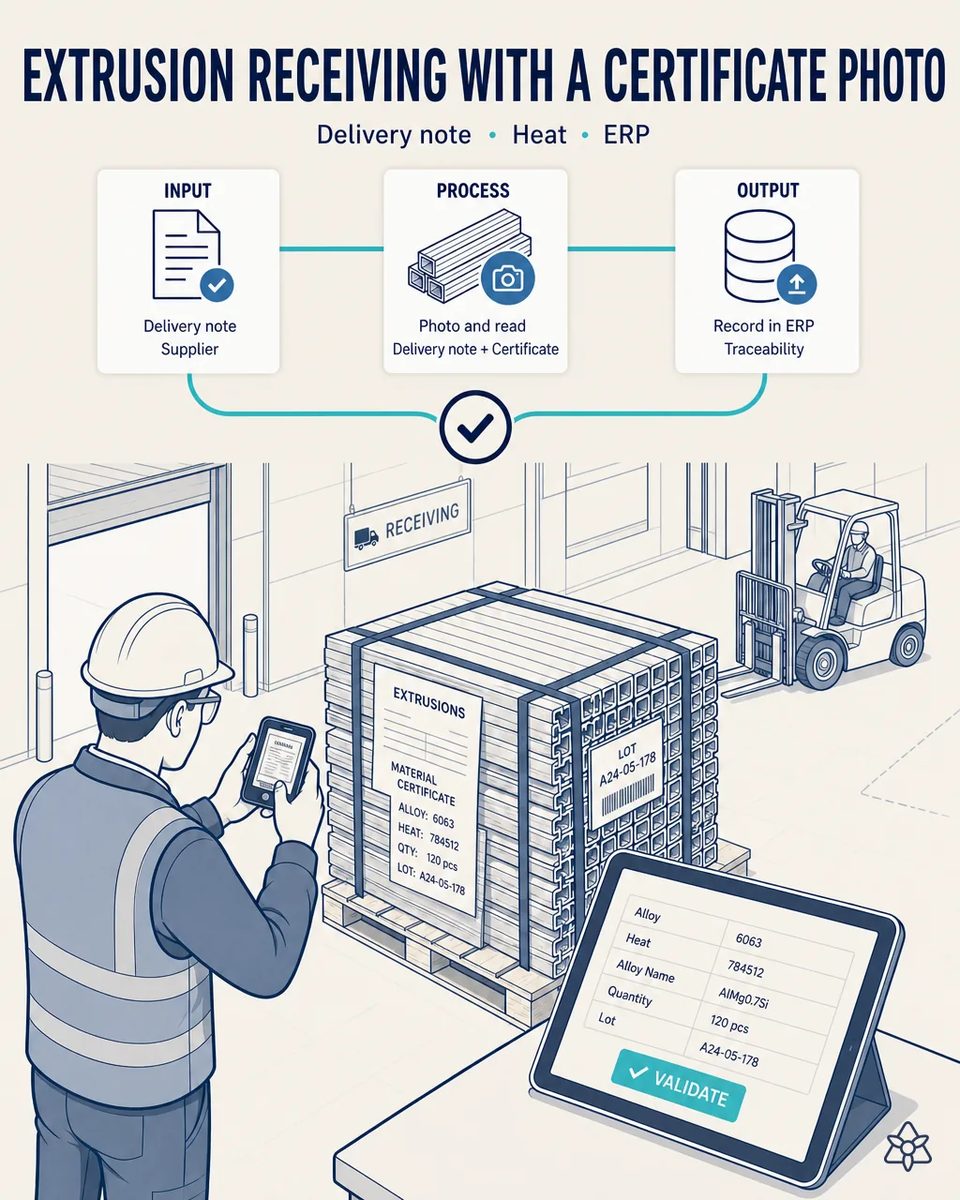
The battery tray plant receives bundles of extruded profiles and aluminum castings, each with a delivery note, a lot label and a material certificate with alloy, temper and heat number. With iLEAN Connect they photograph the delivery note, the label and the certificate. iLEAN extracts alloy, heat number, quantities and supplier, compares them with the purchase order and shows them on the tablet. One tap to validate and it goes into the ERP.
One mistyped heat number breaks the tray's traceability.
The battery tray plant receives bundles of extruded profiles and aluminum castings, each with a delivery note, a lot label and a material certificate with alloy, temper and heat number. The receiving lead types every line into the ERP. In a hurry, one mistyped heat number breaks the traceability the customer demands the day a tray shows a crack or a leak. Going slowly, the truck waits.
- The tray plant receives bundles of extruded profiles and aluminum castings, each with a delivery note, a lot label and a material certificate with alloy, temper and heat number. Several suppliers, several certificate layouts, all on the same morning.
- The receiving lead types every line into the ERP. Going slowly, the truck waits at the dock. And the carrier charges for it.
- In a hurry, one mistyped heat number breaks the traceability the vehicle maker demands the day a tray shows a crack or a leak.
- And when that day comes, finding which trays were built from which extrusion heat means going back to paper certificates in a binder. Hours of work, and a delayed answer to the customer at the worst possible moment.
Connect in photo mode at receiving — note, label and certificate in one capture.
The heat number is the first link of the chain that ends in a tray serial. Capturing it from the certificate itself, instead of retyping it, is what makes heat-to-tray traceability something you can query rather than rebuild. It also speeds up the dock, which the carriers notice in the first week.
- One photo of the note and certificate; one tap to validate — With iLEAN Connect they photograph the delivery note, the label and the certificate. iLEAN extracts alloy, heat number, quantities and supplier, compares them with the purchase order and shows them on the tablet. One tap to validate and it goes into the ERP.
- CFO angle: fewer receiving licenses — The receiving module usually has two or three active licenses. With Connect a single person validates without logging into the ERP: a typical reduction of fifty to seventy percent in those licenses, plus fewer carrier delays.
Extrusion receiving typed by hand versus receiving by photo
| Aspect | Today | With iLEAN Connect |
|---|---|---|
| Booking a profile bundle | Typed line by line | One photo and one tap |
| Alloy and temper from the certificate | Copied by hand | Extracted and checked |
| Heat number on the extrusion lot | Mistyped under pressure | Read from the certificate itself |
| Certificate against the extrusion purchase order | Done when there is time | Automatic, mismatches flagged |
| Heat-to-tray traceability | Rebuilt from binders | Queryable per serial |
| ERP receiving module seats | Two or three active | −50 to −70% |
Receiving typed line by line → one photo and one tap. Mistyped heat numbers → full heat-to-tray traceability. Receiving licenses −50 to −70% (estimate to validate).
Impact estimate — to be validated with your numbers.
The block below is an estimate to be validated against your plant's actual data. We put it forward so the committee has an order of magnitude; we refine it during the assessment.
- Estimated payback 3-8 months. To validate with your delivery volume and the licenses active in the receiving module.
- −50 to −70% of receiving module ERP licenses: a single person validates without logging into the ERP. The others stop needing a seat just to book deliveries.
- Full heat-to-tray traceability from a photo, ready for the day a crack or leak needs a root cause. The containment is bounded to the trays that share the suspect heat, not to a whole month.
- And fewer carrier delays at the dock, because booking a delivery no longer depends on typing speed. Carriers spend less time waiting, and that shows in the freight bills.
Payback 3-8 months · −50 to −70% of receiving module ERP licenses (estimate to validate). Estimated payback of three to eight months, with full heat-to-tray traceability from a photo; an estimate to validate.
And the fair question from the production manager
“What if it reads the heat number wrong?” — extracting alloy, temper and heat number from a mill certificate with a known structure is an anchored task, where the best models drop below 1.5% error [1]. And it is double-checked: the values are compared with the purchase order and the lot label, and the receiving lead validates on the tablet before the ERP is touched. If a value is unreadable, it is flagged instead of guessed.
[1] OpenAI paper "Why Language Models Hallucinate", 2025 — on the reliability of AI in anchored tasks.
What people ask about receiving aluminum extrusions by photo
Can it read certificates from different extrusion and casting suppliers?
Yes. Each supplier's certificate layout is learned once, and new ones are added as they appear. Suppliers do not have to change anything. Scanned and photographed certificates are handled the same way. So are certificates in other languages.
What if the delivery note and the material certificate disagree?
The mismatch is flagged on the tablet before booking, for example a quantity or an alloy that does not match the purchase order. The receiving lead decides. Nothing is booked until the difference is resolved or accepted on purpose. The decision is recorded with the name of whoever took it.
How does the extrusion heat number follow the profile to the tray?
It is stored with the lot at receiving, and from there it is carried through cutting and welding to the tray serial that consumed that lot. The day a tray cracks, one query tells you which other trays share its heat.
Do we still need someone logged into the ERP at receiving?
One person validates on the tablet without logging into the ERP. That is where the license reduction comes from. The rest of the receiving team keeps working without an ERP seat. They photograph, the validator confirms.
Does it handle castings as well as extruded profiles?
Yes. Cast corners and housings come with their own certificates and lot labels, and they follow the same capture and validation flow. Fasteners, rivets and sealant can be added later if traceability requires them.
More cases from this series
- IATF evidence pack, always readyEvery inspection, leak test and work order generates evidence; iLEAN Agents builds the IATF and customer…
- A tray line without surprise stopsConnect, Edge, Agents and JIDOKA AI correlate every signal per cell and give the maintenance manager a…
- The legacy CNC that now talksAn external camera reads the panel of an offline CNC center: spindle load and alarms in central memory,…
- The downtime spreadsheet, straight to ERPiLEAN reads the downtime sheet on save and, after validation, pushes it to the ERP: up-to-date OEE and…
- Hands-free maintenance on the roundThe technician dictates observations while walking the line; iLEAN structures them per cell and shift so…
- Leak tester stitched to the MESSerial number, test program and tightness curve flow between tester and MES with no typing: per-tray…
Tell us how long an extrusion delivery takes to be booked at your dock.
We work on your plant's real data, not ours. Assessment with no commitment.
Request estimated ROI within 48h ‹ See all cases of battery trays See automotive