Leak tester stitched to the MES
Every battery tray goes through a tightness test before leaving. The tester is fairly modern and has a data interface, but it is not connected to the traceability system: the result stays in its memory or on a sheet. With iLEAN Connect the tester and the MES are stitched together: the serial number read at the station travels with the test program, and the result with its curve returns to that tray's record with no typing in between.
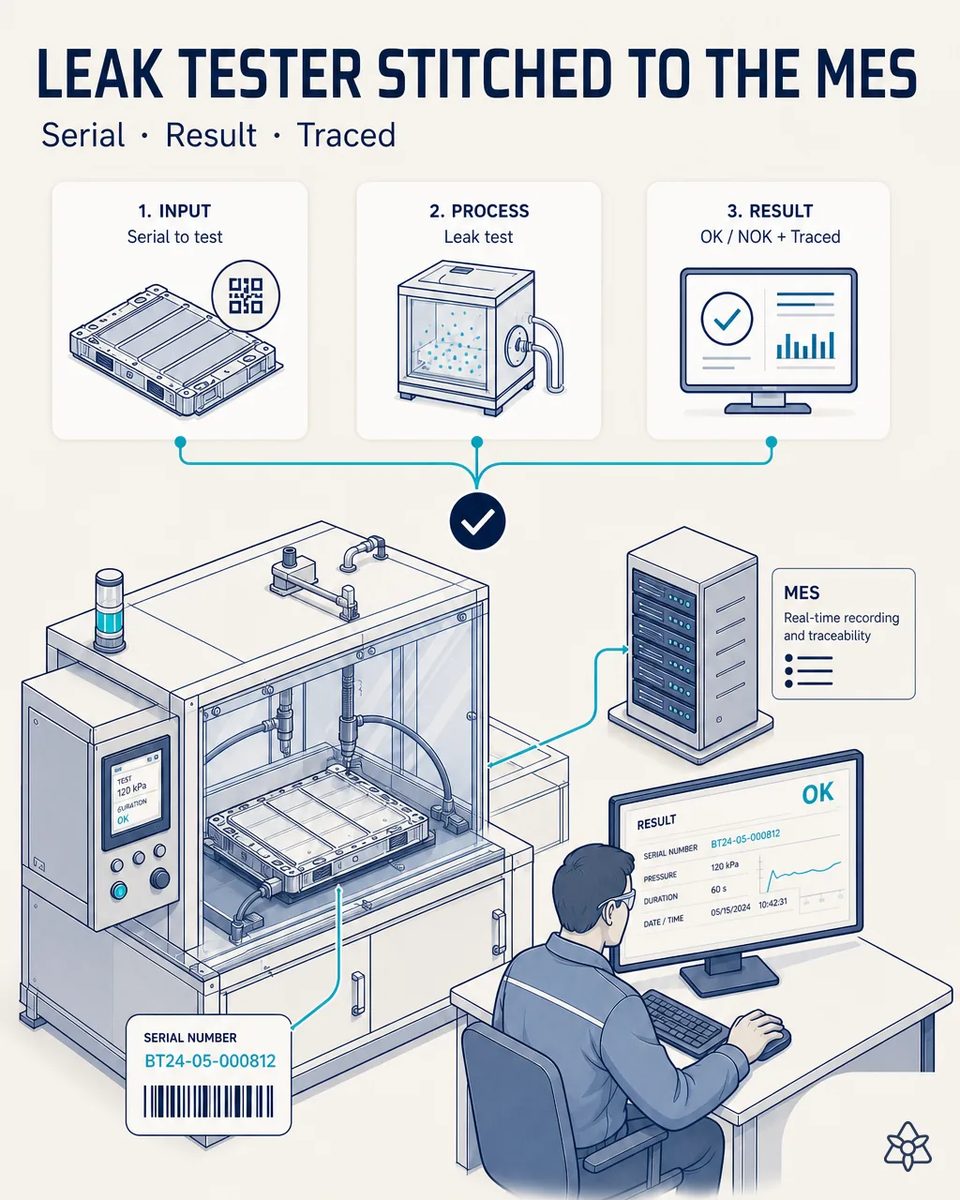
The tightness result stays in the tester and the serial is copied by hand.
Every battery tray goes through a tightness test before leaving. The tester is fairly modern and has a data interface, but it is not connected to the traceability system: the result stays in its memory or on a sheet. Someone writes down or types serial number, pressure, decay and result. One wrong digit and the tray carries a test that is not its own. The day the customer asks about a specific serial, rebuilding it takes hours.
- Every battery tray goes through a tightness test before leaving. The tester is fairly modern and has a data interface, but it is not connected to the traceability system. It was bought with the interface; nobody had time to connect it.
- The result stays in its memory or on a sheet. Someone writes down or types serial number, pressure, decay and result.
- One wrong digit and the tray carries a test that is not its own. The day the customer asks about a specific serial, rebuilding it takes hours. And the answer is only as good as the handwriting on the sheet.
- Meanwhile nobody looks at the curves, so a station that takes longer to stabilize or whose calibration drifts is only noticed when it starts rejecting good trays.
Connect stitching two modern systems via API — the tester and the MES talk directly.
Both systems stay as they are; iLEAN is the stitch between them. The serial read at the station travels with the test program, and the result with its curve comes back to that tray's record with no person retyping digits in between. It is one of the fastest cases to deploy because both ends already speak a data language.
- iLEAN stitches the tester to the MES through APIs — With iLEAN Connect the tester and the MES are stitched together: the serial number read at the station travels with the test program, and the result with its curve returns to that tray's record with no typing in between.
- Maintenance wins too — With every curve stored, maintenance sees when the station takes longer to stabilize or its calibration drifts, and services it before it starts throwing false rejects.
Leak results copied by hand versus results stitched to the MES
| Aspect | Today | With iLEAN Connect |
|---|---|---|
| Tray serial at the leak station | Typed or written down | Read and sent with the program |
| Pressure, decay and verdict | Noted on a sheet | Stored on that tray's record |
| Full tightness curve | Stays in the tester memory | Kept per serial |
| Customer asks about one tray | Hours rebuilding | Instant lookup |
| Calibration drift of the station | Noticed via false rejects | Seen in the curves first |
| Tester and MES software | — | Unchanged, connected via API |
Results noted by hand → automatic record per serial number. Hours rebuilding a serial → instant lookup. Unnoticed calibration drift → detected in the curves.
Impact estimate — to be validated with your numbers.
The block below is an estimate to be validated against your plant's actual data. We put it forward so the committee has an order of magnitude; we refine it during the assessment.
- Estimated payback 3-6 months, one of the fastest in the matrix. To validate with your tray volume and the time spent today on transcription.
- Zero hand-typed records between tester and MES: transcription errors on tightness data practically eliminated.
- Instant answer when the customer asks about a specific tray serial, instead of hours of reconstruction. That answer is what the vehicle maker remembers after a field question.
- And maintenance sees calibration drift in the stored curves, servicing the station before it starts throwing false rejects. Good trays stop going to rework because of a tired station.
Payback 3-6 months · zero hand-typed records between tester and MES (estimate to validate). Fast payback, an estimated three to six months, and transcription errors on tightness data practically eliminated; an estimate to validate.
And the fair question from the production manager
“Is an integration like this a long IT project?” — no: both systems already have interfaces, so it is a stitch, not a rebuild. The data travels machine to machine, and where iLEAN does interpret, for example a test program name or a result field, it is an anchored task where the best models drop below 1.5% error [1]. Any record that does not match a serial in the MES is held for a person to check. So a test can never end up on the wrong tray.
[1] OpenAI paper "Why Language Models Hallucinate", 2025 — on the reliability of AI in anchored tasks.
What people ask about connecting the tray leak tester to the MES
Does our leak tester have to be replaced?
No. If it has a data interface, iLEAN connects to it as it is. Nothing is installed that would change how the test runs. The test program, its limits and its validation stay exactly as approved.
What exactly reaches the tray record in the MES?
Serial number, test program, pressure, decay, verdict, time stamp and the full curve. Everything the customer may ask about later. And because it travels with the serial, nobody has to match results to trays by hand.
What happens when a tray is retested after a sealing repair?
Each test is stored as its own entry on the same serial, in order. You can see the first reject and the later pass, which is what an auditor wants. A retest never overwrites the original result. The sealing repair in between can be linked to the work order that did it.
How does it help maintenance on the leak station?
With every curve kept, stabilization time and drift become visible trends. The station is serviced before it rejects good trays. That also protects the line's capacity, because false rejects send good trays to rework.
Do we need to customize the MES?
Usually not. iLEAN uses the MES's existing interface to write to the tray record. We confirm it during discovery. If a field is missing, it is usually a configuration change rather than development. The tester side is handled the same way.
More cases from this series
- IATF evidence pack, always readyEvery inspection, leak test and work order generates evidence; iLEAN Agents builds the IATF and customer…
- A tray line without surprise stopsConnect, Edge, Agents and JIDOKA AI correlate every signal per cell and give the maintenance manager a…
- The legacy CNC that now talksAn external camera reads the panel of an offline CNC center: spindle load and alarms in central memory,…
- The downtime spreadsheet, straight to ERPiLEAN reads the downtime sheet on save and, after validation, pushes it to the ERP: up-to-date OEE and…
- Extrusion receiving with a certificate photoPhotograph the delivery note and material certificate: alloy, heat number and quantities into the ERP…
- Hands-free maintenance on the roundThe technician dictates observations while walking the line; iLEAN structures them per cell and shift so…
Tell us how long it takes you today to find the leak test of one tray serial.
We work on your plant's real data, not ours. Assessment with no commitment.
Request estimated ROI within 48h ‹ See all cases of battery trays See automotive