Hands-free maintenance on the round
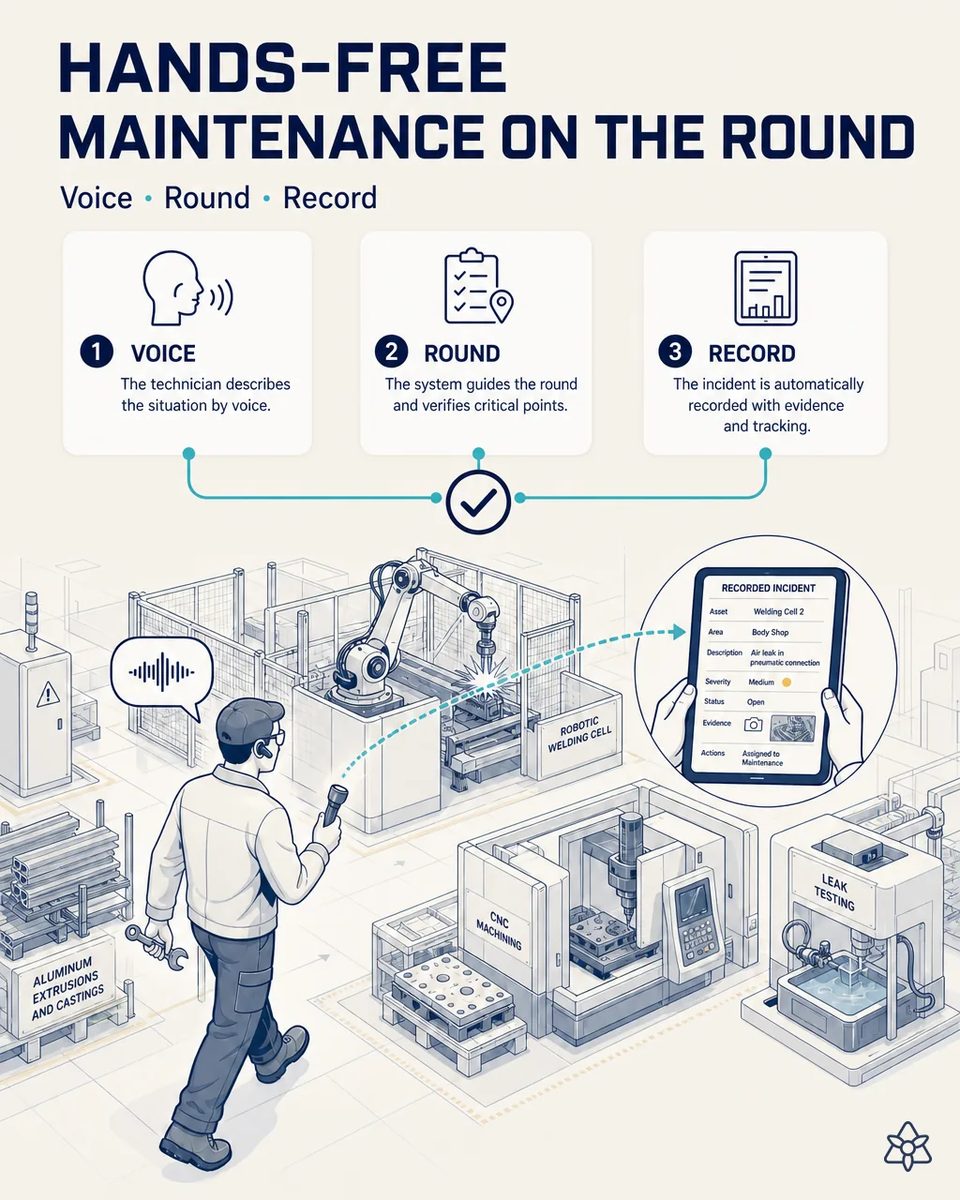
The maintenance technician on a battery tray line spends the shift between welding cells, riveting stations, CNC centers and leak testers. Always with a tool in hand. There is no time to stop and type into the CMMS every thing they notice. With iLEAN Connect in earpiece mode, they say it out loud while working: note that the cell three wire feeder has been noisy since the spool change. iLEAN structures it as an observation linked to the cell and shift, and confirms by voice within seconds.
The noisy wire feeder on cell three is forgotten by the next shift.
The maintenance technician on a battery tray line spends the shift between welding cells, riveting stations, CNC centers and leak testers. Always with a tool in hand. There is no time to stop and type into the CMMS every thing they notice. That the wire feeder on cell three makes a new noise, that the leak tester takes longer to stabilize, that compressed air pressure drops mid-afternoon. All of it stays in their head or a notebook, and is lost at shift change.
- The maintenance technician spends the shift between welding cells, riveting stations, CNC centers and leak testers, always with a tool in hand. There is no time to stop and type into the CMMS. Going back to the office to log a noise means leaving a breakdown half done.
- That the wire feeder on cell three makes a new noise since the spool change, that the leak tester takes longer to stabilize, that compressed air pressure drops mid-afternoon.
- All of it stays in their head or in a notebook, and is lost at shift change. The next technician starts blind. Sometimes they rediscover the same noise hours later, when it has already become a stop.
- The maintenance manager never sees patterns across shifts, because what is not recorded cannot be compared.
Connect in earpiece mode — the technician talks, iLEAN structures and confirms.
Humans in command taken literally: iLEAN records what the technician chooses to say, when they choose to say it. The AI does not judge or decide anything; it just keeps the observation from dying at shift change. Over a few months that record is what lets the maintenance manager see which cells really degrade first.
- They dictate it while walking; iLEAN structures it — With iLEAN Connect in earpiece mode, they say it out loud while working: note that the cell three wire feeder has been noisy since the spool change. iLEAN structures it as an observation linked to the cell and shift, and confirms by voice within seconds.
- The next shift arrives informed — The next technician starts with a summary of observations per cell, and the maintenance manager sees patterns across shifts. The person stays in command; the AI just keeps the information from being lost.
The maintenance round from memory versus the round captured by voice
| Aspect | Today | With iLEAN Connect |
|---|---|---|
| Noisy wire feeder after a spool change | Remembered, maybe | Observation linked to the cell |
| Leak tester slow to stabilize | Mentioned at the coffee machine | Logged with shift and time |
| Afternoon compressed air pressure drop | Noticed, never written | Recorded and comparable across days |
| Technician's hands during the round | Busy, so nothing is typed | Still on the tools |
| Maintenance shift handover | Blind or from a notebook | Summary per cell |
| Patterns across shifts | Invisible to the manager | Visible in the record |
Observations lost at shift change → structured record per cell in real time. Blind handover → handover with a per-cell summary.
Impact estimate — to be validated with your numbers.
The block below is an estimate to be validated against your plant's actual data. We put it forward so the committee has an order of magnitude; we refine it during the assessment.
- No standalone payback: this is an enabling piece. We do not put a month range on it because its value shows up in the other cases.
- Shift knowledge captured in real time, which is the basis of every preventive maintenance improvement on the tray line. Without recorded observations there is nothing to analyze.
- A handover with a per-cell summary instead of a blind start for the next technician. The first ten minutes of each shift stop being spent asking around.
- We estimate its effect together with your maintenance manager, on the observations that start appearing in the record. Typically, the first useful patterns show up within a few weeks of dictation.
Shift knowledge captured in real time · the basis of all continuous improvement (estimate to validate). It is hard to put a number on it at first, but every improvement in preventive maintenance depends on this information existing. Estimate to validate with the maintenance manager.
And the fair question from the production manager
“Is this a way to listen to the maintenance crew?” — no: it only records what the technician decides to dictate, with no continuous listening. Turning a spoken note into an observation with cell, symptom and shift is an anchored task, where the best models stay below 1.5% error [1]; and the technician hears the confirmation by voice within seconds and can correct it on the spot.
[1] OpenAI paper "Why Language Models Hallucinate", 2025 — on the reliability of AI in anchored tasks.
What people ask about voice notes on the tray line maintenance round
Does the earpiece work next to welding cells and riveting stations?
That is the design condition. It is compatible with hearing protection and recognition is prepared for industrial noise and for maintenance vocabulary like liner, contact tip or decay. It also copes with the plant's own names for cells and stations.
How does it know which cell or station the technician means?
From what they say, such as cell three or leak tester two, matched against the plant's asset list. If it is ambiguous, it asks back by voice. The technician answers in a couple of words and keeps walking. Every observation is tied to the asset code used in the CMMS.
Does it turn every observation into a work order?
No. It records observations. Whether one becomes a notification or a work order is decided by the maintenance manager or the planner. The observation stays in the record either way, so a pattern can be spotted later even if nothing was done at the time.
Who sees what the technician dictated?
The next shift's technician and the maintenance manager, as a summary per cell. It is a maintenance record, not a performance log. Nobody is measured on what they dictate, which is what keeps people using it.
Why does this case carry no payback figure?
Because its value appears in the other cases: the spare alert, the close-out and the stop plan all get better when observations exist. We prefer to estimate it with you than to invent a number. What we can show from the first weeks is how many observations stop being lost.
More cases from this series
- IATF evidence pack, always readyEvery inspection, leak test and work order generates evidence; iLEAN Agents builds the IATF and customer…
- A tray line without surprise stopsConnect, Edge, Agents and JIDOKA AI correlate every signal per cell and give the maintenance manager a…
- The legacy CNC that now talksAn external camera reads the panel of an offline CNC center: spindle load and alarms in central memory,…
- The downtime spreadsheet, straight to ERPiLEAN reads the downtime sheet on save and, after validation, pushes it to the ERP: up-to-date OEE and…
- Extrusion receiving with a certificate photoPhotograph the delivery note and material certificate: alloy, heat number and quantities into the ERP…
- Leak tester stitched to the MESSerial number, test program and tightness curve flow between tester and MES with no typing: per-tray…
Tell us what your maintenance technicians lose at every shift change.
We work on your plant's real data, not ours. Assessment with no commitment.
Request estimated ROI within 48h ‹ See all cases of battery trays See automotive