Validated cell restart after maintenance
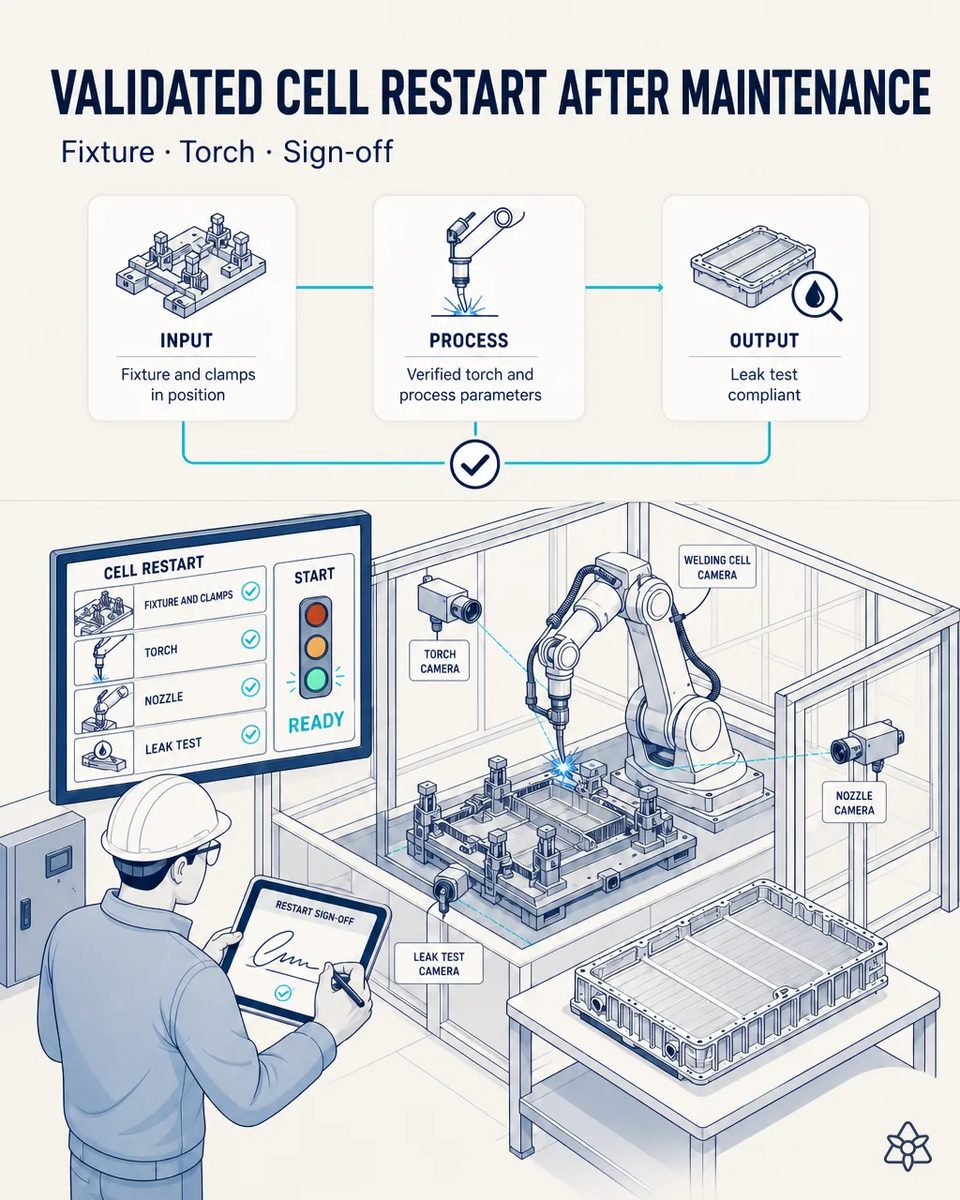
After a tray model changeover, a contact tip change or a robot repair, the cell goes back into production. If a clamp was left wrong, a nozzle dirty or the program is not the right one, the first trays come out bad. With iLEAN Edge, cameras at the critical points of the cell compare the current state with the model reference: clamps closed, correct fixture, clean nozzle, torch position.
After a changeover, the first trays pay for a check done in a hurry.
After a tray model changeover, a contact tip change or a robot repair, the cell goes back into production. If a clamp was left wrong, a nozzle dirty or the program is not the right one, the first trays come out bad. Release depends on someone signing that all is well. Under pressure to recover output, the check gets shortened, and the first parts pay the price.
- After a tray model changeover, a contact tip change or a robot repair, the cell goes back into production. On a high-mix tray line that happens several times a week.
- If a clamp was left open, a nozzle dirty or the wrong fixture or program loaded, the first trays come out bad.
- Release depends on someone signing that all is well. Under pressure to recover output, the check gets shortened. Nobody skips it on purpose; it just gets faster every time the line is behind.
- The first trays pay the price: rework on frames that are already welded, or a leak reject much further down the line. And the cause is rarely recorded, so it happens again at the next changeover.
Edge with JIDOKA AI — no restart until every camera says OK and someone signs.
The technician still decides, but no longer blind: the sign-off happens with visual evidence of every critical point in front of them. And if something does not match the reference, JIDOKA AI stops the cell before the first tray is welded. The first good tray after a changeover arrives sooner, not later.
- Edge cameras compare against the reference state — With iLEAN Edge, cameras at the critical points of the cell compare the current state with the model reference: clamps closed, correct fixture, clean nozzle, torch position.
- JIDOKA AI: no start until everything is OK and someone signs — The cell is not released until every camera reports OK and the technician signs with the evidence in front of them. If something does not match, JIDOKA AI stops it before the first tray. The person still decides, but no longer blind.
Cell restart signed from memory versus restart backed by cameras
| Aspect | Today | With iLEAN Edge |
|---|---|---|
| Basis for releasing the welding cell | A signature without evidence | Visual evidence per critical point |
| Fixture for the new tray model | Checked by eye | Compared with the model reference |
| Clamps closed on the frame | Assumed | Confirmed by camera |
| Nozzle and torch position after a tip change | Trusted to the technician | Verified before restart |
| Wrong state at restart | Discovered on the first trays | Stopped before the first tray |
| Who releases the cell | The technician, under pressure | The technician, with evidence |
Release signed without evidence → sign-off backed by visual evidence per critical point. Bad first trays after changeover → stopped before they are made.
Impact estimate — to be validated with your numbers.
The block below is an estimate to be validated against your plant's actual data. We put it forward so the committee has an order of magnitude; we refine it during the assessment.
- Estimated payback 4-10 months. To validate with your changeover frequency and the rework on first trays today.
- Fewer bad first trays after a changeover or repair, and less rework on frames already welded. Each changeover stops costing the first trays of the run.
- Faster, safer restarts, because the check is objective and does not depend on how much pressure the shift is under. The technician spends less time checking and more time confirming.
- And every restart leaves its evidence, which later feeds the IATF evidence pack without extra work. The auditor sees how each cell was released, with images.
Payback 4-10 months · fewer bad first parts after changeover or repair (estimate to validate). Fewer bad trays at restart, less rework and faster, safer restarts. Estimated payback of four to ten months; an estimate to validate.
And the fair question from the production manager
“Will the cameras slow down our changeovers?” — the comparison happens in seconds while the technician finishes the cell, and it replaces a manual check that is already being done, only faster and with evidence. Comparing a cell against a known reference state is an anchored task, where the best models drop below 1.5% error [1]; and the final word is still the technician's signature. If a camera reports a mismatch, the screen shows exactly which point and why.
[1] OpenAI paper "Why Language Models Hallucinate", 2025 — on the reliability of AI in anchored tasks.
What people ask about camera-validated welding cell restarts
Which points of the welding cell get a camera?
The critical ones for that cell: fixture and clamps, torch and nozzle, and the points where a wrong state would ruin the first tray. It is defined cell by cell. A cell with two fixtures may need more cameras than a simple one.
Who defines the reference state for each tray model?
Your process engineering, by capturing the correct state once per model. From then on each restart is compared against it. When the fixture or tooling changes, the reference is updated by the same people. Each new tray model gets its reference before its first production run.
Does JIDOKA AI stop the cell on its own?
It holds the release while a camera reports a mismatch. Releasing the cell remains a human decision, taken with the evidence on screen. If a mismatch is a false alarm, the technician can override it with a reason that is logged.
What about restarts after maintenance, not just model changeovers?
Those are covered too. After a contact tip change or a robot repair, the same comparison runs before the cell goes back into production. Those are often the riskiest restarts, because they happen under pressure in the middle of a shift. The cameras do not care how late the line is.
Is the restart evidence kept?
Yes, with time stamp and signature. It becomes part of the record an IATF auditor or the vehicle maker may ask for. It goes straight into the evidence pack without anyone copying it.
More cases from this series
- IATF evidence pack, always readyEvery inspection, leak test and work order generates evidence; iLEAN Agents builds the IATF and customer…
- A tray line without surprise stopsConnect, Edge, Agents and JIDOKA AI correlate every signal per cell and give the maintenance manager a…
- The legacy CNC that now talksAn external camera reads the panel of an offline CNC center: spindle load and alarms in central memory,…
- The downtime spreadsheet, straight to ERPiLEAN reads the downtime sheet on save and, after validation, pushes it to the ERP: up-to-date OEE and…
- Extrusion receiving with a certificate photoPhotograph the delivery note and material certificate: alloy, heat number and quantities into the ERP…
- Hands-free maintenance on the roundThe technician dictates observations while walking the line; iLEAN structures them per cell and shift so…
Tell us how many bad first trays you get after a changeover.
We work on your plant's real data, not ours. Assessment with no commitment.
Request estimated ROI within 48h ‹ See all cases of battery trays See automotive