Work order close-out in two taps
This is what sets iLEAN apart from an autonomous agent that writes unsigned data: nothing it captures enters the CMMS or the ERP before a person has seen it. iLEAN assembles the close-out from what it already captured: the photo of the removed part, what the technician dictated, the alarm and restart times. A two-second summary appears on the cell tablet and the technician confirms or corrects with two taps.
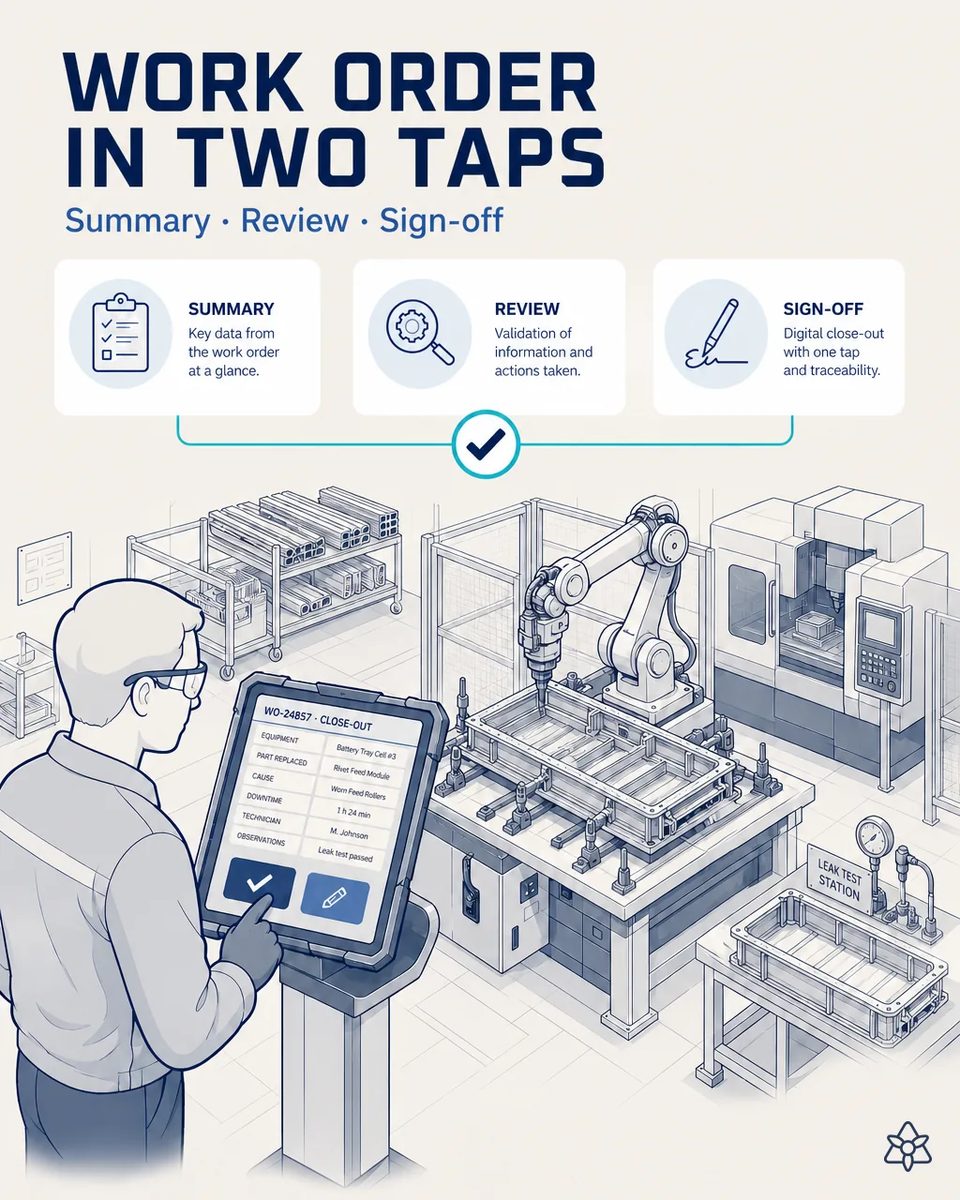
The work order is closed hours later with a cause nobody remembers.
This is what sets iLEAN apart from an autonomous agent that writes unsigned data: nothing it captures enters the CMMS or the ERP before a person has seen it. On a battery tray line, the technician fixes the cell and moves on to the next breakdown. The work order is closed hours later with a generic cause, no record of the part replaced and a rough downtime figure. The failure history becomes useless for decisions.
- This is what sets iLEAN apart from an autonomous agent that writes unsigned data: nothing it captures enters the CMMS or the ERP before a person has seen it. That principle is easy to say and hard to keep on a busy tray line.
- On a battery tray line, the technician fixes the riveting head or the welding torch and moves on to the next breakdown. The work order is closed hours later. Often by someone who did not do the repair, filling in from what they were told.
- It closes with a generic cause, no record of the part replaced and a rough downtime figure. Multiply that by every cell and every shift.
- The failure history becomes useless for decisions: MTBF per cell, root cause and spare planning rest on reconstructions, not facts.
Connect with early human verification — two taps on the cell tablet.
It is the piece that guarantees nothing unsigned reaches the CMMS and that every close-out has a technician's name on it. Without it, the rest of the matrix does not get approved: nobody signs off on AI writing into the maintenance master by itself. With it, every record has a name and a moment attached.
- iLEAN prepares the close-out; the technician signs in two taps — iLEAN assembles the close-out from what it already captured: the photo of the removed part, what the technician dictated, the alarm and restart times. A two-second summary appears on the cell tablet and the technician confirms or corrects with two taps.
- A failure history you can trust — With complete, validated close-outs, root cause analysis, MTBF per cell and spare parts planning rest on real data, not reconstructions.
Work order close-out from memory versus close-out prepared and signed
| Aspect | Today | With iLEAN |
|---|---|---|
| When the close-out is written | Hours after the repair | Seconds after the cell restarts |
| Cause recorded | Generic, from memory | From the dictation and the alarm |
| Part replaced on the riveting head or torch | Often missing | Photo of the removed part attached |
| Downtime minutes | A rough figure | Alarm and restart times |
| Who writes to the CMMS | Whoever types later | The technician who fixed it, confirming |
| MTBF per tray line cell | Built on reconstructions | Built on validated close-outs |
Work orders closed hours later with generic causes → complete close-out validated in seconds. Useless failure history → reliable MTBF and root cause per cell.
Impact estimate — to be validated with your numbers.
The block below is an estimate to be validated against your plant's actual data. We put it forward so the committee has an order of magnitude; we refine it during the assessment.
- No standalone payback: it is the enabling piece of the whole matrix, with strategic rather than direct value. We do not attach a month range to it.
- Without early human verification no other case gets signed off, because it is what keeps the CMMS clean and reliable.
- Complete close-outs validated in seconds instead of generic causes typed hours later. Each one carries the photo of the removed part and the real downtime minutes.
- And a failure history you can trust: reliable MTBF and root cause per cell, and spare planning based on what was really replaced.
Clean, reliable CMMS · the enabling piece of the whole matrix (strategic value). It is the piece that makes everything else possible: without early human verification no other case gets signed off. Its value is strategic rather than direct.
And the fair question from the production manager
“If the technician confirms everything, what is the AI actually saving?” — the work is not in deciding, it is in assembling. Building a close-out from a photo, a dictation and alarm times is an anchored task where the best models drop below 1.5% error [1], so what reaches the tablet is almost always right. The technician confirms or corrects, and every correction is stored so extraction improves at that point.
[1] OpenAI paper "Why Language Models Hallucinate", 2025 — on the reliability of AI in anchored tasks.
What people ask about two-tap work order close-out on the tray line
Can iLEAN close a work order without the technician's tap?
No, and it is not a setting: it is the architecture. The technician's tap is the only door between what iLEAN captured and the maintenance master. Captured data crosses into the CMMS or the ERP only after a person confirms it.
How long does each close-out take the technician?
Seconds. The summary arrives already assembled with the part, cause and times, and is resolved with two taps on the cell tablet. It is faster than closing the work order from memory at the end of the shift.
Where does the close-out content come from?
From what iLEAN already captured: the photo of the removed part, what the technician dictated on the round and the alarm and restart times of the cell. When something is missing, the summary says so instead of filling the gap with a guess.
What happens when the technician corrects the summary?
The correction is stored with its author. It works both as an audit trail and as feedback so the next close-out on that cell comes out better. Over time the corrections show where the capture needs adjusting, cell by cell.
Is the tablet close-out needed before the other cases?
In practice yes. It is the piece that makes the rest approvable, because it guarantees that the maintenance master is not contaminated by unsigned data. It is also the case that convinces quality and IT that the AI never writes on its own.
More cases from this series
- IATF evidence pack, always readyEvery inspection, leak test and work order generates evidence; iLEAN Agents builds the IATF and customer…
- A tray line without surprise stopsConnect, Edge, Agents and JIDOKA AI correlate every signal per cell and give the maintenance manager a…
- The legacy CNC that now talksAn external camera reads the panel of an offline CNC center: spindle load and alarms in central memory,…
- The downtime spreadsheet, straight to ERPiLEAN reads the downtime sheet on save and, after validation, pushes it to the ERP: up-to-date OEE and…
- Extrusion receiving with a certificate photoPhotograph the delivery note and material certificate: alloy, heat number and quantities into the ERP…
- Hands-free maintenance on the roundThe technician dictates observations while walking the line; iLEAN structures them per cell and shift so…
Tell us how your work orders are closed on the tray line today.
We work on your plant's real data, not ours. Assessment with no commitment.
Request estimated ROI within 48h ‹ See all cases of battery trays See automotive