Critical spare-part alerts, instantly
A spare parts supplier writes that the replacement servo motor for a welding robot will arrive two weeks late. The email lands in the purchasing inbox and nobody in maintenance sees it until the part is needed. With iLEAN Connect silently copied on the purchasing mailbox, the email is read at second zero. iLEAN extracts supplier, part and new date, cross-checks spare parts stock and the maintenance plan, and alerts the maintenance manager with a concrete action.
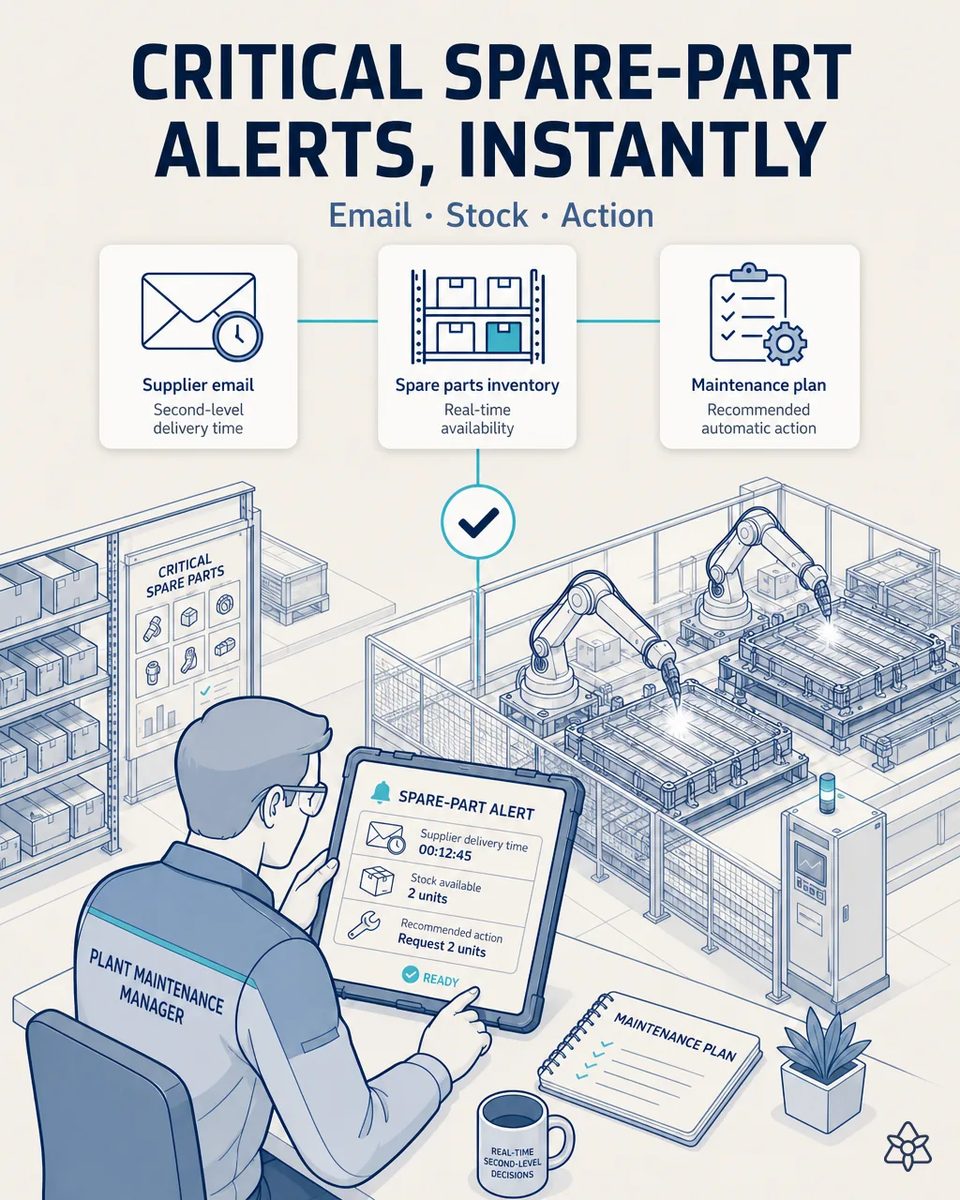
The delay email sits in purchasing while the welding robot servo starts to fail.
A spare parts supplier writes that the replacement servo motor for a welding robot will arrive two weeks late. The email lands in the purchasing inbox and nobody in maintenance sees it until the part is needed. That same day the cell's servo starts raising alarms. Maintenance goes to the store counting on the spare and it is not there. The cell stands still, and with it the line that delivers trays to the customer just in time.
- A spare parts supplier writes that the replacement servo motor for a welding robot will arrive two weeks late. The email lands in the purchasing inbox and nobody in maintenance sees it. Purchasing has no way to know which cell depends on that servo or how close it is to failing.
- That same day the cell's servo starts raising alarms. Maintenance goes to the store counting on the spare and it is not there. The stock figure in the ERP still showed the unit that was used last month.
- The cell stands still, and with it the line that delivers trays to the vehicle maker just in time. A shared servo model across several cells multiplies the exposure.
- Nobody did anything wrong: purchasing read the email, maintenance trusted the stock figure. The gap is that no one crossed the delay with the plan and the alarm trend.
Connect in chaotic-sources mode — silent copy on the purchasing mailbox, read at second zero.
The value is not reading the email; it is crossing it in seconds with spare stock, the maintenance plan and which cells share that servo. What reaches the maintenance manager is a decision to take, not another message to forward. Purchasing keeps working as before; the difference is that maintenance is in the loop from the first second.
- iLEAN in copy: reads the alert and cross-checks stock and plan — With iLEAN Connect silently copied on the purchasing mailbox, the email is read at second zero. iLEAN extracts supplier, part and new date, cross-checks spare parts stock and the maintenance plan, and alerts the maintenance manager with a concrete action.
- Suggested action, human decision — For example: there is only one unit of that servo left, two cells use the same model and one shows an alarm trend; it makes sense to order from a second supplier or bring the overhaul forward. The maintenance manager decides.
A supplier delay in the purchasing inbox versus read and cross-checked
| Aspect | Today | With iLEAN Connect |
|---|---|---|
| When maintenance learns of the servo delay | Hours or days later | Seconds after the email |
| Stock of that robot servo | Checked when the part is needed | Crossed automatically |
| Cells sharing the same servo model | Known only from memory | Listed in the alert |
| Cell showing an alarm trend | Not linked to the delay | Flagged as the priority |
| Second supplier or brought-forward overhaul | Decided in a hurry | Proposed in advance |
| Who decides the action | Whoever notices first | The maintenance manager |
Hours or days before maintenance finds out → seconds. Cell down with no spare → alternative decided before the part is needed.
Impact estimate — to be validated with your numbers.
The block below is an estimate to be validated against your plant's actual data. We put it forward so the committee has an order of magnitude; we refine it during the assessment.
- Estimated payback 3-7 months, depending on how often critical alerts arrive. The figure is validated against your record of stops caused by missing spares.
- From hours of latency to seconds on critical spare-part alerts.
- A single cell stop avoided for lack of a spare usually justifies the case on its own. Especially when that cell is the only one able to weld a given tray model.
- And the alternative, ordering from a second supplier or bringing the overhaul forward, is decided before the part is needed.
Payback 3-7 months · from hours of latency to seconds on critical alerts (estimate to validate). A single stop avoided for lack of a spare usually justifies the case. Estimated payback of three to seven months depending on how often critical alerts arrive; an estimate to validate.
And the fair question from the production manager
“What if it misreads the supplier email and raises a false alarm?” — extracting supplier, part number and new date from a delivery notice is an anchored task, where the best models drop below 1.5% error [1]. And the alert never acts on its own: it proposes, with the original email attached, and the maintenance manager decides whether to reorder or reschedule.
[1] OpenAI paper "Why Language Models Hallucinate", 2025 — on the reliability of AI in anchored tasks.
What people ask about critical spare alerts for tray lines
Do our spare parts suppliers have to change how they notify delays?
No. iLEAN reads the emails and attachments they already send, in whatever format and language, from the purchasing mailbox where it is silently copied. The relationship with each supplier stays exactly as it is today.
Does it read people's personal mailboxes?
No. Only the shared purchasing mailbox it is copied on. It is a channel decided by the plant, not a way to read individual inboxes. The plant decides which mailboxes are in scope and can change that at any time.
How does it know which welding or riveting cells use that part?
By crossing the part number with the spare parts master and the asset list in the CMMS. That is how it can say that two cells share the same servo and one of them is trending toward failure. If the asset list is incomplete, the first alerts also show where it needs cleaning up.
Who receives the alert, and can it order the part by itself?
The maintenance manager receives it with a suggested action. Ordering from a second supplier or bringing an overhaul forward remains a human decision. iLEAN prepares the options with stock, lead times and affected cells, so the decision takes minutes instead of a morning of phone calls.
Does it only cover robot servos?
No. Wire feeders, riveting heads, spindle bearings and leak tester seals follow the same logic. You start with the parts whose absence stops the line longest. The list grows as the maintenance manager sees which alerts are worth having.
More cases from this series
- IATF evidence pack, always readyEvery inspection, leak test and work order generates evidence; iLEAN Agents builds the IATF and customer…
- A tray line without surprise stopsConnect, Edge, Agents and JIDOKA AI correlate every signal per cell and give the maintenance manager a…
- The legacy CNC that now talksAn external camera reads the panel of an offline CNC center: spindle load and alarms in central memory,…
- The downtime spreadsheet, straight to ERPiLEAN reads the downtime sheet on save and, after validation, pushes it to the ERP: up-to-date OEE and…
- Extrusion receiving with a certificate photoPhotograph the delivery note and material certificate: alloy, heat number and quantities into the ERP…
- Hands-free maintenance on the roundThe technician dictates observations while walking the line; iLEAN structures them per cell and shift so…
Tell us which spare part stopped your tray line last time.
We work on your plant's real data, not ours. Assessment with no commitment.
Request estimated ROI within 48h ‹ See all cases of battery trays See automotive