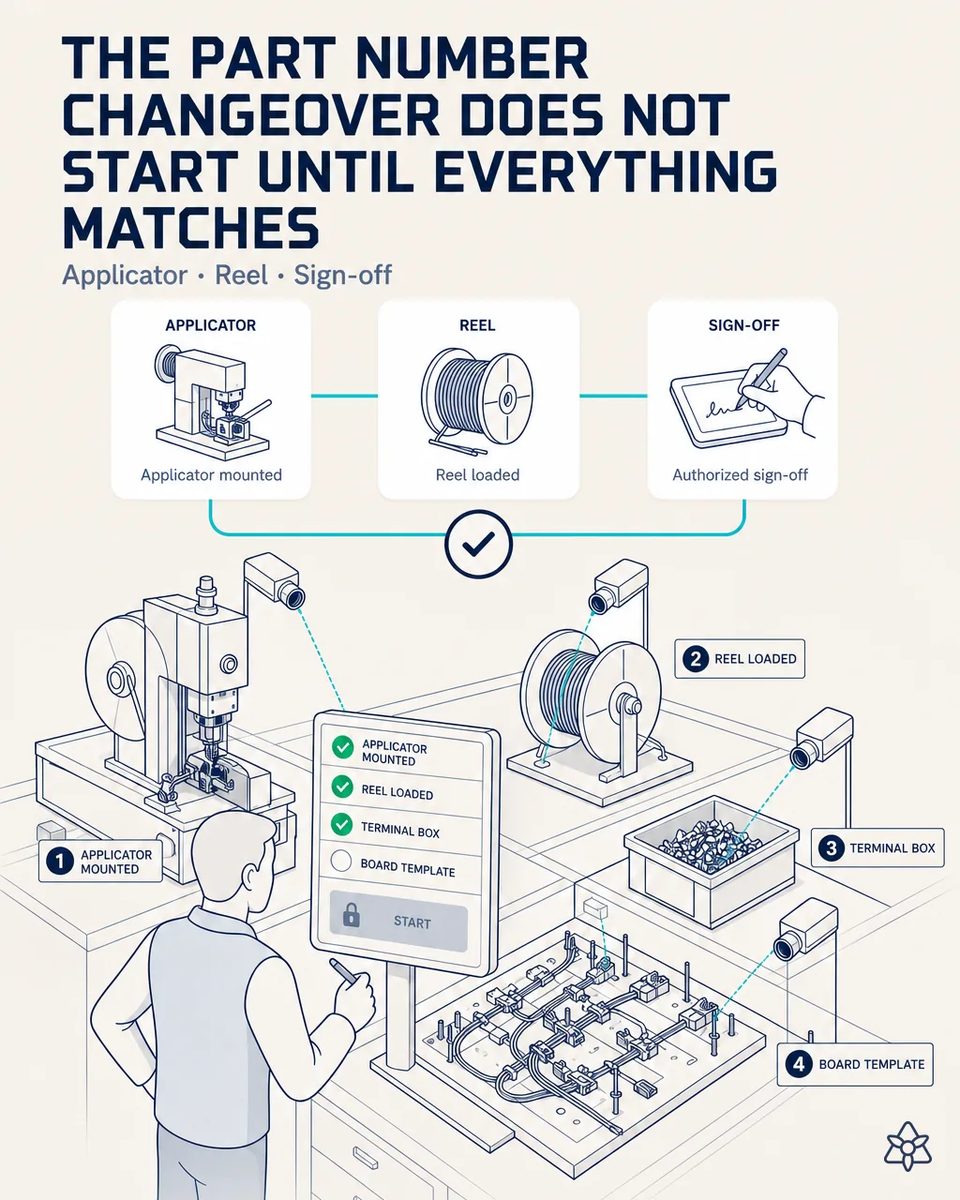
The part number changeover does not start until everything matches
The most dangerous moment in a high-variety harness plant is the part number changeover. The press applicator changes, the reel changes, the terminal family, the connector and the board configuration all change. If any of that is left over from the previous part, the first harnesses of the new run are born contaminated. And on a harness you cannot see it, because a similar terminal fits the cavity and will even pass continuity.
A badly validated changeover does not produce a defect. It produces a whole batch of suspect harnesses.
If any of that is left over from the previous part, the first harnesses of the new run are born contaminated. And on a harness you cannot see it, because a similar terminal fits the cavity and will even pass continuity. Today it all rests on someone signing a checklist, and that checklist gets signed under pressure to start. With several changeovers a day, the odds of one being signed from memory are not theoretical. And the cost is asymmetric: a badly validated changeover does not produce one defect, it produces a whole lot of suspect harnesses already mixed in with the good ones.
- If anything is left over from the previous reference — applicator, reel, terminal box, board layout — the first harnesses of the new run are born contaminated.
- And on a harness that does not show: a similar terminal fits the cavity and even passes continuity.
- Today it all rests on somebody signing a checklist, and that checklist gets signed under pressure to start.
- With several changeovers a day, the chance that one gets signed from memory is not theoretical.
Cameras on the critical points and a reference state per part number. This is JIDOKA with AI.
With Edge you install cameras at the critical points, with a reference state per part number. iLEAN compares what it sees, the code of the mounted applicator, the label of the loaded reel, the terminal box reference, the board layout, against what the active order requires. While any point mismatches, the station does not enable the start. This is JIDOKA with artificial intelligence. When every point is conforming, the supervisor signs on the tablet and the run starts with the evidence already stored.
While there is a discrepancy, the station does not enable the start. When every point is conforming, the owner signs on the tablet and the run starts with the evidence already stored.
The changeover, before and after
| Aspect | Today | With iLEAN Edge |
|---|---|---|
| Changeover verification | A checklist signed under pressure | Point-by-point comparison |
| Mounted applicator | Checked from memory | Code read and cross-checked |
| Reel and terminal box | Label glanced at | Label read against the active order |
| Starting with a discrepancy | Possible | The station does not enable it |
| Changeover evidence | A signature on paper | Stored, point by point |
| Changeover duration | Depends who runs it | SMED with AI works on the sequence |
see the impact section; the attached pool details the before and after for this case.
Impact estimate — to validate against your numbers.
The block below is an estimate to be validated against your plant's actual data. We put it forward so the committee has an order of magnitude; we refine it during the assessment.
- Estimated payback 5-10 months.
- Fewer suspect batches from crossed components — this case's asymmetric cost.
- Shorter changeover: in parallel, SMED with AI works on the sequence of the changeover itself.
- The changeover evidence is stored on its own, and it is exactly what the process audit asks for.
Estimated payback 5-10 months · fewer suspect lots from mixed components and shorter changeovers And in parallel, SMED with artificial intelligence works on the sequence of the changeover itself, so that all this verification does not lengthen it but organises it. Estimated payback five to ten months. An estimate to validate against your own history of changeover-related incidents.
And the fair question from the production manager
"Is this not going to make every changeover longer?" — that is the right objection, which is why the case comes with SMED with AI in parallel, working on the changeover sequence so the verification overlaps rather than adds. Comparing an applicator code or a label against the active order is an anchored task and resolves in seconds [1].
[1] OpenAI paper "Why Language Models Hallucinate", 2025 — on the reliability of AI in anchored tasks.
What people ask about verifying the changeover
How many points have to be instrumented?
The ones that actually cross components: applicator, reel, terminal box and board layout. Instrumenting more adds cost without reducing risk, because escapes always come from the same places.
Can the owner override the block in an emergency?
They can, but it is recorded with who and why. A block with no way out ends up physically bypassed; one with a traced override is used rarely and you can see when.
Is this process control or quality?
It is JIDOKA: not letting production run out of condition. The difference from an inspection is that it acts before the first piece, not after the last.
What if the active order in the system is wrong?
Then the block fires against a wrong order, and that is valuable information too. Better to find out at the changeover than at the customer's plant.
How long does one point take to get running?
A critical point is a matter of weeks, because the reference state is built from the changeovers you already run. What takes time is covering every reference, and that is prioritised by volume.
More cases from this series
- The audit evidence pack assembles itselfEvery critical event leaves evidence indexed by clause and by customer requirement. The audit stops…
- Zero customer line stop: four coordinated ringsFour cross-checked verification rings from reel to sequenced shipment, holding harness quality steady…
- The crimp lab spreadsheet reaches the ERP on its ownCrimp height, pull test and micrograph data reach the ERP with no transcription, and the quality module…
- The legacy crimp press panel starts talkingAn external camera digitises crimp height, counters and alarms from a legacy cut-and-crimp panel without…
- The supervisor who walks the floor and talks to the systemEarpiece and voice so the harness supervisor records and queries without stopping between boards. Weak…
- Nothing enters the system without a human signing itNothing the AI captures enters the system until a human signs it with two taps at the board. Humans in…
Tell us how many part number changeovers you run a day and how many get signed from memory.
We work on your plant's real data, not ours. Assessment with no commitment.
Request estimated ROI within 48h ‹ See all cases of automotive wire harnesses See automotive