The defect the electrical test cannot see
There is a whole family of harness defects the electrical test cannot see: the missing clip, the half-seated retainer, the taping that leaves a bare stretch, the branch routed outside the board channel, the short corrugated tube. Electrically the harness is perfect. On the customer's line, it does not fit. Or it fits and vibrates until it breaks months later. It is the classic escaped defect of this sub-sector, and the one that drives the most containment, precisely because the electrical test lets it through and creates false confidence.
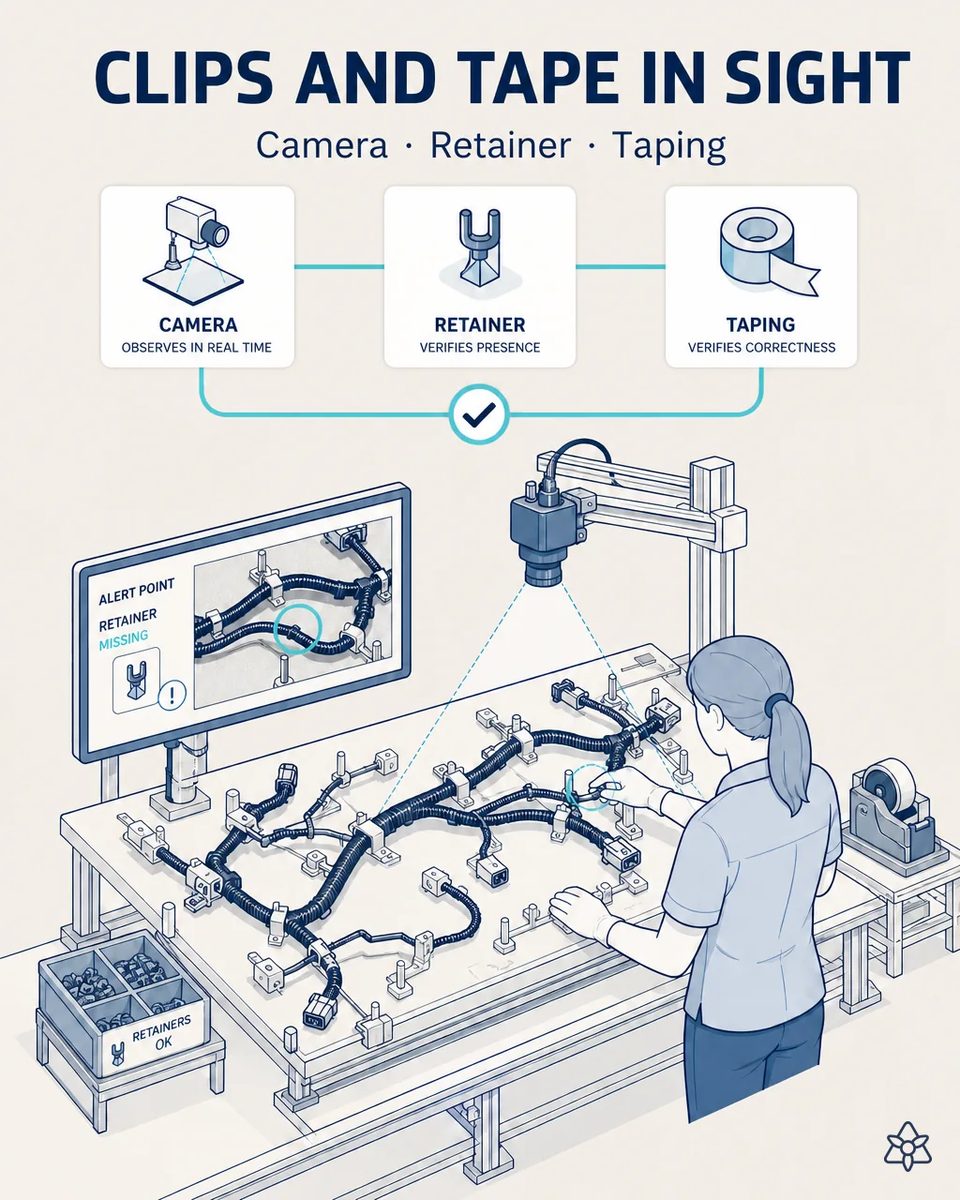
Electrically the harness is perfect. On the customer's line, it does not fit.
Electrically the harness is perfect. On the customer's line, it does not fit. Or it fits and vibrates until it breaks months later. It is the classic escaped defect of this sub-sector, and the one that drives the most containment, precisely because the electrical test lets it through and creates false confidence. Today the human eye catches it at the end of the board, at line rate, shift after shift. That person has been looking at near-identical harnesses for six hours, and with workforce turnover they may have been in the role for three weeks. On top of that, part variety multiplies the clip and retainer variants they have to remember.
- A missing clip, a badly seated retainer, incomplete taping: the electrical test lets it through and gives false confidence.
- On the customer's line it does not fit. Or it fits and vibrates until it breaks months later.
- It is the classic escape of this sub-sector, and the one that generates the most containment.
- Today it is caught by the human eye at the end of the board, at takt, shift after shift — six hours looking at near-identical harnesses, with rotating staff and dozens of references.
Edge with local inference over the final station — and it does not tire at hour six.
With Edge you mount an industrial camera over the final station, with local inference, no dependency on the network or the cloud, and a model trained per part number from real good and bad examples from your own plant. When it detects a missing clip or incomplete taping, it flags the harness before it comes off the board and points at the exact spot on screen for the operator. The rework decision stays human: Edge points, the person resolves. And it does not get tired six hours into the shift.
The rework decision stays human: Edge marks the exact point on screen and the person resolves it. What the machine brings is not judgement, it is consistency.
Final inspection, before and after
| Aspect | Today | With iLEAN Edge |
|---|---|---|
| Who catches the missing clip | The human eye, at takt | Vision, over 100% of harnesses |
| Performance at hour six of the shift | Drops | The same as at minute one |
| Dozens of near-identical references | A source of error | A model per part number |
| Where it is caught | At the customer, sometimes | Before it leaves the board |
| Dependence on network or cloud | — | None: local inference |
| Who decides on rework | The person | The person |
see the impact section; the attached pool details the before and after for this case.
Impact estimate — to validate against your numbers.
The block below is an estimate to be validated against your plant's actual data. We put it forward so the committee has an order of magnitude; we refine it during the assessment.
- Estimated payback 6-12 months, depending on how many stations are covered.
- Clip and taping escapes down by at least 30%.
- Fewer containment events, which is where this sub-sector's asymmetric cost lives.
- And one less load on the person at the final station, who today holds the last barrier alone.
Estimated payback 6-12 months · escaped clip and taping defects down at least 30% Estimated payback runs six to twelve months depending on how many stations you cover, with escaped defects in this family down at least thirty per cent. But the real return is not the avoided rework: it is the containment event that never happens. An estimate to validate.
And the fair question from the production manager
"How many bad parts does it need to be trained?" — fewer than feared, because the model is trained per part number from good and bad examples that are real to the plant, not from a generic catalogue. And it does not decide: it marks. The person confirms. That is the difference between a system that helps and one that gets switched off the first busy day.
[1] OpenAI paper "Why Language Models Hallucinate", 2025 — on the reliability of AI in anchored tasks.
What people ask about vision inspection of clips and taping
Does it slow the board's takt?
It should not: inference is local and resolves within the time the harness is already stopped at the final station. If it slowed things in the pilot, the inspection point is in the wrong place.
We have dozens of active references. Do we train one by one?
It is trained per part number, but starting with the ones with most volume and most escapes. Covering twenty per cent of references usually covers most of the risk.
What happens when a new reference comes in?
Until it has a model, that reference carries on as today, with human inspection. The system does not block production for a part it does not know.
Does it replace the person at the final station?
No. It takes away the part a human does badly by design — looking at the same thing for six hours — and leaves the part they do well: deciding what gets reworked and how.
What if the harness is presented rotated or the board moves?
That is the number one cause of false positives and it is handled in the pilot, by fixing how the harness is presented. It is commissioning work, not model work.
More cases from this series
- The audit evidence pack assembles itselfEvery critical event leaves evidence indexed by clause and by customer requirement. The audit stops…
- Zero customer line stop: four coordinated ringsFour cross-checked verification rings from reel to sequenced shipment, holding harness quality steady…
- The crimp lab spreadsheet reaches the ERP on its ownCrimp height, pull test and micrograph data reach the ERP with no transcription, and the quality module…
- The legacy crimp press panel starts talkingAn external camera digitises crimp height, counters and alarms from a legacy cut-and-crimp panel without…
- The supervisor who walks the floor and talks to the systemEarpiece and voice so the harness supervisor records and queries without stopping between boards. Weak…
- Nothing enters the system without a human signing itNothing the AI captures enters the system until a human signs it with two taps at the board. Humans in…
Tell us how many of your containments started with a clip the test did not see.
We work on your plant's real data, not ours. Assessment with no commitment.
Request estimated ROI within 48h ‹ See all cases of automotive wire harnesses See automotive