Receiving reels and terminals, in two photos
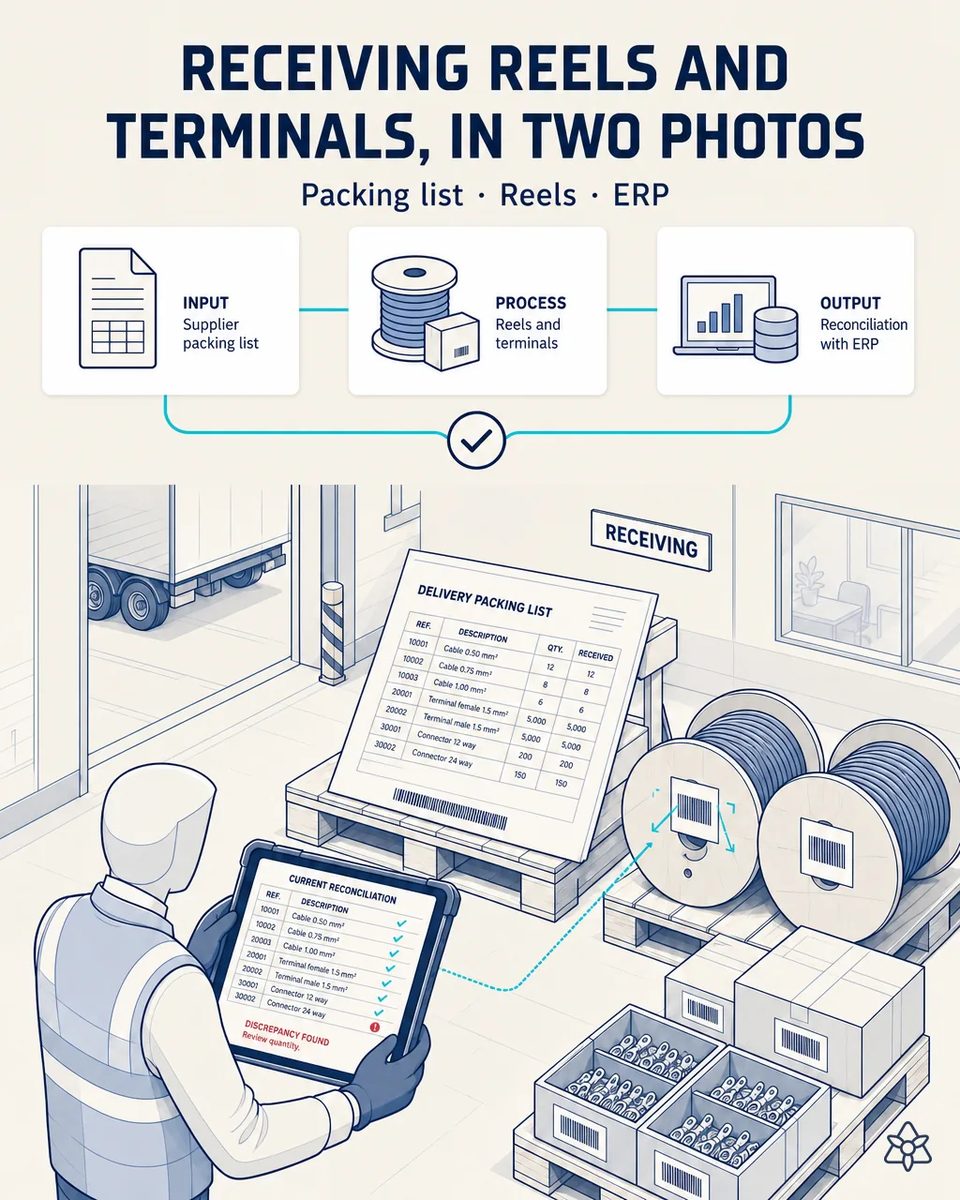
The truck arrives with wire reels, terminal boxes and connector bags. The receiving supervisor has a large-format packing list with twenty lines and pallets carrying supplier lot labels that have to be matched one by one. They have to sign for the delivery and then log into the system and enter it line by line. Either the carrier waits and charges demurrage, or it gets keyed in fast and the lots end up badly traced.
A harness's traceability starts at the dock. And at the dock, people type in a hurry.
They have to sign for the delivery and then log into the system and enter it line by line. Either the carrier waits and charges demurrage, or it gets keyed in fast and the lots end up badly traced. And harness traceability starts on the dock. If the incoming terminal lot is not recorded properly, the whole chain downstream inherits the error. The first time anyone notices is when the supplier issues a quality alert on a specific lot and the plant cannot say for certain where that lot went. Then you contain everything, which is the expensive option.
- The lead has to sign the receipt and then go into the system and enter it line by line.
- Either the carrier waits charging demurrage, or it gets typed fast and the lots end up badly traced.
- The first time it shows is when the supplier issues a quality alert on a specific lot and the plant cannot say with certainty where that lot is.
- Then everything gets contained, which is the expensive answer to a question that should have an exact one.
A photo of the note, a photo of the labels — and Connect matches one against the other.
With Connect, one photo of the packing list and one of the labels. It reads standard logistics barcodes, QR codes and data matrix codes, and does flat optical reading of whatever carries no code. It matches list lines to physical labels and flags discrepancies: quantities that do not add up, lots not listed, missing certificates. The supervisor validates on the tablet and Connect pushes into the system through its interface, filing the labels as photographic evidence. The usual pattern in receiving is going from four named users to one on the goods receipt module, a recurring cut of fifty to seventy per cent. On top of that comes the elimination of carrier demurrage, which in a plant receiving daily is a directly measurable cost.
It reads standard logistics barcodes, QR codes and data matrix, and does flat optical reading of whatever carries no code. The point is not reading: it is matching the note's lines against the physical labels and flagging what does not add up.
Material receiving, before and after
| Aspect | Today | With iLEAN Connect |
|---|---|---|
| Typing time per truck | 30-45 minutes | Minutes |
| Carrier demurrage | Paid while waiting | Eliminated |
| Lot traceability | Rebuilt by approximation | Physical label matched to the note |
| Quantity or lot discrepancies | Seen later, if at all | Flagged on the spot |
| Missing certificate | Discovered weeks later | Flagged at receiving |
| Goods-receipt module licences | One per person typing | One, the owner who validates |
see the impact section; the attached pool details the before and after for this case.
Impact estimate — to validate against your numbers.
The block below is an estimate to be validated against your plant's actual data. We put it forward so the committee has an order of magnitude; we refine it during the assessment.
- Estimated payback 4-8 months.
- From 4 to 1 receiving licence: between −50% and −70% recurring.
- From 30-45 minutes of typing per truck to minutes, and carrier demurrage eliminated.
- From lot traceability rebuilt by approximation, to the physical label filed as photographic evidence.
Estimated payback 4-8 months · from 4 to 1 receiving licence, a 50% to 70% cut, plus demurrage removed From thirty to forty-five minutes of keying per truck, down to minutes. From lot traceability rebuilt by approximation, to photographic traceability reel by reel. Estimated payback four to eight months. An estimate to validate against your pricing and your demurrage history.
And the fair question from the production manager
"Our suppliers each label in their own way." — that is the normal case, which is why three readings are combined: logistics barcode, data matrix and flat optical reading of whatever carries no code. All three are anchored tasks [1]. And none of them decides alone: what crosses into the system is what the owner confirms on the tablet.
[1] OpenAI paper "Why Language Models Hallucinate", 2025 — on the reliability of AI in anchored tasks.
What people ask about digitising receiving
Does it work with suppliers who send no electronic advance notice?
It is meant for exactly them. With an advance notice the problem is a different one; this solves the case of a paper note and mixed labelling, which is what still costs time at the dock.
What if the note quantity does not match what was unloaded?
It is flagged as a discrepancy and does not cross into the system until somebody decides. Today that mismatch usually enters as good and shows up weeks later in a stock count.
Are the label photos archived?
Yes, and that is half the reason the case exists: when a supplier issues an alert on a lot, the evidence of what came in and when is in one place, not in the memory of whoever received it.
How many people does the dock need with this?
The same; what changes is what their time goes on. What drops is the number of people who need a goods-receipt licence, because only the validator goes in.
What about weekend or night-shift deliveries?
They are captured the same way and stay pending validation. That beats the current alternative, which is a piece of paper on a desk until Monday.
More cases from this series
- The audit evidence pack assembles itselfEvery critical event leaves evidence indexed by clause and by customer requirement. The audit stops…
- Zero customer line stop: four coordinated ringsFour cross-checked verification rings from reel to sequenced shipment, holding harness quality steady…
- The crimp lab spreadsheet reaches the ERP on its ownCrimp height, pull test and micrograph data reach the ERP with no transcription, and the quality module…
- The legacy crimp press panel starts talkingAn external camera digitises crimp height, counters and alarms from a legacy cut-and-crimp panel without…
- The supervisor who walks the floor and talks to the systemEarpiece and voice so the harness supervisor records and queries without stopping between boards. Weak…
- Nothing enters the system without a human signing itNothing the AI captures enters the system until a human signs it with two taps at the board. Humans in…
Tell us how much time goes into typing for every truck you unload.
We work on your plant's real data, not ours. Assessment with no commitment.
Request estimated ROI within 48h ‹ See all cases of automotive wire harnesses See automotive