At cadence, the human eye adapts and lets things through
At the real cadence of a wheel assembly line the human eye tires, adapts and lets things through. The defects that matter are known and repetitive: on the 360° disc-to-rim weld, porosity, spatter, undercut, lack of penetration or a discontinuous bead; on the finish, runs, craters, poor coverage and contamination. An Edge camera with a network trained on the plant's own real parts runs inference in milliseconds and rejects the wheel at the next station.
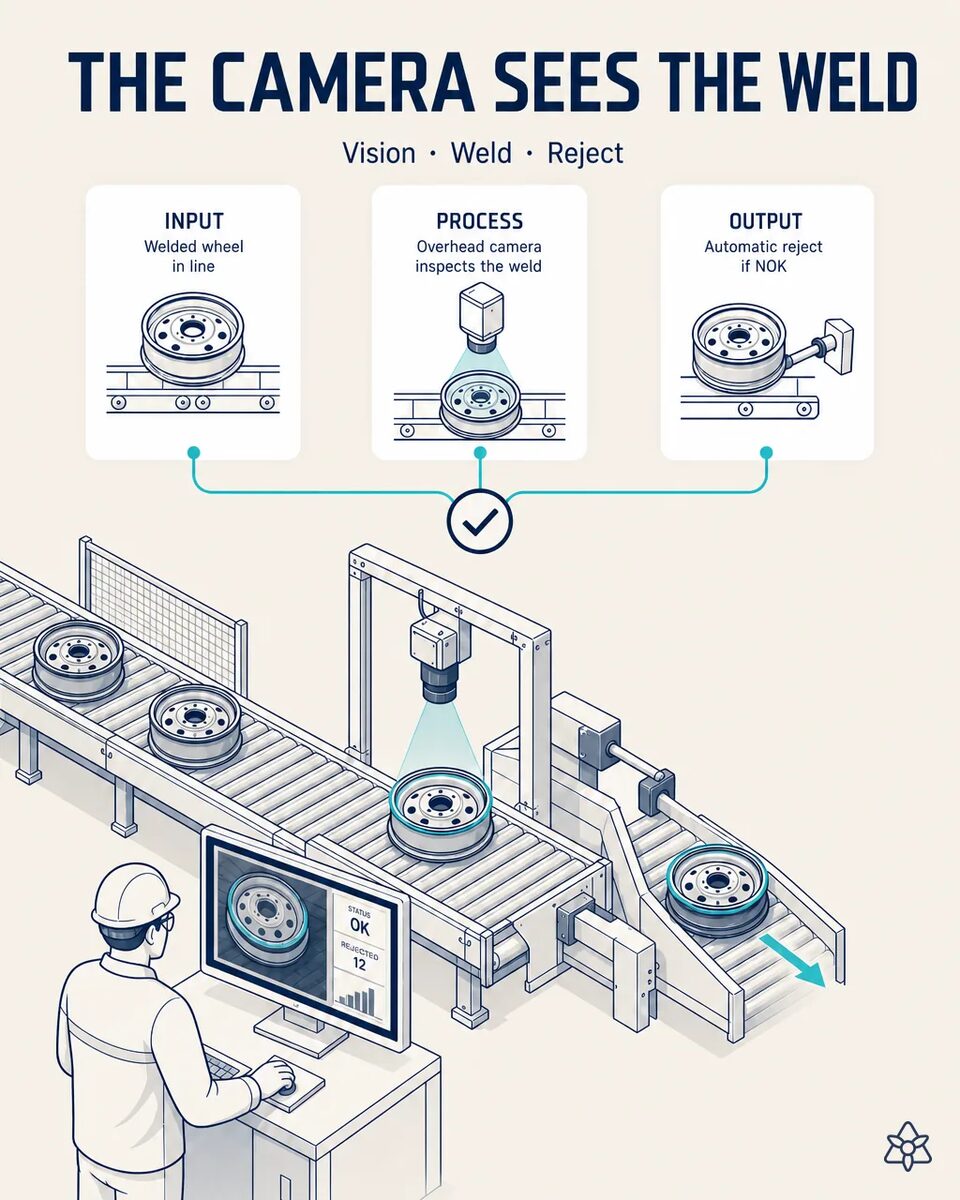
At cadence, the human eye adapts and lets things through.
The cost of a defect grows with every operation added on top of it. A wheel with a defective weld caught before finishing costs the disc, the rim and the weld. The same wheel caught at final audit also costs pretreatment, e-coat, paint, curing and all the handling in between. And caught at the customer it costs sorting, premium freight and your reputation as a supplier. Full human visual inspection is on top of that a station nobody wants to staff across three shifts, and one where performance declines predictably through the shift. Sampling by acceptable quality level, the usual alternative, is statistically reasonable but lets the sporadic defect through — and the sporadic defect is precisely the one that ends up as a field claim.
- The cost of a defect grows with every operation added on top of it: the same wheel costs three times as much caught after paint as caught after welding.
- Caught at the customer it also costs the sorting, the urgent freight and your reputation as a supplier.
- One hundred percent visual inspection is a job nobody wants to staff across three shifts, and one where performance falls predictably as the shift goes on.
- Acceptable quality level sampling is statistically reasonable, but it lets the sporadic defect through — and that is precisely the one that ends up as a field claim.
- The defects that matter are known and repetitive: porosity, spatter, undercut, lack of penetration and a discontinuous bead.
Edge, AI vision in line — the machine filters, the person judges.
Edge, in-line AI vision.
The operator does not disappear: they stop inspecting and start ruling on the borderline cases the AI escalates. That is the shift that makes one hundred percent control sustainable, because what does not survive three shifts is looking at every part, not judging the hard ones.
- An industrial camera at the station after welding, with controlled lighting, and a second one at the curing oven exit.
- A neural network trained on the plant's own real catalogue of good and bad parts, part number by part number.
- Local inference in milliseconds, with no dependency on the network or the cloud.
- Automatic rejection and recording of the defect image linked to the order, the heat number and the welding parameters read from the panel.
- The operator stops inspecting and starts deciding on the borderline cases the AI escalates: the machine filters, the person judges.
Today's visual control versus Edge vision
| Aspect | Human visual control | With iLEAN Edge |
|---|---|---|
| Coverage | 100 % nominal, with real fatigue | 100 % at cadence, no drift |
| Where it is caught | Final audit or customer | The station after welding |
| Cost of the caught defect | With all the finishing on top | Disc, rim and weld |
| The sporadic defect | That is the one that escapes | That is the one it catches |
| Evidence | None | Image, part number, heat and weld parameters |
| The operator's role | Inspect everything | Judge the borderline cases |
Estimated impact — to validate with your own numbers.
The block below is an estimate to be validated against your plant's actual data. We put it forward so the committee has an order of magnitude; we refine it during the assessment.
- Estimated payback 5-10 months.
- Scrap down ≥ 30 % on the covered failure mode.
- Value added currently invested in parts that will end up rejected, and that you stop investing.
- Reduced risk of a field claim, which is where the cost stops having a ceiling.
estimated payback 5-10 months, with scrap down ≥ 30 % on the covered failure mode. Add the value added currently invested in parts that will end up rejected, and the reduced risk of a field claim. *Estimate to validate.*
And the fair question from the production manager
«What if the camera flags good parts as bad?» — the false positive is the real risk of any vision system, which is why the network is trained on the catalog of good and bad parts from your own plant, part number by part number, not on a generic model. Borderline cases are not rejected: they are escalated to the operator, who decides. And every decision they make feeds back into training.
[1] OpenAI paper "Why Language Models Hallucinate", 2025 — on the reliability of AI in anchored tasks.
What people ask about weld bead vision
How many parts are needed to train it?
Fewer than people usually fear, because the defect catalog for this operation is known and repetitive. What is needed is that they be real parts from your plant and your part numbers, not a generic dataset.
Does it keep up with line cadence?
Yes: inference is local and resolves in milliseconds. It does not depend on the plant network or the cloud, which is exactly why it is called Edge.
Does it replace final inspection?
It does not replace it, it unloads it. Final inspection stops being the first net that catches the defect and becomes the last one, which is where it belongs.
Does it also catch finishing defects?
Yes, with a second camera at the curing oven exit: runs, craters, coverage gaps and contamination. They are a different failure mode and are trained separately.
What is recorded for each defect?
The image, tied to the order, the heat and the weld parameters read from the panel. That is what turns a rejection into a root cause lead instead of a number.
More cases from this series
- The auditor is not one day a year, it is a permanent regimeEvery critical change generates its dossier with before/after photos, parameters and signature. Agents…
- Four rings between the coil and the palletFour coordinated verification rings from the coil heat to the pallet, with JIDOKA AI stopping the line…
- Wheel traceability begins with a twelve digit numberA photo of the delivery note and the heat tags, one validation tap and into the ERP. No carrier…
- The human gate that separates iLEAN from a loose AIWhat the AI captures never enters the system unsigned. First piece validated in two taps, with photo and…
- The knowledge that predicts failure is spoken, and today it is lostThe maintenance manager talks to the AI during his round: the odd noise and the leak stop dying with the…
- The plant's most expensive data lives in a shared folderFilm thickness, runout and fatigue results reach the ERP on their own after human validation. From 4-6…
Tell us where on the line you catch the first bead defect today.
We work on your plant's real data, not ours. Assessment with no commitment.
Request estimated ROI within 48h ‹ See all cases of automotive wheels See automotive