The plant's most expensive data lives in a shared folder
Every wheel plant has a shared folder where the laboratory spreadsheet lives. The technician fills it in every shift and it holds the plant's most expensive data: e-coat film thickness, adhesion, salt spray, radial and lateral runout, imbalance, and the verdict of the fatigue and impact tests that qualify the part number. It is live data, but the business system and statistical control both require someone to transcribe it. With Connect in listen-inward mode, the file is read the moment it is saved and, after human validation, posts itself.
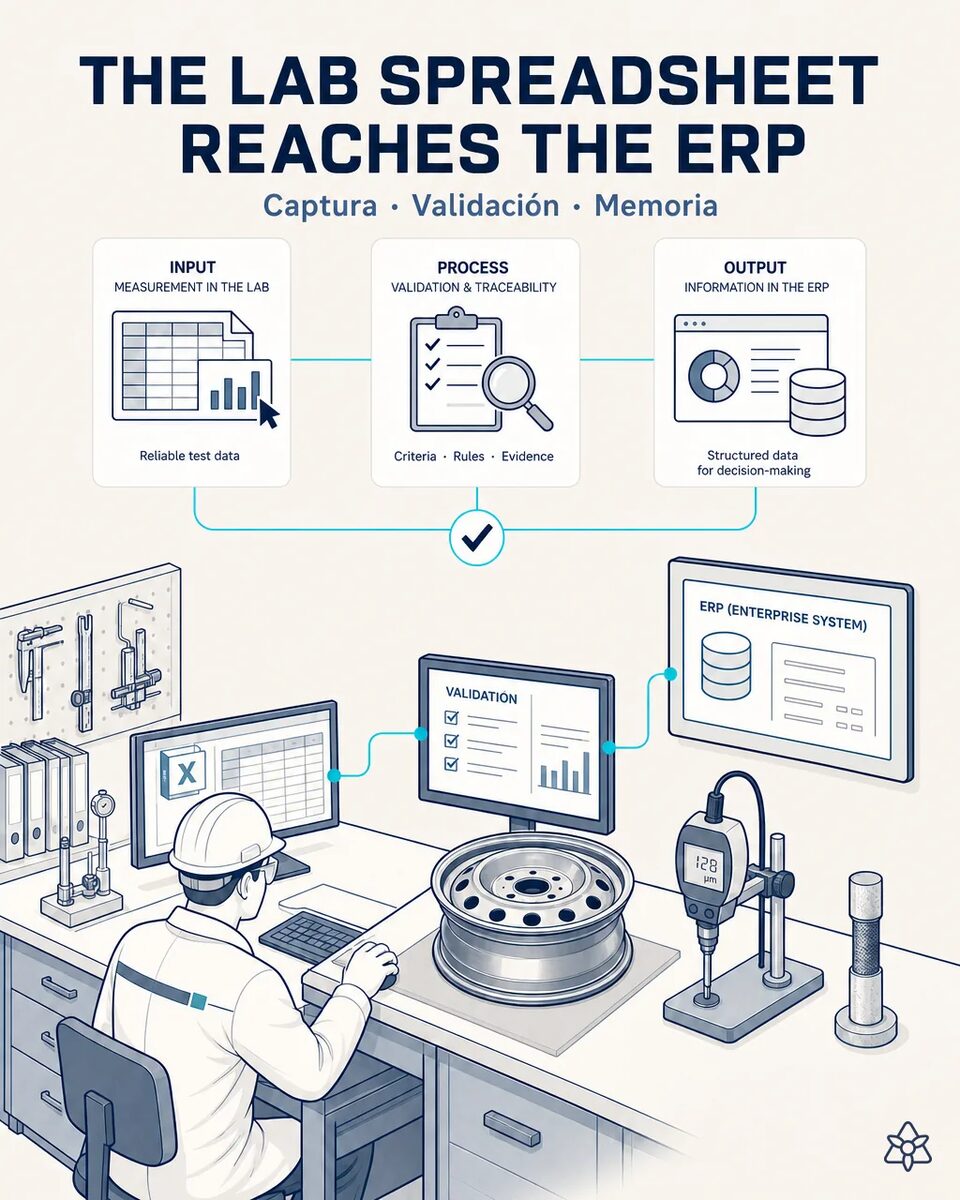
This is not a discipline problem. It is a latency problem.
The laboratory produces the data, saves it in its spreadsheet, and then somebody moves it into the business system and statistical control. It gets transcribed late, transcribed with typos, and often only the part that "has to be uploaded" gets transcribed at all, losing the rest. Half a day a month of qualified staff dedicated purely to copying numbers from one screen to another is the visible cost. The invisible one is worse: when statistical control fires a trend signal, the data that would have anticipated it had been sitting for three weeks in a spreadsheet nobody read. This is not a laboratory problem or a discipline problem. It is a latency problem, and it is solved by removing the manual step, not by demanding it be done faster.
- The laboratory generates the data, saves it in its sheet, and then someone moves it to the business system and to statistical control. It is transcribed late, with typos, and often only the part that "has to be uploaded".
- Half a day a month of qualified staff copying numbers from one screen to another is the visible cost.
- The invisible one is worse: when statistical control raises a trend signal, the data that would have anticipated it had been sitting for three weeks in a spreadsheet nobody read.
- And this is the plant's most expensive data: film thickness, adhesion, salt spray, radial and lateral runout, imbalance and the verdict of the tests that qualify the part number.
Connect in inward listening mode — it reads the file, not the person.
Connect in listen-inward mode.
iLEAN feeds the statistical control the plant has already deployed. It does not compete with it: it removes the data-entry bottleneck that today makes it arrive late to its own signals.
- iLEAN observes the shared folder and reads the file the moment it is saved. It does not observe the person: it reads the file.
- A grounded model parses the sheet tolerating its real format — merged cells, margin comments, mixed units — and structures the records in central memory.
- The lab manager validates on a summary screen.
- After validation, Connect posts to the business system and to statistical process control through their interfaces.
- An important point for anyone who has already invested: iLEAN feeds the statistical control the plant already runs. It does not compete with it; it removes its data entry bottleneck.
Today's laboratory versus the connected laboratory
| Aspect | Today | With iLEAN Connect |
|---|---|---|
| Gap between real data and system data | Weeks | Minutes |
| Manual transcription | Half a day a month | Zero |
| What reaches the SPC | Whatever there is time to upload | The complete series |
| Trend signal | Fires late | Fires on fresh data |
| Sheet format | Has to be respected, nobody touches it | Tolerated as is: merged cells, mixed units |
| Quality module licences | 4-6 | 1, the supervisor who validates |
Estimated impact — to validate with your own numbers.
The block below is an estimate to be validated against your plant's actual data. We put it forward so the committee has an order of magnitude; we refine it during the assessment.
- Estimated payback 4-8 months.
- 💰 Financial angle: if 4 to 6 laboratory and quality people log into the business system today purely to enter results, that is 4-6 quality module licences. With Connect only the validating supervisor needs one: from 4-6 down to 1, a recurring 50-80 % reduction each year depending on your vendor's rate.
- Half a day a month of qualified staff recovered.
- The complete series available for root cause analysis, instead of partial records.
estimated payback 4-8 months. 💰 Financial angle: if 4 to 6 laboratory and quality people log into the business system today purely to enter results, that is 4-6 quality module licences. With Connect only the validating manager needs one: from 4-6 down to 1, a 50-80 % reduction recurring every year at the vendor's list rate. *Estimate to validate against last year's actual invoice.*
And the fair question from the production manager
«What if the technician changes the sheet layout?» — that always happens, which is why parsing does not depend on fixed positions: the model interprets the sheet tolerating merged cells, margin comments and mixed units. It is an anchored task, where the best models drop below 1.5% error [1], and the laboratory supervisor validates on a summary screen before anything crosses into the system.
[1] OpenAI paper "Why Language Models Hallucinate", 2025 — on the reliability of AI in anchored tasks.
What people ask about connecting the lab spreadsheet
Do we have to change the laboratory spreadsheet?
No. The sheet is built around how that laboratory works, and replacing it is the fast route to nobody using the system. iLEAN reads the file exactly as it is, in the real format it has today.
Does it replace the statistical control we already have?
No, it feeds it. This matters for anyone who has already invested in SPC: the problem was never the tool, it was that the data arrived late and by hand.
Can licences really be reduced?
It depends on your contract, which is why the figure is framed as an estimate to validate against last year's actual invoice. The logic is simple: anyone entering the quality module only to type results stops needing to log in.
What about fatigue tests, which take days?
They are handled the same way: the record enters when the technician saves the result. What changes is not the duration of the test, it is the time between the result and its availability in the system.
Does it read the shared folder constantly?
It watches the folder and reacts when the file is saved. It reads files, not people: there is no tracking of who opens what or how long they spend on it.
More cases from this series
- The auditor is not one day a year, it is a permanent regimeEvery critical change generates its dossier with before/after photos, parameters and signature. Agents…
- Four rings between the coil and the palletFour coordinated verification rings from the coil heat to the pallet, with JIDOKA AI stopping the line…
- Wheel traceability begins with a twelve digit numberA photo of the delivery note and the heat tags, one validation tap and into the ERP. No carrier…
- The human gate that separates iLEAN from a loose AIWhat the AI captures never enters the system unsigned. First piece validated in two taps, with photo and…
- The knowledge that predicts failure is spoken, and today it is lostThe maintenance manager talks to the AI during his round: the odd noise and the leak stop dying with the…
- The modern machine that lives isolated from the real flowThe marker engraves what the MES publishes, by API, and returns confirmation. From two keyings per…
Tell us how many people log into the ERP today purely to enter laboratory results.
We work on your plant's real data, not ours. Assessment with no commitment.
Request estimated ROI within 48h ‹ See all cases of automotive wheels See automotive