The knowledge that predicts failure is spoken, and today it is lost
The maintenance and engineering manager spends the day walking between stamping presses, the flash butt welder, the welding robots, the overhead paint conveyor and the compressor room. Hands busy, gloves on, hearing protection in, background noise throughout. On that round he notices a bearing singing differently, a leak on a hydraulic cylinder, an electrode more worn than it should be. None of it gets typed. With Connect in voice mode he talks to the AI without stopping, and what he says is structured, raised as a ticket and returned with context in seconds.
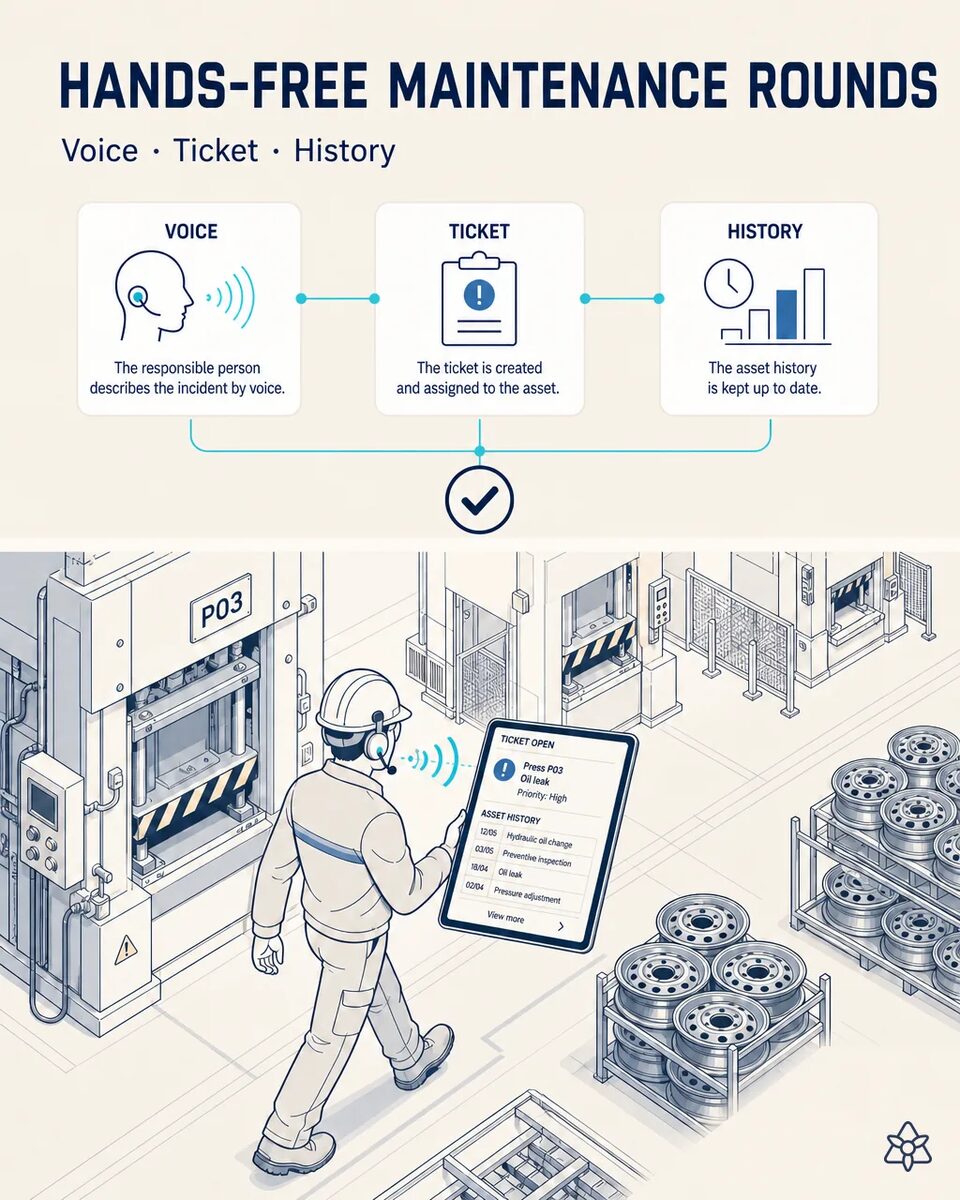
The knowledge that anticipates a breakdown is spoken, and it dies at the end of the shift.
The most valuable knowledge in an industrial plant is the knowledge that anticipates downtime. And it is tacit, spoken and perishable: it dies at the end of the shift. The maintenance management system is only fed once something has broken. The result is an asset history that records breakdowns perfectly but none of the signals that preceded them. Without those signals, predictive maintenance has nothing to learn from. And the person holding those signals is precisely the one least able to type: standing, on the floor, hands busy, with no surface to rest anything on. There is a longer horizon problem too: when a veteran technician retires, two decades of know-how leave with them, having never reached any system.
- On the round somebody notices the bearing that sings differently, the leak in a hydraulic cylinder, the electrode more worn than it should be. None of it gets typed.
- The maintenance management system is only fed once there is a breakdown. The asset history tells the failures perfectly and records none of the signals that preceded them.
- Without those signals, predictive maintenance has nothing to learn from: it is asked to predict from a history that only contains endings.
- And the person holding the signals is precisely the one least able to type: on their feet, in gloves, in hearing protection, with no surface to write on.
- There is an uncomfortable horizon too: when a veteran technician retires, twenty years of knowledge that never reached any system leaves with them.
Connect in hands-free voice mode — the AI hears what the manager chooses to tell it.
Connect in hands-free voice mode.
This is the fastest payback in the series for a simple reason: it needs no plant hardware. An earpiece compatible with mandatory hearing protection, and the round that already happens every day.
- A Bluetooth earpiece compatible with mandatory hearing protection.
- The manager speaks while walking, in natural language and in the vocabulary of the trade.
- iLEAN listens and structures: asset, symptom, criticality, context. It stores this in central memory and opens the ticket in the maintenance system.
- It returns support in seconds with what the person does not carry in their head: prior reports on that asset, the date of the last component change, the preventive due date, and a proposed action.
- Nobody is under scrutiny: the AI hears what the manager chooses to tell it.
Today's round versus the captured round
| Aspect | Today | With iLEAN Connect |
|---|---|---|
| Where the observation ends up | In the head of whoever saw it | In the asset history |
| What the CMMS holds | The breakdown, once it happened | The prior signals as well |
| Effort for the manager | Type it later, if there is time | Speak while walking |
| What comes back on the spot | Nothing | Prior reports, last component change, preventive due date |
| Basis for predictive | Failures only | A symptom trail per asset |
| A veteran retiring | The knowledge is lost | It stays in the history |
Estimated impact — to validate with your own numbers.
The block below is an estimate to be validated against your plant's actual data. We put it forward so the committee has an order of magnitude; we refine it during the assessment.
- Estimated payback 3-8 months — the fastest in the series, because it requires no plant hardware.
- Improved mean time between failures on the assets that accumulate the most prior reports.
- Reduced unplanned downtime at the bottlenecks, which in this plant are the press and the welder.
- Preventive work reordered by observed symptom instead of by calendar.
estimated payback 3-8 months — the fastest in the series, because it requires no plant hardware. It shows up as improved mean time between failures on the assets with the most prior reports, and as less unplanned downtime at the bottlenecks. *Estimate to validate.*
And the fair question from the production manager
«Is this here to check up on my team?» — no, and framed that way the case would fail within a month. The AI hears what the manager chooses to tell it, when they choose to tell it. There is no continuous listening and no record of where anyone is. The gain runs the other way: the technician no longer has to remember at the end of the shift what they saw at seven in the morning.
[1] OpenAI paper "Why Language Models Hallucinate", 2025 — on the reliability of AI in anchored tasks.
What people ask about capturing the round by voice
Does it work with the noise of a press bay?
That is the design condition of the case. The earpiece is compatible with mandatory hearing protection and recognition is prepared for industrial background noise and for trade vocabulary, which is not general language.
Do they have to speak in a particular way?
No. They speak naturally, the way they would tell a colleague. iLEAN is the one that structures it afterwards: asset, symptom, criticality and context.
Does it open the work order directly in the CMMS?
Yes, and it returns confirmation. What it does not do is close or reschedule anything on its own: that remains a maintenance decision.
What if it identifies the wrong asset?
It returns what it understood within seconds, with the asset identified, so the correction happens on the spot rather than three days later while reviewing odd work orders.
Does it work for line operators too?
The case is deployed with maintenance first because the signal is densest there, but the same voice mode works for production and quality once the team has adopted it.
More cases from this series
- The auditor is not one day a year, it is a permanent regimeEvery critical change generates its dossier with before/after photos, parameters and signature. Agents…
- Four rings between the coil and the palletFour coordinated verification rings from the coil heat to the pallet, with JIDOKA AI stopping the line…
- Wheel traceability begins with a twelve digit numberA photo of the delivery note and the heat tags, one validation tap and into the ERP. No carrier…
- The human gate that separates iLEAN from a loose AIWhat the AI captures never enters the system unsigned. First piece validated in two taps, with photo and…
- The plant's most expensive data lives in a shared folderFilm thickness, runout and fatigue results reach the ERP on their own after human validation. From 4-6…
- The modern machine that lives isolated from the real flowThe marker engraves what the MES publishes, by API, and returns confirmation. From two keyings per…
Tell us how many of last year's breakdowns gave you a warning that was never recorded.
We work on your plant's real data, not ours. Assessment with no commitment.
Request estimated ROI within 48h ‹ See all cases of automotive wheels See automotive