The human gate that separates iLEAN from a loose AI
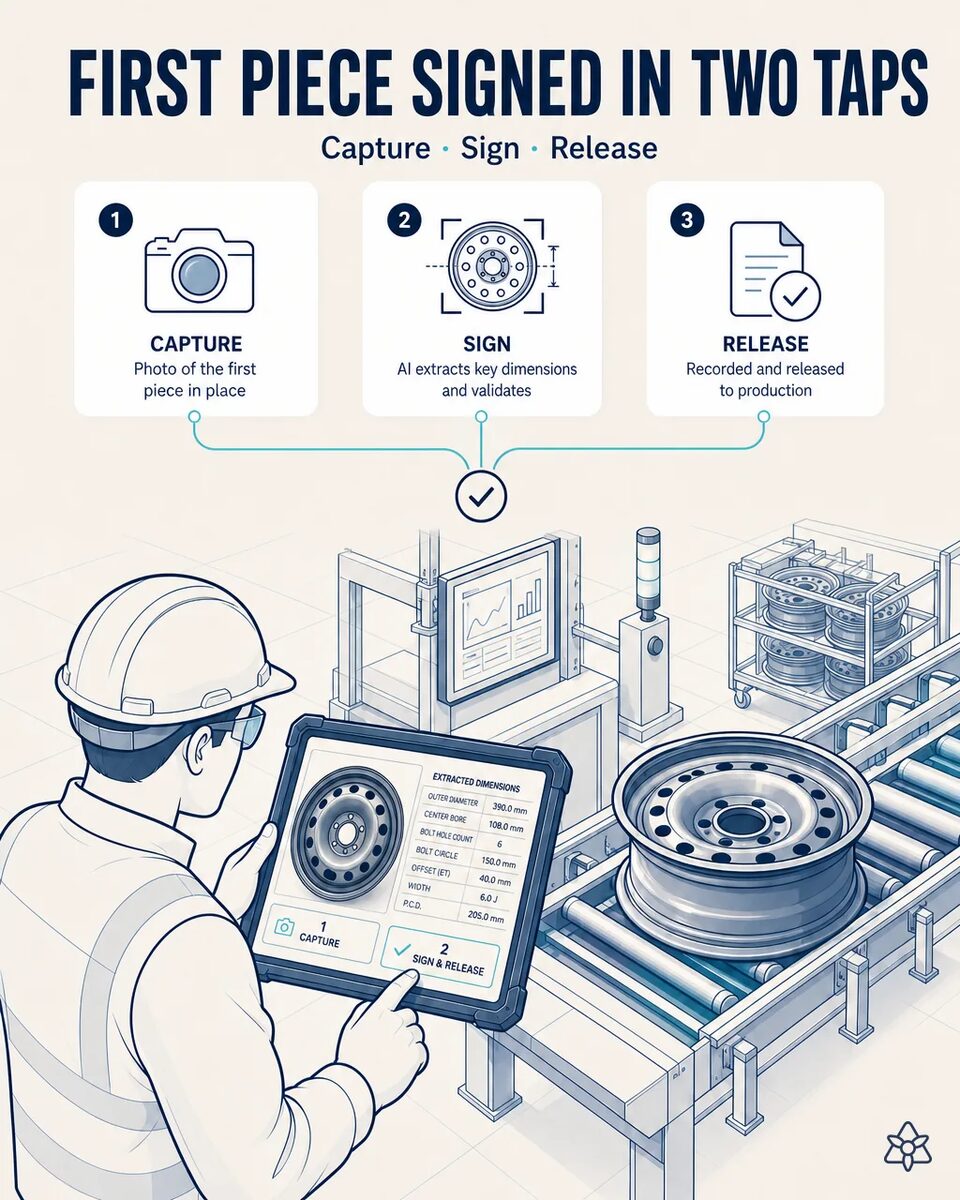
What iLEAN captures never enters the central system without a human having seen it first. In a wheel plant, the data point that cannot enter alone is first-piece approval after a changeover: disc dimensions, gauge, runout, weld appearance and the mounted die code. Today it is a hand-signed sheet with no evidence attached. With iLEAN, the industrial tablet shows on one screen the summary of what the AI has just captured, the supervisor confirms in two taps or corrects, and only then does the data cross and the line get released.
A signature on paper proves somebody signed. Not that the part conformed.
Releasing a line on a wrongly approved first piece means running a complete lot out of tolerance before anyone notices and, at worst, damaging the die set. The signature exists, but it is a signature on paper with no evidence attached: there is no record of what exactly was measured or what was seen. In front of an auditor, that signature proves somebody signed, not that the part conformed. And there is a real tension any solution has to respect: the operator has no time for a long form. Any control costing several minutes per changeover gets skipped or filled in afterwards, which is worse. At the same time, letting an AI write directly to master data without a human signature is exactly what no steering committee approves, and rightly so: an autonomous agent entering unvalidated data ends up contaminating the plant's master.
- Releasing a line on a badly approved first piece means producing a whole out-of-tolerance lot before anyone notices and, at worst, damaging the die set.
- The signature exists, but it sits on paper with no evidence attached: there is no record of what was actually measured or what was seen.
- There is a real tension any solution has to respect: the operator has no time for a long form. Anything that costs several minutes per changeover gets skipped or filled in afterwards, which is worse.
- And at the same time, letting an AI write straight into the data master with no human signature is exactly what no management board approves — rightly so.
Connect with an early human verification gate.
Connect with an early human verification gate.
Every time a human corrects the AI, the system learns where it fails and extraction improves. The validation gate is not only a control: it is the mechanism by which the system gets better without anyone having to train it separately.
- Industrial tablets at the press and at the assembly line.
- A single screen with the photo of the part, the extracted dimensions, the settings read from the press and the identified tooling, with deviations already highlighted.
- Two taps: confirm or correct. Latency in seconds, not minutes.
- Only after confirmation does the data enter the manufacturing system and statistical process control, and only then is the line released.
- The correction is stored too: every time a human corrects the AI, the system learns where it fails and extraction improves.
Today's signature versus the signature with evidence
| Aspect | Today, on paper | With iLEAN |
|---|---|---|
| What the signature proves | That somebody signed | What was measured and what was seen |
| Operator time | A form taking several minutes | Two taps |
| When the data enters | Hours later, or never | Within seconds, once confirmed |
| Out-of-tolerance deviations | Caught if somebody looks | Highlighted on the validation screen |
| Who writes to the master | A person, typing | A person, confirming |
| If the AI gets it wrong | — | Corrected at the gate, and the system learns from the correction |
Estimated impact — to validate with your own numbers.
The block below is an estimate to be validated against your plant's actual data. We put it forward so the committee has an order of magnitude; we refine it during the assessment.
- Estimated payback 4-9 months, from the out-of-tolerance lots you stop producing.
- First-piece documentation gap that disappears in customer and certification audits.
- Tooling damage avoided on the start-ups released today with no objective check.
- The governance guarantee any board requires before letting an AI write into the plant's data master.
estimated payback 4-9 months, from the out-of-tolerance lots you stop producing and the first-piece documentation gap that disappears in audits. It also delivers the governance guarantee any committee requires before letting an AI write to the master. *Estimate to validate.*
And the fair question from the production manager
«If a human still has to validate, what is the AI saving?» — the work is not in deciding, it is in assembling. Today the person has to search, measure, transcribe and only then decide. With the verification gate they only do the last part: they arrive at a screen with the photo, the dimensions and the parameters already assembled and the deviations highlighted, and they say yes or no. On extraction, it is an anchored task and the best models drop below 1.5% error [1] — but the point is that the error is caught at the gate, not in the master.
[1] OpenAI paper "Why Language Models Hallucinate", 2025 — on the reliability of AI in anchored tasks.
What people ask about human validation
How long does it really take the operator?
Seconds. All the information arrives assembled on a single screen with deviations already highlighted. If a control costs minutes it ends up being filled in afterwards, and that is precisely the failure this case closes.
Can the AI write to the ERP without anyone signing?
No, and this is not a configuration option: it is the architecture. Data crosses into the manufacturing system and into statistical control only after human confirmation.
What happens when the operator corrects the AI?
The correction is stored. It serves two purposes: there is a trail of what was changed and by whom, and the system learns where extraction is failing for that part number.
What if the supervisor is not there at that moment?
The line is not released. That is deliberate: the case exists precisely so that release depends on a real validation rather than on a signature added later.
Does it apply beyond first piece?
Yes. The same human-gate pattern is used at coil receiving and at laboratory validation. First piece is where you start because that is where getting it wrong is most expensive.
More cases from this series
- The auditor is not one day a year, it is a permanent regimeEvery critical change generates its dossier with before/after photos, parameters and signature. Agents…
- Four rings between the coil and the palletFour coordinated verification rings from the coil heat to the pallet, with JIDOKA AI stopping the line…
- Wheel traceability begins with a twelve digit numberA photo of the delivery note and the heat tags, one validation tap and into the ERP. No carrier…
- The knowledge that predicts failure is spoken, and today it is lostThe maintenance manager talks to the AI during his round: the odd noise and the leak stop dying with the…
- The plant's most expensive data lives in a shared folderFilm thickness, runout and fatigue results reach the ERP on their own after human validation. From 4-6…
- The modern machine that lives isolated from the real flowThe marker engraves what the MES publishes, by API, and returns confirmation. From two keyings per…
Tell us how line release is signed off in your plant today.
We work on your plant's real data, not ours. Assessment with no commitment.
Request estimated ROI within 48h ‹ See all cases of automotive wheels See automotive