Four rings between the coil and the pallet
The capital pain of any automotive wheel plant is the same: a nonconforming wheel leaving the plant. Because a wheel is a safety-critical part, the consequences scale by orders of magnitude — the customer's line stoppage billed by the minute, sorting at destination with a team on site and, at worst, a safety campaign across thousands of vehicles. The iLEAN flagship coordinates the eleven preceding cases into four verification rings that cross-check each other: if the four do not agree, the line stops before the pallet leaves the plant.
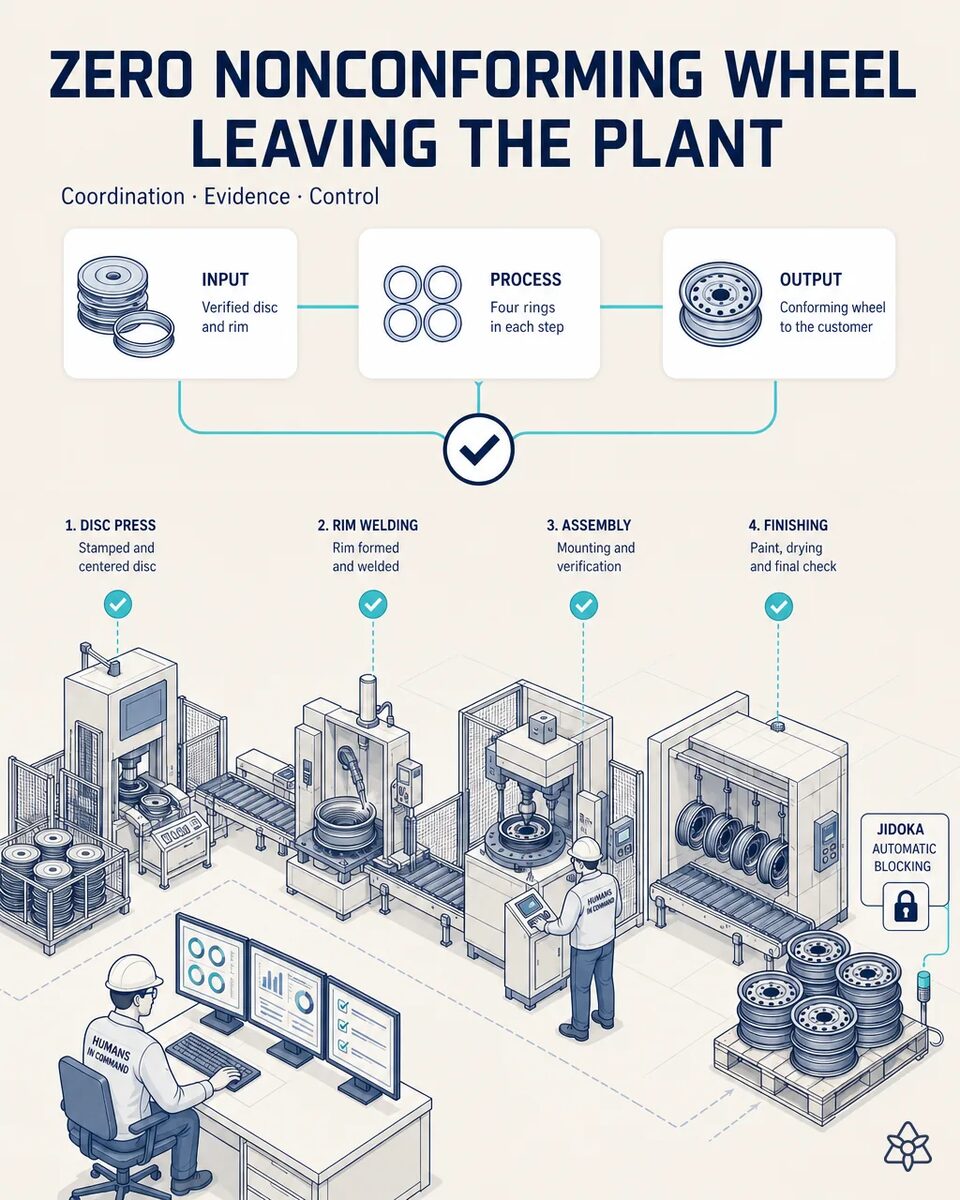
The capital pain: a nonconforming wheel leaving the plant.
A single nonconforming wheel at the customer triggers a cost chain that starts in the tens of thousands of euros and has no defined ceiling. And unlike other sectors, here the part is critical to vehicle safety: there is no concession available and no negotiable deviation. Its internal twin is unplanned downtime, in a plant that must deliver millions of wheels a year against a sequenced schedule with no inventory buffer. Both problems share the same root: information that exists in one system but is not cross-checked against another in time. The plant already knows this and already tries. What it lacks is not will or procedure: it is cross-checked evidence in real time between systems that today do not talk to each other.
- A single nonconforming wheel at the customer triggers a cost chain that starts in the tens of thousands of euros and has no defined ceiling.
- The wheel is a safety part: no concession is possible, no deviation is negotiable. At worst, the scale is a safety campaign across thousands of vehicles.
- Its internal twin is your own unplanned downtime, in a plant that must deliver millions of wheels a year against a sequenced schedule with no stock buffer.
- Both problems share the same root: information that exists in one system but is not crossed with another's in time.
- The plant already knows this and already tries. What it lacks is neither will nor procedure: it is real-time cross-checked evidence between systems that do not talk to each other today.
Four rings that cross-check — if they do not agree, the line stops.
No single ring solves the problem: the strength is in the cross-check. The wheel passing the camera has to agree with what the order says, with what the marker engraved and with what the pallet dossier declares. Four independent sources contradicting each other is an alarm; a single source is an assumption.
- Ring 1 · The order is the truth (business and manufacturing system). The active order defines part number, coil heat, die set, process parameters and destination customer.
- Ring 2 · The marker engraves what is published (case 8). It engraves exactly what the system publishes and returns confirmation of what was engraved. Zero intermediate keying, no possible divergence between the order and the wheel's physical identity.
- Ring 3 · The camera cross-checks and JIDOKA stops (cases 9 and 10). The camera reads the weld, the finish and the actual marking on the wheel going past and cross-checks them against the active order. On any discrepancy, JIDOKA AI stops the line on the spot. And the changeover could not even have started without visual validation of the tooling.
- Ring 4 · The pallet ships with its dossier (case 11). Every pallet ships with an evidence pack cross-referencing the previous three rings plus the photo of the marking, the welding parameters read from the panel and the signature of whoever validated the first piece.
Underneath runs the predictive layer (cases 2 and 4): the welder curve and the spoken reports from the maintenance round feed the reliability model, so downtime is anticipated before something breaks and parameter drift is corrected before the first bad part is produced. And SMED AI speeds up changeovers so that running four active rings is never paid for in productivity — the condition that makes the system acceptable on the floor.
The four rings, and what each one closes
| Ring | What it contributes | What failure it closes |
|---|---|---|
| 1 · The order is the truth | Part number, heat, tooling, parameters and destination customer | Ambiguity about what should have been produced |
| 2 · The marker engraves what is published | Engraved with no keystroke in between, confirmation returned | Divergence between marking and order |
| 3 · The camera cross-checks and JIDOKA stops | Bead, finish and actual marking against the live order | A nonconforming part that keeps moving |
| 4 · The pallet ships with its dossier | Evidence from the three rings plus marking photo and parameters | Traceability that has to be rebuilt afterwards |
Estimated impact — to validate with your own numbers.
The block below is an estimate to be validated against your plant's actual data. We put it forward so the committee has an order of magnitude; we refine it during the assessment.
- Estimated payback 6-12 months against the first customer line stoppage avoided.
- Protection against a safety campaign: a single impact potentially running into several hundred thousand euros, with no defined ceiling.
- From detection at the customer to detection on the line, and from reactive unplanned downtime to anticipated downtime.
- Protection of the OEM relationship and of the award of future programs, on a multi-year horizon.
estimated payback 6-12 months against the first customer line stoppage avoided. Add the protection against a safety campaign — a single impact potentially running into several hundred thousand euros with no defined ceiling — and the protection of the customer relationship and of future programme nominations, which is multi-year in value. *Estimate to validate with the quality manager and plant management.*
And the fair question from the production manager
«Do we have to deploy all twelve cases to get this?» — no, and framing it that way would be the way never to start. The rings are built in layers: each case pays for itself from the first month and, as they add up, they close the cross-check. A plant that starts with coil receiving and the welder panel already has half of ring 1 and half of ring 3 running without committing to a two-year project.
[1] OpenAI paper "Why Language Models Hallucinate", 2025 — on the reliability of AI in anchored tasks.
What people ask about the complete system
Where do you start?
With the case that has the shortest payback and fewest dependencies, which in this matrix is usually coil receiving or the hands-free maintenance round. What matters is that each layer pays on its own, without waiting for the next one.
How long until it is complete?
That depends on the pace the plant sets, not on the system. The rings can be built in whatever order suits your investment plan, and none blocks the others from delivering.
What if a ring flags a false discrepancy?
JIDOKA stops on a verifiable discrepancy between sources, not on model uncertainty. When the doubt is the model's, the case is escalated to a person rather than stopping the line.
Does it replace the ERP and MES we already have?
No. Ring 1 rests precisely on the business system's order being the truth. iLEAN does not replace those systems: it cross-checks them against each other and against what actually happens on the line.
Can the return be measured before committing?
Yes, and that is what we propose: with your numbers on changeovers per week, scrap by failure mode and the cost of recent customer incidents, the return per layer is estimated before deciding the order.
More cases from this series
- The auditor is not one day a year, it is a permanent regimeEvery critical change generates its dossier with before/after photos, parameters and signature. Agents…
- Wheel traceability begins with a twelve digit numberA photo of the delivery note and the heat tags, one validation tap and into the ERP. No carrier…
- The human gate that separates iLEAN from a loose AIWhat the AI captures never enters the system unsigned. First piece validated in two taps, with photo and…
- The knowledge that predicts failure is spoken, and today it is lostThe maintenance manager talks to the AI during his round: the odd noise and the leak stop dying with the…
- The plant's most expensive data lives in a shared folderFilm thickness, runout and fatigue results reach the ERP on their own after human validation. From 4-6…
- The modern machine that lives isolated from the real flowThe marker engraves what the MES publishes, by API, and returns confirmation. From two keyings per…
Tell us what your last quality incident that reached the customer cost you.
We work on your plant's real data, not ours. Assessment with no commitment.
Request estimated ROI within 48h ‹ See all cases of automotive wheels See automotive