Wheel traceability begins with a twelve digit number
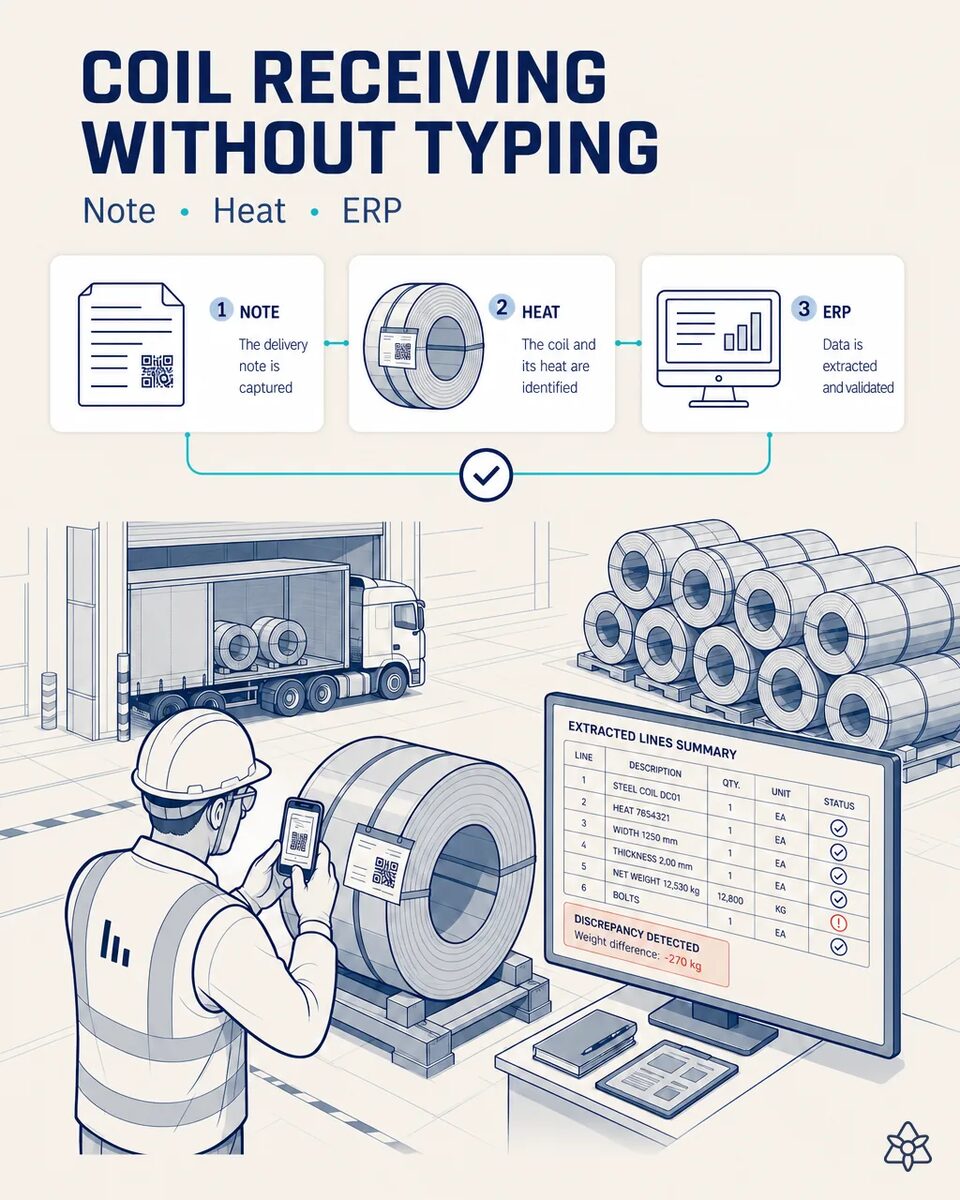
The truck arrives with hot rolled steel coils. The receiving supervisor faces a large-format delivery note with eight to twenty lines, one tag per coil carrying its heat number, grade, gauge, width and weight, and the material quality certificate. He has to sign and then also log into the business system and type it line by line. Either the carrier waits charging demurrage, or it gets typed in a hurry and the heat number ends up wrongly tied. With Connect: two photos, one tap, and everything enters with the heat number properly secured.
The weakest link in the whole traceability chain is somebody typing, standing on the dock.
The traceability an automotive customer demands reaches back to the steel heat of every wheel. That entire chain, which underpins the response to a field claim, rests on someone typing a twelve digit number correctly, standing up, with a truck waiting on the dock. It is the most fragile point in the plant's whole traceability and the hardest to defend in front of an auditor. And its failure mode is invisible at the time: a mistyped number throws no error, it simply ties the coil to the wrong heat. The cost surfaces three weeks later, when a specific wheel has to be traced and the trail leads nowhere. Meanwhile the operational pressure on the dock pushes the other way: every minute of typing is a billable minute of carrier demurrage.
- The traceability an automotive customer requires reaches back to the steel heat of every wheel. That entire chain rests on somebody typing a twelve digit number correctly.
- It is typed standing up, with a truck waiting at the dock and a large-format delivery note of eight to twenty lines in front of them.
- The failure is invisible at the time: a mistyped number does not raise an error, it simply ties the coil to the wrong heat.
- The cost shows up three weeks later, when a specific wheel has to be traced and the trail leads nowhere.
- And operational pressure pushes the other way: every minute of typing is a minute of billable carrier demurrage.
Connect in photo mode on analog documents, pushing into the business system.
Connect in photo-to-analogue mode with posting to the business system.
The on-screen summary arrives with the discrepancies between delivery note and labels already highlighted. That is the point where there is no control at all today: nobody compares twenty labels against twenty delivery note lines with a truck waiting.
- A photo of the delivery note, recognised with its table structure, lines and quantities.
- A photo of the coil tags, reading standard barcode and two-dimensional symbologies plus plain optical recognition when a tag is printed without symbology.
- An on-screen summary with note-versus-tag discrepancies already highlighted.
- The supervisor validates with one tap and Connect creates the goods receipt with the heat number tied and the photo of the original document attached.
Today's receiving versus captured receiving
| Aspect | Today | With iLEAN Connect |
|---|---|---|
| Time per truck | 30-45 minutes of typing | A couple of minutes |
| Carrier demurrage | Recurring and billable | Zero |
| Heat tied to the coil | Depends on manual typing | Read from the label and validated |
| Delivery note versus labels | Nobody compares them | Discrepancies highlighted before validating |
| Documentary evidence | The note, in a filing cabinet | Photo of the document attached to the entry |
| ERP licences in receiving | 3-5 | 1, the supervisor who validates |
Estimated impact — to validate with your own numbers.
The block below is an estimate to be validated against your plant's actual data. We put it forward so the committee has an order of magnitude; we refine it during the assessment.
- Estimated payback 3-7 months — the shortest in the series, because the saving comes in three forms at once.
- 💰 Financial angle: if 3 to 5 receiving and warehouse people hold a business system licence purely to book goods in, with Connect only the validating supervisor needs one: from 3-5 down to 1, a 50-70 % reduction in recurring licences.
- Carrier demurrage you stop paying, truck after truck.
- Heat-to-wheel traceability backed by attached documentary evidence instead of depending on a keystroke.
estimated payback 3-7 months — the shortest in the series, because the saving comes in three forms at once. 💰 Financial angle: if 3 to 5 receiving and warehouse people hold a business system licence purely to book incoming material, with Connect only the validating supervisor needs one: from 3-5 down to 1, a 50-70 % reduction in receiving module licences, recurring annually. Add the carrier demurrage you stop being charged, which is cash within the same financial year. *Estimate to validate.*
And the fair question from the production manager
«Does it read a dirty or creased label on the dock?» — the coil label carries standard barcode and two-dimensional symbology, which is direct reading; flat optical recognition only comes in when the label is printed without symbology. In that case it is an anchored task and the best models drop below 1.5% error [1]. And above all there is the cross-check: if label and delivery note do not match, the discrepancy is highlighted rather than resolved silently.
[1] OpenAI paper "Why Language Models Hallucinate", 2025 — on the reliability of AI in anchored tasks.
What people ask about digitizing coil receiving
Does it work with delivery notes from different suppliers?
Yes. Every steel supplier has its own format and the model recognizes the table, line and quantity structure without needing a template per supplier.
What if the truck brings more coils than the note says?
That is exactly the case that slips through today. The discrepancy between what the labels say and what the note says is highlighted on screen before the receiving supervisor validates.
Do we need a barcode scanner?
Not necessarily: a photo from the phone or industrial tablet is enough. If the plant already has scanners that work well, they integrate just the same.
What if there is no signal on the dock?
Capture does not depend on being connected at that instant: it is recorded and synced when there is a network. What is never done is booking an entry without human validation.
Can we start with receiving alone?
Yes, and it is usually a good starting point because the payback is the shortest of the twelve cases and the result is visible from the first truck.
More cases from this series
- The auditor is not one day a year, it is a permanent regimeEvery critical change generates its dossier with before/after photos, parameters and signature. Agents…
- Four rings between the coil and the palletFour coordinated verification rings from the coil heat to the pallet, with JIDOKA AI stopping the line…
- The human gate that separates iLEAN from a loose AIWhat the AI captures never enters the system unsigned. First piece validated in two taps, with photo and…
- The knowledge that predicts failure is spoken, and today it is lostThe maintenance manager talks to the AI during his round: the odd noise and the leak stop dying with the…
- The plant's most expensive data lives in a shared folderFilm thickness, runout and fatigue results reach the ERP on their own after human validation. From 4-6…
- The modern machine that lives isolated from the real flowThe marker engraves what the MES publishes, by API, and returns confirmation. From two keyings per…
Tell us how long it takes today to book in a truckload of coils.
We work on your plant's real data, not ours. Assessment with no commitment.
Request estimated ROI within 48h ‹ See all cases of automotive wheels See automotive