The modern machine that lives isolated from the real flow
There is a machine in the plant that is modern — five to fifteen years old — that already exposes a programming interface, and that nonetheless lives isolated from the real flow because there was never time to integrate it properly. The traceability marker is the classic case: at every changeover someone types the part number, the date and the plant code into its panel, having already typed them into the manufacturing system. Two keyings, two chances to get it wrong, and an error here means a whole lot mismarked on a safety-critical part.
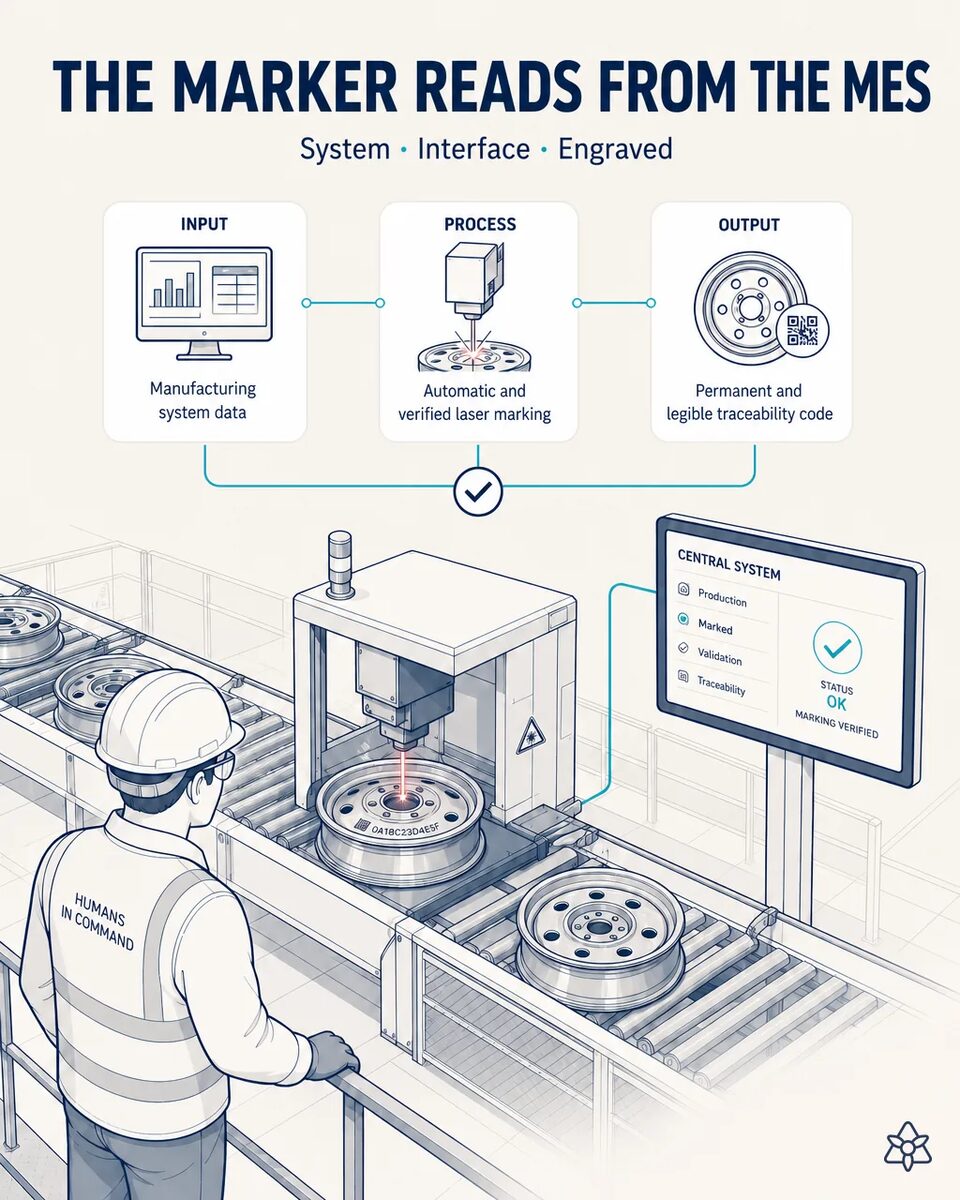
Marking is the wheel's legal identity, and today it depends on typing the same thing twice.
The marking is the wheel's legal identity. If it does not match the production order, traceability breaks at exactly the link the customer and the regulator look at first. And the mechanism guaranteeing it today is an operator typing the same thing twice in two different places, at every changeover, several times a day, under time pressure. The pattern repeats across other islands in the plant: the balancer, the fatigue test rig, the statistical control system. All modern, all with an available interface, all fed by hand because integrating them never reached the top of the list.
- If the marking does not match the production order, traceability breaks at exactly the link the customer and the regulator look at first.
- The mechanism guaranteeing it today is an operator typing the same thing in two different places, several times a day, under time pressure.
- An error here is not a bad data point: it is a whole lot mis-marked on a safety part.
- The machine is not old. It is five to fifteen years old and already ships with a programming interface — there was simply never time to integrate it.
- The pattern repeats with the balancer, the fatigue test rig and statistical control: all modern, all with an interface available, all fed by hand.
Connect as stitching between modern systems that were never connected.
Connect as the seam between modern systems.
Connect returns to the system confirmation of what the machine actually engraved, not what it should have engraved. That distinction is what turns marking into evidence instead of an assumption.
- When the manufacturing system publishes the active order, Connect pushes part number, julian date, plant code and serial to the marker.
- The marker engraves, and Connect returns to the system a confirmation of what the machine actually engraved — not what it should have engraved.
- Neither system is replaced and the marker's own program is untouched.
- The same pattern then repeats with the balancer, the test rig and statistical control: every island stitched in stops asking for keystrokes.
The isolated marker versus the stitched marker
| Aspect | Today | With iLEAN Connect |
|---|---|---|
| Keystrokes per changeover | Two, in two systems | Zero |
| Risk of wrong marking | Real, and on a safety part | Impossible by construction |
| Confirmation of what was engraved | Nobody records it | Returned and filed per lot |
| Integration cost | A project that never rises up the list | Stitched without replacing anything |
| The marker's program | — | Untouched |
| The rest of the plant's islands | Each one by hand | The same pattern replicates |
Estimated impact — to validate with your own numbers.
The block below is an estimate to be validated against your plant's actual data. We put it forward so the committee has an order of magnitude; we refine it during the assessment.
- Estimated payback 4-9 months.
- An entire cause of nonconformity and lot reclassification disappears.
- Operator hours recovered at every changeover, several times a day.
- It is the case that best shows iLEAN does not compete with what the plant already bought: it connects it.
estimated payback 4-9 months, from an entire cause of nonconformity and lot reclassification disappearing and from operator hours recovered at every changeover. It is also the case that best demonstrates iLEAN does not compete with what the plant already bought: it connects it. *Estimate to validate.*
And the fair question from the production manager
«Isn't a classic integration cleaner?» — it is, once the project reaches the top of the list, and that is precisely the problem: it has not for years. This case asks to replace neither system and does not touch the marker's program, so it competes for neither the shutdown window nor a large project budget. And it leaves the pattern in place to stitch the balancer and the test rig next.
[1] OpenAI paper "Why Language Models Hallucinate", 2025 — on the reliability of AI in anchored tasks.
What people ask about integrating the marker
Do we have to replace the marker or the MES?
Neither. Connect leans on the programming interface the marker already has and on what the manufacturing system publishes. It is stitching, not replacement.
What if the marker fails to engrave?
It is detected, because the confirmation returned is of what was actually engraved. Today that failure raises no signal at all: the system assumes what was requested was engraved.
Does it work for the balancer and the test rig?
Yes, it is the same pattern. You start with the marker because it underpins the part's legal identity, and every island stitched afterwards stops asking for keystrokes.
What if a machine has no API?
Then the applicable case is the other one: reading the panel with a camera, as on the flash butt welder. The marker is in this group precisely because it does have one.
Does anything change for the operator?
Yes: they stop typing. The changeover is published once in the manufacturing system and the machine finds out on its own.
More cases from this series
- The auditor is not one day a year, it is a permanent regimeEvery critical change generates its dossier with before/after photos, parameters and signature. Agents…
- Four rings between the coil and the palletFour coordinated verification rings from the coil heat to the pallet, with JIDOKA AI stopping the line…
- Wheel traceability begins with a twelve digit numberA photo of the delivery note and the heat tags, one validation tap and into the ERP. No carrier…
- The human gate that separates iLEAN from a loose AIWhat the AI captures never enters the system unsigned. First piece validated in two taps, with photo and…
- The knowledge that predicts failure is spoken, and today it is lostThe maintenance manager talks to the AI during his round: the odd noise and the leak stop dying with the…
- The plant's most expensive data lives in a shared folderFilm thickness, runout and fatigue results reach the ERP on their own after human validation. From 4-6…
Tell us which machines in your plant have an API and are still fed by hand.
We work on your plant's real data, not ours. Assessment with no commitment.
Request estimated ROI within 48h ‹ See all cases of automotive wheels See automotive