The most expensive planned stop restarts today on a signature with no evidence
Changeover is the most expensive planned stop in the plant: one to three hours to swap the die set on the stamping press and readjust the rolls on the profiling line. And its restart depends on someone signing "mounted and centred" with no objective evidence behind it. If it starts badly the outcome is a full lot out of tolerance, a damaged die worth tens of thousands, or both plus several hours of downtime. With Edge, the line does not start until the cameras confirm the state and the supervisor signs on that evidence.
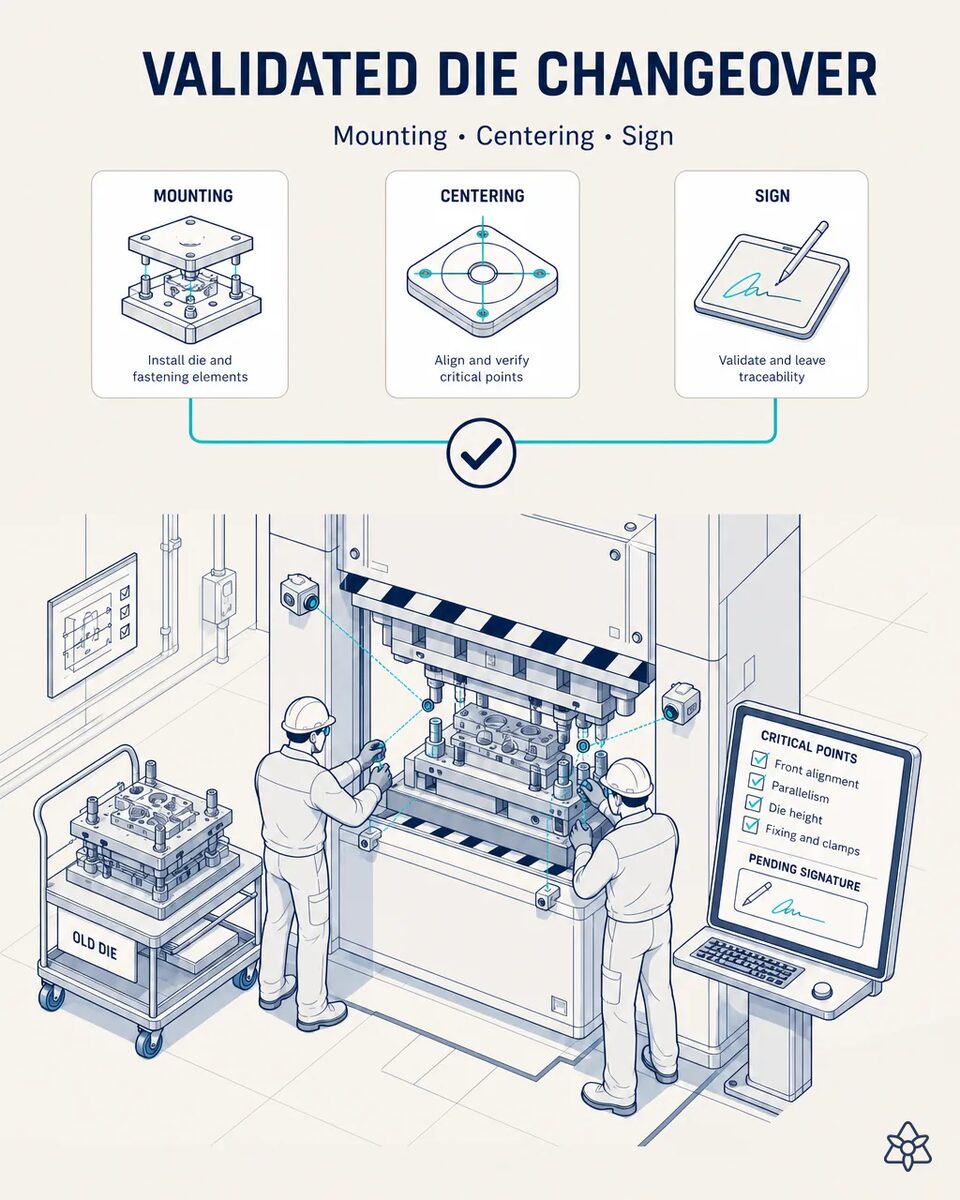
The most expensive stop of the week restarts on a signature with no evidence.
Changeover concentrates the whole week's risk into a window of a few hours. A scrap offcut left in the die destroys the tooling on the first stroke. A set mounted with the wrong code produces a part number that is not the one on the order. Centring outside tolerance produces a whole lot with runout out of specification that is only discovered at final inspection, once the entire finishing process has already been invested in it. And the pressure to recover the lost hour always pushes the same way: start before you are entirely sure. This is not a discipline problem, it is an incentive problem. Exhaustive checklist verification, the classic answer, collides with that same pressure: it lengthens the stop, so it gets filled in afterwards.
- The tooling changeover concentrates the whole week's risk into a window of a few hours: one to three, to swap the die set and readjust the roll former rollers.
- A scrap offcut left on the die face destroys the tooling on the first stroke — tens of thousands of euros per incident.
- A die set mounted under the wrong code produces a part number that is not the one on the order.
- Centering out of tolerance produces a whole lot with out-of-spec runout, and it only surfaces at final inspection, once all the finishing has been invested in it.
- Pressure to recover the lost hour always pushes toward starting before you are entirely sure. It is not a discipline problem, it is an incentives problem — and that is why the checklist gets filled in afterwards.
Edge with JIDOKA AI, plus SMED AI pulling the other way.
Edge with JIDOKA AI, plus SMED AI.
JIDOKA AI and SMED AI offset each other on purpose: one prevents starting too early and the other shortens the window. Without the second, the first would be experienced as a brake; together, the changeover comes out shorter and correct.
- Edge cameras at the N critical points of the changeover.
- Comparison of the current state against the mounted-and-ready reference state for that specific part number: tooling code visible and correct, position and centring within tolerance, die clean and free of offcuts, lubrication done, no tool left inside.
- JIDOKA AI: until the cameras confirm and the supervisor signs on that evidence, the press does not start. The line stops itself before producing badly, not after.
- SMED AI works the other way: it guides the changeover sequence step by step, orders the tasks that can overlap and learns from the history of changeovers on that same part number to shorten the window. Verification cannot cost productivity, or it will not be adopted.
Today's changeover versus the validated changeover
| Aspect | Today | With iLEAN Edge |
|---|---|---|
| What authorizes start-up | A signature with no evidence | Camera conformity, then a signature on it |
| Offcut left on the die face | Found on the first stroke | Detected before start-up |
| Wrong tooling code | Found at final inspection | Detected before start-up |
| Centering out of tolerance | A whole lot with runout out of spec | Blocked before producing |
| Changeover duration | 1-3 h | Guided step by step and shortened |
| When the line stops | After producing badly | Before producing badly |
Estimated impact — to validate with your own numbers.
The block below is an estimate to be validated against your plant's actual data. We put it forward so the committee has an order of magnitude; we refine it during the assessment.
- Estimated payback 5-10 months, and probably the easiest to calculate with your own data.
- Availability hours recovered at the plant's bottleneck.
- Tooling damage avoided: tens of thousands of € per incident.
- Out-of-tolerance lots that never get produced. Two of your numbers are enough: how many changeovers per week and how long they average.
estimated payback 5-10 months, and probably the easiest to calculate with your own data: availability hours recovered at the bottleneck, tooling damage avoided (tens of thousands of € per incident) and out-of-tolerance lots never produced. Two numbers are enough: how many changeovers per week and how long they take on average. *Estimate to validate.*
And the fair question from the production manager
«What if the camera blocks the line by mistake and stops my production?» — that is the right objection, because a false stop at the bottleneck costs real money. This is why conformity is checked against the reference state for that specific part number and, in case of doubt, the system does not block silently: it escalates to the supervisor, who signs on the evidence. The line stops on a verifiable discrepancy, not on model uncertainty.
[1] OpenAI paper "Why Language Models Hallucinate", 2025 — on the reliability of AI in anchored tasks.
What people ask about validating the tooling changeover
How many cameras are needed?
As many as cover the critical points of that particular changeover, defined at commissioning with your tooling team. It is not a standard installation: it depends on the press and the die set.
Doesn't it make the changeover longer?
The check itself takes seconds, and SMED AI pulls the other way: it guides the sequence, orders the tasks that can overlap and learns from the history of that same part number. The goal is a shorter window, not a longer one.
Can validation be skipped in an emergency?
An exception can be defined with a supervisor signature, and it is recorded as such. What cannot happen is starting up with no trace of who decided to skip the check.
Does it detect a small metal offcut on the die face?
It is one of the reference states trained explicitly, because it is the most expensive one: it destroys the tooling on the first stroke.
Does it work for the roll former as well as the press?
Yes. Roller readjustment is part of the same changeover and shares the same reference-state versus current-state logic.
More cases from this series
- The auditor is not one day a year, it is a permanent regimeEvery critical change generates its dossier with before/after photos, parameters and signature. Agents…
- Four rings between the coil and the palletFour coordinated verification rings from the coil heat to the pallet, with JIDOKA AI stopping the line…
- Wheel traceability begins with a twelve digit numberA photo of the delivery note and the heat tags, one validation tap and into the ERP. No carrier…
- The human gate that separates iLEAN from a loose AIWhat the AI captures never enters the system unsigned. First piece validated in two taps, with photo and…
- The knowledge that predicts failure is spoken, and today it is lostThe maintenance manager talks to the AI during his round: the odd noise and the leak stop dying with the…
- The plant's most expensive data lives in a shared folderFilm thickness, runout and fatigue results reach the ERP on their own after human validation. From 4-6…
Tell us how many changeovers you run per week and how long they take.
We work on your plant's real data, not ours. Assessment with no commitment.
Request estimated ROI within 48h ‹ See all cases of automotive wheels See automotive