The machine stays itself, but now it speaks
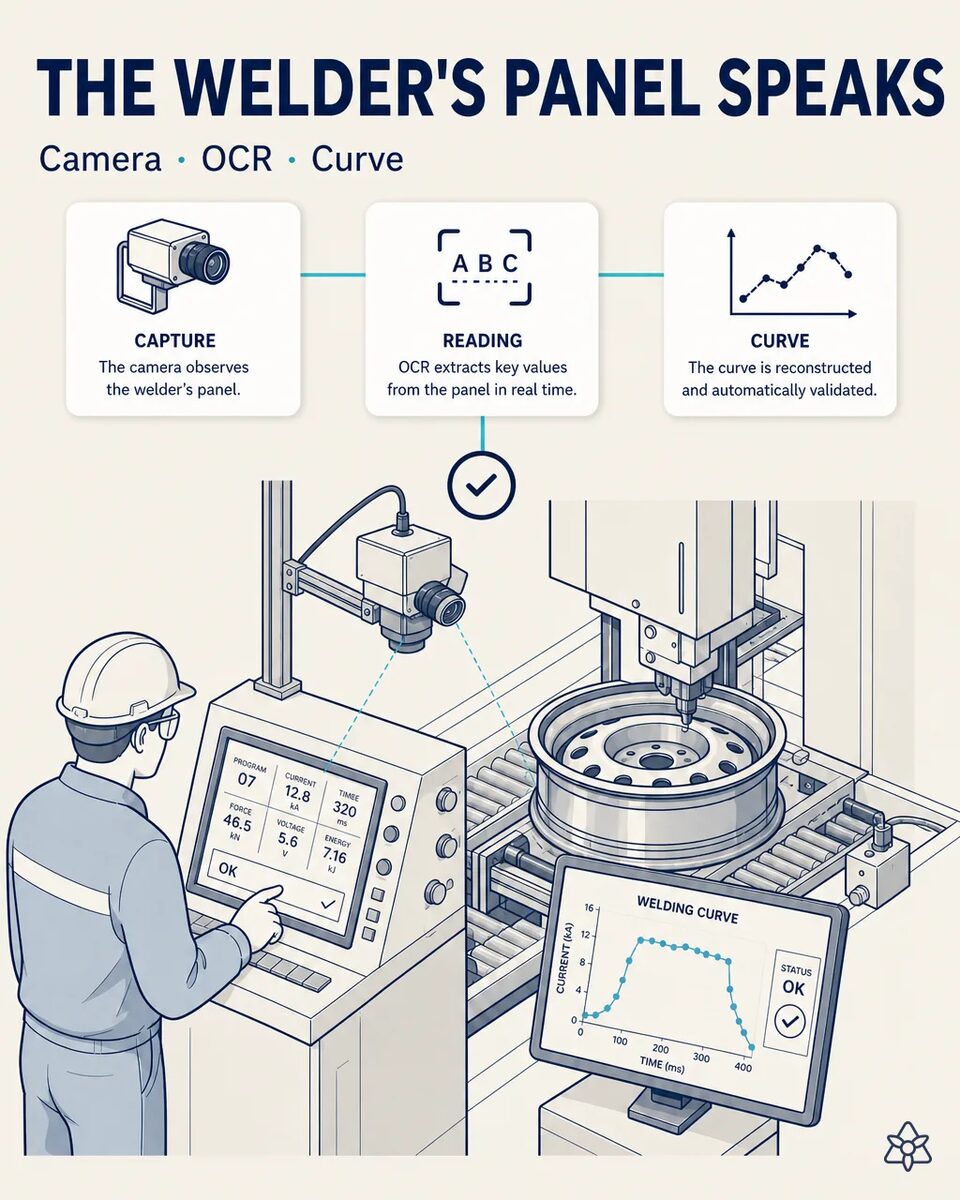
The flash butt welder that closes the rim hoop is typically fifteen to twenty-five years old and lives on an isolated network. Its panel shows, cycle by cycle, flashing current, upset time and length, pressure and electrode displacement — the very parameters industry literature identifies as responsible for oxides and inclusions trapped in the weld, the origin of rim cracking and fatigue failure. Replacing the machine costs more than half a million. With Connect, an external camera pointed at the panel is enough.
The parameters that explain the crack do exist. They last one cycle.
Flash butt welding is the most expensive structural failure point in the product. The panel displays exactly what would be needed to correlate parameter with defect and with test rejection, but that data is overwritten every cycle. When a lot fails radial fatigue testing, or a crack shows up at the customer, nobody can go back and check the upset factor that specific rim was welded with. Root cause investigation runs blind, and the prudent reaction — blocking a whole week of production — is the most expensive one. The electrode also wears progressively, and its drift is invisible until the weld no longer conforms. Maintenance is scheduled by calendar because no other signal is available. And the obvious way out is blocked: replacing the welder costs over half a million euros and weeks of downtime on a line with no inventory buffer. That is why it has been sitting in the capital plan for years without leaving it.
- The flash butt weld is the most expensive structural failure point in the product: this is where the trapped oxides and inclusions that end in rim cracking and fatigue failure come from.
- The panel shows flashing current, upset time and length, pressure and electrode displacement — exactly what would be needed. And it overwrites all of it every cycle.
- When a lot fails the radial fatigue test, nobody can go back and check what upset factor that particular rim was welded with. Root cause is investigated blind.
- The prudent reaction — blocking a whole week of production — is the most expensive one, and it is the only one available without data.
- The electrode wears progressively and its drift stays invisible until the bead no longer conforms. Maintenance runs on the calendar because there is no other signal.
Connect in photo mode on a machine with no interface — and without touching its qualification.
Connect in photo mode over an interface-less machine panel.
The obvious alternative is blocked by its price: replacing the welder runs above half a million euros and weeks of downtime on a line with no stock buffer. An external camera costs three orders of magnitude less and leaves the machine's qualification status untouched.
- A fixed industrial camera pointed at the panel, with optics suited to its flicker and screen rotation.
- Optical recognition with a grounded model that interprets each frame and structures the time curve per rim and per lot.
- Cross-referenced with the manufacturing system — which part number and which heat was on the machine at each instant — and with electrode replacement history in the maintenance system.
- No new controller, no change to the original control system and no impact on the machine's compliance status.
Replacing the welder versus reading its panel
| Aspect | Replacing the machine | With iLEAN Connect |
|---|---|---|
| Investment | Above 500 K€ | Industrial camera and commissioning |
| Line downtime | Weeks | None: installed while running |
| Machine qualification | Starts over | Untouched: original control not modified |
| Parameter-to-crack correlation | Yes, from zero history | Yes, from the first captured cycle |
| Electrode replacement | By calendar | By observed drift |
| Scope of a containment | One week of production | The suspect lot, bounded |
Estimated impact — to validate with your own numbers.
The block below is an estimate to be validated against your plant's actual data. We put it forward so the committee has an order of magnitude; we refine it during the assessment.
- Estimated payback 5-10 months, combining three effects that do not overlap.
- Deferred replacement capex, above 500 K€, taken out of the investment plan.
- Reduced rim scrap attributable to weld parameter drift.
- The ability to bound the suspect lot instead of blocking a full week of production.
estimated payback 5-10 months. It combines deferred replacement capex (above 500 K€), reduced rim scrap attributable to parameter drift, and the ability to bound lots instead of blocking them. *Estimate to validate.*
And the fair question from the production manager
«Isn't a camera reading a screen a fragile workaround?» — it would be if the model were asked to interpret an arbitrary image. Here the task is anchored: fixed screen, fields in known positions, expected ranges. In that regime the best models drop below 1.5% error [1], and on top of that the system discards any frame whose value falls outside the physically possible range instead of accepting it.
[1] OpenAI paper "Why Language Models Hallucinate", 2025 — on the reliability of AI in anchored tasks.
What people ask about reading an old machine's panel
Do we have to touch the welder's control?
No, and that is exactly the point. The camera looks at the panel from outside. It does not connect to the controller, no software is installed on it and its program is not modified, so the machine's qualification status is unaffected.
What if the panel cycles through several screens?
That is designed for: optics and capture cadence are set to the panel's rotation and flicker, and the system identifies which screen it is looking at before extracting any value from it.
What happens when someone stands in front of the camera?
The frame is discarded. The value is not invented or interpolated: that cycle simply has no reading and is flagged as such, which is very different from filling it with a false number.
Does it work for the other old machines in the plant?
Yes, the pattern is the same for the roll former, the curing oven or the balancer. You start with the welder because that is where the most expensive failure sits, then replicate where it pays.
How much history before the correlation is useful?
To investigate a specific root cause, capturing the period of the suspect lot is enough. To detect electrode drift you need some weeks of cycles, which is how long the trend takes to draw itself.
More cases from this series
- The auditor is not one day a year, it is a permanent regimeEvery critical change generates its dossier with before/after photos, parameters and signature. Agents…
- Four rings between the coil and the palletFour coordinated verification rings from the coil heat to the pallet, with JIDOKA AI stopping the line…
- Wheel traceability begins with a twelve digit numberA photo of the delivery note and the heat tags, one validation tap and into the ERP. No carrier…
- The human gate that separates iLEAN from a loose AIWhat the AI captures never enters the system unsigned. First piece validated in two taps, with photo and…
- The knowledge that predicts failure is spoken, and today it is lostThe maintenance manager talks to the AI during his round: the odd noise and the leak stop dying with the…
- The plant's most expensive data lives in a shared folderFilm thickness, runout and fatigue results reach the ERP on their own after human validation. From 4-6…
Tell us which critical machine you have today with no data output.
We work on your plant's real data, not ours. Assessment with no commitment.
Request estimated ROI within 48h ‹ See all cases of automotive wheels See automotive