From the setup paperwork to the central system, at second zero
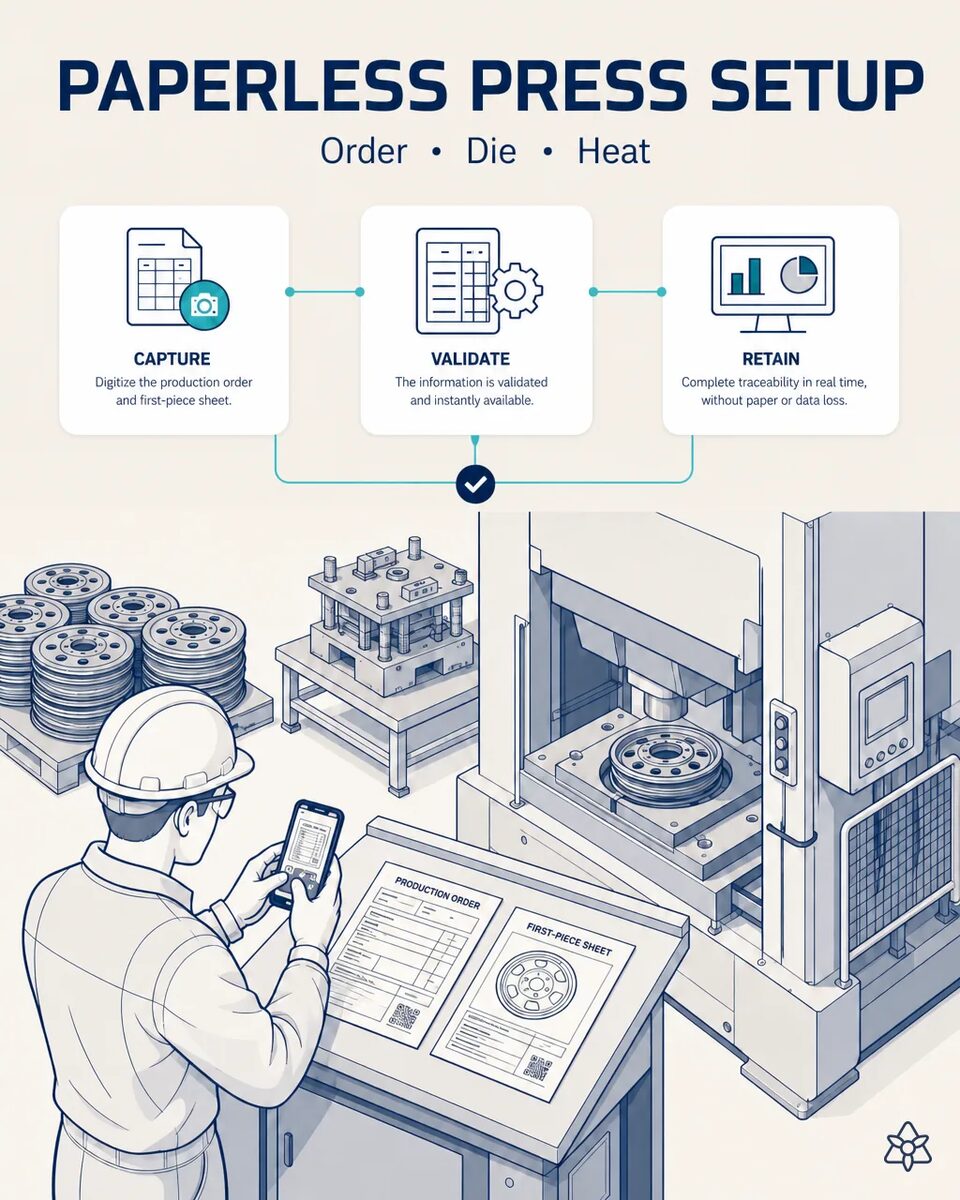
In a steel wheel plant every changeover starts with three sheets of paper on the setter's desk: the printed production order, the first-piece sheet where he records gauge measurements by hand, and the tag of the die set he has just mounted. Together they define the entire lot. Today they end up in an office folder until someone types them in, badly and late. With Connect the setter takes two photos with his phone at start-up and the lot already exists in the central system at second zero, with nothing about his routine changed.
Paper is not the problem. The hours it takes to reach the system are.
The production order leaves the business system with the part number and the schedule, but everything that actually happens at start-up is written on top of it by hand: the heat number of the coil being consumed, the code of the mounted die set, the stroke count, the dimensions of the approved first piece and any authorised deviation. That sheet can sit four to eight hours without being digitised, or a whole shift. Meanwhile the lot exists physically — it is coming off the press — but it exists in no queryable system. The cost surfaces weeks later. When the OEM returns a cracked wheel and asks for traceability back to the steel heat, someone has to rebuild it by hand from a folder. The same happens when an auditor asks for the first-piece records for a given period.
- Those three documents — order, first-piece sheet and die tag — are the real traceability of the lot. The business system only holds half of it: the part number and the schedule.
- For four to eight hours, or a whole shift, the lot exists at the press but exists nowhere you can query.
- The cost does not show up that day. It shows up weeks later, when the OEM reports a cracked wheel and asks for traceability back to the steel heat.
- And because the answer sits in a folder in the office, rebuilding it takes a quality technician hours — with the customer waiting.
Connect in photo mode — the setter keeps filling in exactly the same paperwork.
Connect in photo-to-analogue mode.
The habit change is zero, and that is not a detail: it is the reason the case is still alive in month six, which is where anything that asks a setter to learn a new app at the press dies.
- The setter photographs the order, the first-piece sheet and the tooling tag with his phone or industrial tablet. Zero change of habit.
- A grounded model recognises the structure of each document and extracts the fields: part number, heat number, die code, first-piece dimensions, press settings and the approver's signature.
- Records are structured in central memory and matched against the live order in the business system.
- The image of the original document stays attached as evidence, so any later query shows the real sheet rather than a transcription.
Setup on paper versus setup captured
| Aspect | Today, on paper | With iLEAN Connect |
|---|---|---|
| When the lot exists in the system | 4-8 h later, or at shift close | Second zero |
| Steel heat of the coil | Rebuilt from paper, if legible | Tied to the lot from setup |
| First-piece dimensions | Sheet filed in a folder | History queryable by part number and die set |
| Answering a field claim | Hours of a quality technician | One query by lot |
| An illegible or mislaid sheet | The lot data is lost | The photo of the real document stands as evidence |
| Setter's routine | — | Unchanged: two photos at setup |
Estimated impact — to validate with your own numbers.
The block below is an estimate to be validated against your plant's actual data. We put it forward so the committee has an order of magnitude; we refine it during the assessment.
- Estimated payback 4-9 months, depending on how many changeovers you run per week.
- From 4-8 h of latency between the data and the system, down to second zero.
- Direct recovery of transcription time from the production supervisor and the quality technician.
- First-piece documentation gap closed in customer audits — the large saving sits here, and it shows up the day there is a claim.
estimated payback 4-9 months, depending on the number of changeovers per week. It comes from transcription time recovered from the production supervisor and the quality technician, and from the documentation gap removed in customer audits. *Estimate to validate.*
And the fair question from the production manager
«What if it misreads the heat number and ties the coil to the wrong lot?» — reading fields from a document with a known structure is an anchored task, where the best models drop below 1.5% error [1]. But the real answer is the other one: the extracted summary goes to the tablet and the supervisor confirms or corrects it before anything crosses into the system. Nothing enters on its own.
[1] OpenAI paper "Why Language Models Hallucinate", 2025 — on the reliability of AI in anchored tasks.
What people ask about digitizing press setup
Do we have to change the first-piece sheet?
No, and that is the condition. The sheet is tuned to how that plant works and to what the control plan asks for. Every attempt to replace it with an on-screen form ends with the setter writing on paper anyway and typing later. Vision reads the document structure exactly as it is.
Does it work with handwriting from several shifts?
Yes, because the model is not asked to guess: it is asked to fill fields on a form it already knows. When a field comes back with low confidence it is flagged on the tablet for a person to confirm, instead of slipping through.
What about the dimensions the setter measures with calipers?
They are extracted like any other field and cross-checked against the tolerance for that part number, so an out-of-range dimension is highlighted on the validation screen before the line is released.
Do we need ERP integration from day one?
No. The case works from day one against iLEAN's central memory, and the push into the business system is connected afterwards. That is how you get value in weeks instead of waiting for an integration project.
What about the paperwork from previous years?
It can be digitized in bulk with the same model if having the history queryable is worth it, but it is not a requirement: the case starts paying from the first changeover captured.
More cases from this series
- The auditor is not one day a year, it is a permanent regimeEvery critical change generates its dossier with before/after photos, parameters and signature. Agents…
- Four rings between the coil and the palletFour coordinated verification rings from the coil heat to the pallet, with JIDOKA AI stopping the line…
- Wheel traceability begins with a twelve digit numberA photo of the delivery note and the heat tags, one validation tap and into the ERP. No carrier…
- The human gate that separates iLEAN from a loose AIWhat the AI captures never enters the system unsigned. First piece validated in two taps, with photo and…
- The knowledge that predicts failure is spoken, and today it is lostThe maintenance manager talks to the AI during his round: the odd noise and the leak stop dying with the…
- The plant's most expensive data lives in a shared folderFilm thickness, runout and fatigue results reach the ERP on their own after human validation. From 4-6…
Tell us how many hours pass today between a press starting and the data reaching the system.
We work on your plant's real data, not ours. Assessment with no commitment.
Request estimated ROI within 48h ‹ See all cases of automotive wheels See automotive