Tire visual defects caught in line
At the end of the line, inspectors check every tire by hand and by eye: blisters, flash, missing rubber, molding defects, unreadable DOT marking. At thousands of tires per shift the eye tires and something slips through to the customer. iLEAN Edge inspects every tire in milliseconds with cameras and a model trained on your defects, and diverts doubtful ones so the inspector decides.
At thousands of tires per shift, the inspector's eye gets tired.
In final inspection, inspectors check every tire: blisters, flash, missing rubber, molding defects, unreadable marking. At thousands of tires per shift, the human eye gets tired and something slips through. A visual defect that reaches a carmaker means a claim, containment and a hit to the supplier rating. In the replacement market it means a return and a damaged brand.
- At final inspection, inspectors check every tire by hand and by eye: blisters, flash, missing rubber, molding defects and unreadable DOT marking. Every tire gets a few seconds of attention from a person who has already seen hundreds.
- At thousands of tires per shift the human eye gets tired, and something slips through, typically late in the shift or after a size change. The defects that escape are rarely the obvious ones.
- A visual defect that reaches a carmaker means a claim, containment and a hit to the supplier rating. It also brings the carmaker's quality team into the plant.
- In the replacement market it means a return and a damaged brand, with no record of whether the tire was ever properly seen. There is no image to show what it looked like when it left.
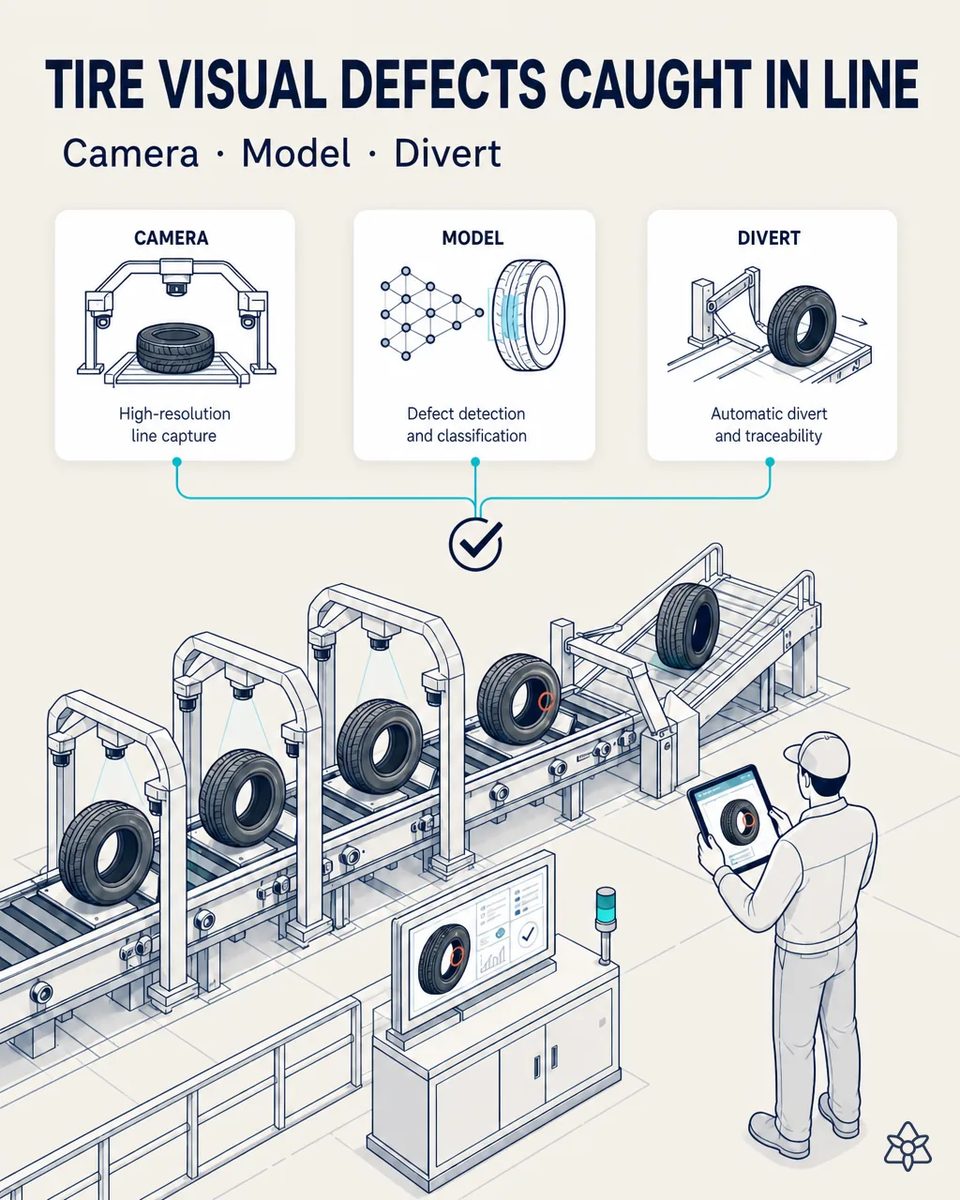
Edge vision at final inspection — every tire analyzed, the inspector decides.
iLEAN Edge places an arch of cameras over the inspection station. A model trained on good and bad examples of your sizes analyzes every tire in milliseconds, locally, without sending images to the cloud. Doubtful tires are diverted with the defect area highlighted on a tablet. The inspector decides: release, repair or reject. The AI does not replace the inspector: it puts what matters in front of them.
The AI does not replace the inspector, it decides where they look. Instead of scanning every tire with the same attention, the inspector receives the doubtful ones with the defect area already highlighted and spends their judgment where it matters. Every decision they take is stored and feeds the next version of the model.
Final tire inspection by eye versus inspection by Edge vision
| Aspect | Today | With iLEAN Edge |
|---|---|---|
| Coverage of finished tires | As much as the eye can hold | 100% at line rate |
| Blisters and missing rubber | Depend on the inspector's fatigue | Detected in milliseconds |
| Unreadable DOT marking | Missed in a busy shift | Flagged and diverted |
| Doubtful tire at the end of line | Released or rejected by feel | Diverted with the area highlighted |
| Images of each finished tire | None kept | Stored for claims and audits |
| Release, repair or reject | — | Decided by the inspector |
Tired human visual inspection at line rate → 100% inspection in milliseconds and doubtful tires diverted with the area highlighted for the inspector.
Impact estimate — to be validated with your numbers.
The block below is an estimate to be validated against your plant's actual data. We put it forward so the committee has an order of magnitude; we refine it during the assessment.
- Estimated payback 5-12 months, depending on current claim and reject levels. The range is calculated with your own claim history and reject rates before deciding anything. A pilot on one size family confirms it.
- 100% visual inspection at line rate, without adding inspectors or slowing the final finish line. The inspection station keeps the line rate it has today. No tire waits for the camera.
- Fewer visual-defect claims from carmakers and fewer returns from the replacement market. Each claim avoided also avoids a containment and a visit from the customer's quality team.
- An image of every tire stored, which turns a claim discussion into a fact check. The image of the shipped tire shows what it looked like when it left the plant. It also gives quality a record of defect trends per mold and press.
Payback 5-12 months · 100% visual inspection at line rate (estimate to be validated). 100 percent visual inspection at line rate and fewer claims. We estimate a payback of 5 to 12 months depending on current claim and reject levels. This is an estimate to be validated.
And the fair question from the production manager
“What if the camera rejects good tires and floods the repair area?” — the false positive is the real risk of any vision system, which is why the model is trained on good and bad tires of your own sizes and lighting. Detecting a known defect at a fixed station is an anchored task, where the best models drop below 1.5% error [1], and doubtful tires are diverted to the inspector, never scrapped automatically. Over time, the inspector's decisions on doubtful tires make the model more precise for each size family.
[1] OpenAI paper "Why Language Models Hallucinate", 2025 — on the reliability of AI in anchored tasks.
What people ask about vision inspection of finished tires
Does it inspect both sidewalls and the tread?
The camera arch is designed for the views that matter in your plant, usually both sidewalls and the tread. Bead area views are added where the line layout allows. The views are agreed with your quality team at commissioning.
Are tire images sent to the cloud?
No. Inference runs locally on the Edge unit at the inspection station, in milliseconds, without depending on the plant network or the internet. The images stay inside the plant.
How many defective tires are needed to train the model?
Fewer than expected, because the catalog of visual defects per size family is short and repetitive. What matters is that they are real tires from your line. New defects or sizes are added by retraining with examples from your own production.
Does it check the DOT code as well?
Yes, it checks that the marking is present and legible. A tire with an unreadable DOT is diverted like any other doubtful tire. That avoids shipping tires whose marking a customer cannot read.
Does it replace uniformity and balance machines?
No. Those machines measure what a camera cannot see. Edge covers the visual defects that today depend only on the inspector's eye. The two checks complement each other at the end of the line.
More cases from this series
- Synchronized compound flow: zero expired materialConnect, Edge and Agents coordinate mixing, components, building and curing so no compound expires and…
- Human check of every component before buildingEverything iLEAN captures goes through a tablet at the building machine: the operator confirms each…
- Compound batch card captured with one photoHow one photo of the compound batch card traces every rubber skid from mixing onwards, with no typing…
- The legacy curing press that now talksA camera reads the panel of legacy tire curing presses and digitizes every cure cycle curve without…
- The curing supervisor talks to the AI on the moveBuilding and curing supervisors dictate issues on the move; iLEAN structures them, links them to press…
- From the compound lab Excel to SAPiLEAN reads the rheometer and Mooney results Excel in the shared folder and, after human validation,…
Tell us how many tires per shift your final inspection checks by eye today.
We work on your plant's real data, not ours. Assessment with no commitment.
Request estimated ROI within 48h ‹ See all cases of radial tires See automotive